
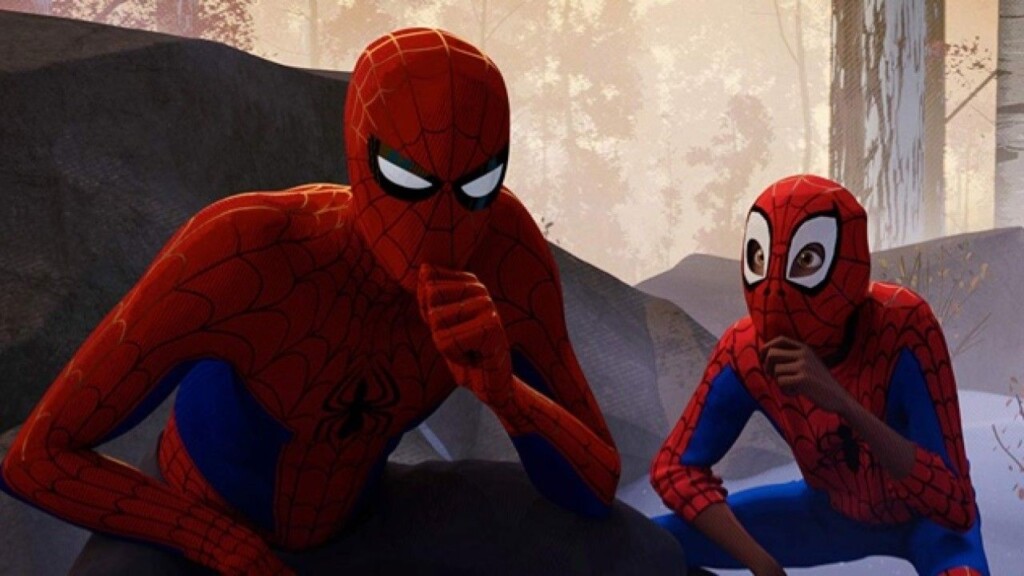
Image: Spider-Man: Into the Spiderverse (2018)
In my closet, there is a binder bursting with notes and handouts—pages of calculus notes, a chemistry doodle that I taped in the front, meticulous notes from many English college classes. For some reason, I had kept nearly every handout from my eleventh grade religion seminar class: half a year on ethics and half a year on theory. I rifled through Plato’s Republic and Euthyphro, works from John Calvin, excerpts from Bernard of Clairvaux on Song of Songs, a chapter from Technolopy by Neil Postman—all covered in notes from class.
Nearly all of what I gleaned from those articles have fallen through the sieve of my mind, which is likely why my college-aged self saved those printouts, but what hasn’t left me is what I realized in my senior year. There was a moment in my senior year when I realized, Hey, all of my opinions are just what adults are telling me. Our religion teacher would present one point of view, and I’d agree with it, and then he’d present another, and I’d agree with it as well.
The story I have told myself is that I saw the issue in high school and learned to think critically for myself in college, perhaps to justify the time and money poured into my degree. Now, as an adult, I have my own positions on things like politics and ICE and artificial intelligence and the economy. Except, I’m not sure I do.
In his comeback video, YouTuber D’Angelo recontextualizes a situation in 2024 where he dealt with severe backlash on a previous video for not bringing up a boycott against Starbucks based on the company’s involvement in Israel. In reflecting on this situation, he sees this backlash as a larger trend of how people are consuming content online in a TikTok world: looking at a headline, looking at other people’s comments, and then diving straight to moral outrage and attacking the other person. A lot of the comments talked about the holier-than-thou posturing, but one comment focused on realizing that all of their opinions were just the opinions that they co-opted from people on the internet.
This isn’t necessarily a bad thing. We have books and podcasts and conversations and YouTube videos for a reason: we learn from each other, and we change and grow according to what we learn. But this person, similar to me and similar to many others today, realized that they are just taking other’s opinions wholesale, which is a recipe for confusion and disaster.
This commenter went on to talk about how you need to do research about topics online rather than just believing what is presented to you, but I am a worse person than this commenter. When I think about trying to drill down on topics that I’m conflicted about, which these days is mostly AI, which I can’t seem to stop bringing up at dinner parties, I get exhausted before I even start.
Hank Green comes to my rescue, from the past, in his video “Is Weed Worse than Gambling? (Challenging My Biases).” He does some things that I am unable to do, like quickly solicit thousands of opinions from social media about the topic, but the simplicity of Green pulling up a Google Doc and writing down four reasons for why he thinks weed is less harmful than gambling and then verbally processing through both his thinking and other’s points was enormously charming, and enticing to me.
Most of the time, my opinions are piggy-backing off of others’. I absorb from my social media feed, the bits of news that trickle in, NPR podcasts, and the people around me. But I can easily see myself falling into the moral outrage bait that lurks in many comment sections, and the lure of AI thinking for you gets more potent day by day. If we are already at the point of asking ChatGPT to come up with our New Year’s resolutions, what kind of world will I be teaching in five years down the line?
If I have a snowball’s chance in hell to prove to my students that they need to be able to write and think for themselves, it’s time to start putting a little more effort and awareness into my own mental defenses.

Alex Johnson (‘19) is a high school English teacher in Massachusetts. She spends her days being an uncool adult who enjoys reading romance novels and explaining niche rhythm game strategies.


Thanks for sharing, Alex. This is some good perspective for us all.
Thanks for writing about something I’ve also realized about myself that makes me nervous. I think your title is perfect, and that’s an opinion I know is mine 🙂