
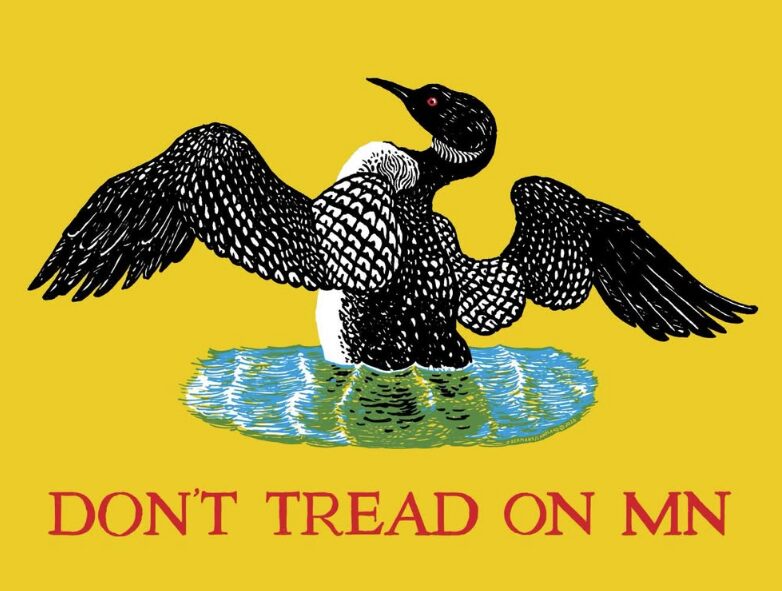
The temperature here in Minnesota has been especially cold the last few weeks. I have to bundle up as much as possible to go to work at 6:30 when the temperature is negative ten degrees. Walking to and from my car, it’s still dark outside, and normally I would enjoy the moments of peace, despite the cold. But at the moment, I’m eager for these early hours to get lighter.
At the coffee shop where I work, I tend to greet customers with the same script as always: something that amounts to “How’s it going?” Recently, the customers have been diverging from their side of the script. Instead of their typical “Good! how about you?” I’ve been getting a lot of “Pretty good… all things considered,” or sometimes just a grim, knowing nod, and no response.
It’s hard to express how unusual this change is, even for the last few years. There’s this uneasy weight in the air. Some people want to talk about it, some don’t, but most are visibly aware, even visibly upset. In both cases, many people express their appreciation for being able to come into the coffee shop and order something, sit down for a while and take a breath, at least. The signs on the outside of the store indicate that this is a safe place, or at least as safe as you can expect a public place to be right now. But everyone seems to be on edge.
For basically as long as I can remember, my awareness of various injustices—foreign as well as domestic—has steadily increased, maybe with a slight acceleration about a decade ago. I’ve felt upset before, angry, indignant, helpless, despondent even, in myriad combinations, for many years now. So why does this feel so different? More broadly, why does the atmosphere in the community feel so different? There are probably dozens of great answers. The window for state-sanctioned violence creeps ever-closer to my extremely privileged demographic profile, sure. That’s no surprise. A new set of legal boundaries have been crossed, but that’s ultimately predictable as well. I think there’s something else going on here.
Something I’ve heard people say about the internet age is that humans weren’t meant to be so aware of the breadth and depth of suffering we’re now aware of. This is a compelling argument for the reason that any given human body simply isn’t capable of holding proportional anger, righteous or otherwise, for the scale of atrocities happening at literally any given moment in the world. In this conception, our scope must be limited to our local community, our neighbors and friends and family. More than that is just too much to handle.
In that vein, I’ve also heard that it’s a strategy of the current administration—and of some before much like it—to completely overwhelm its populace with injustice after atrocity; it naturally causes people to freeze up, unable to even react appropriately, let alone lament, rest, or resist. But this tactic is most effective on those of us who stare at the abyss of our phones, absorbing a literally unending stream of information about incalculable suffering happening everywhere you can think of. Inversely, it is least effective when we are outside, engaged with our community face-to-face, and doing something in the real world.
I suspect that this is one reason (of many) that targeting the Twin Cities has already backfired so spectacularly. Even if, in the past, you might have had the strength of will to pick one injustice, distant or local, and do something about it, a situation like this effectively leaves you no choice. Local businesses I’ve patronized have shut down temporarily. Coworkers of mine have had school cancelled. Squads of helicopters are patrolling overhead. There is no avoiding it, and so there is no loss of focus. This is… terrifying, yes. But it is also motivating. The proximity of the threat demands your attention, and that attention becomes action.
By now you may have seen the tenacious resistance from the people of the Twin Cities. Vigils, marches, patrols, trainings, disruptive actions, mutual aid networks, a whole-ass general strike, and so, so much solidarity. It certainly doesn’t hurt to have a sense of responsibility from the eyes of the country, even the world, being on us right now. But as a new local myself, I suspect that the response would have been the same regardless. The community here is strong, and the people care for each other. That was already true.
Personally, I’m trying to find my small place in those efforts but without making it about myself. At my least hopeful, I’ve felt as though nothing I can contribute will make a dent in a system designed explicitly to methodically crush every person who stands against it. My body feels as though this is true.
But my mind, at least, knows it’s wrong. And my heart apprehensively agrees. As discouraging as the last few weeks have been, the evidence is also unmistakable: small contributions do add up, and a coordinated collective has a tremendous amount of real, tangible power. At my most hopeful, I find myself with a steady faith that this will continue to prove true, that the weather will continue to warm up, and that the ice will eventually melt.

Phil Rienstra (they/he) (’21) studied writing and music, and since graduating has developed an interest in labor rights and coffee. They’re an amateur chef, a perennial bandana wearer, a fledgling dungeon master, and an Enneagram 4. He lives in St. Paul with his spouse, Heidi.


Phil- What to say other than thank you for writing this?
I’m not one for cliches, so I’m NOT going to draw a parallel between the catastrophic failure of Operation Barbarossa and Trump deploying ICE to Minneapolis.
Someone else is free to do so, though.