

There is a small park in the neighborhood I grew up in, down the hill along the path that cuts between two neighbors’ houses. It’s called Bug Park, although only my family knows that. It used to feature two big bugs made out of curving metal pipes for kids to climb on. Although the town got rid of them ages ago, the small park has never been called anything else in our family.
Bug Park is about the size of a city block—it sits like a shallow bowl of bright green grass with a stream running unnaturally straight through it, right down the center, passing underneath the paved road up the hill. There is still a small playground (sans any big metal bugs), as well as a few picnic tables, a lonely funnel ball pole, and a faded wood pallet of a bridge.
It floods quite spectacularly at Bug Park when there’s a heavy rain. As kids, we’d dig out our boogie boards from the garage and pretend to surf as we slid down the hill into the muddy water. (I thought this was an incredible feature of the park, although a one-star review on Google Maps from 2018 disagrees.)
The bridge spanning the small stream has sunken slowly into the mud over the years, pressed down by feet and the gravity of time. One end of it seems to be just barely clinging to the bank, like the stream has chosen to only erode the earth on one side. Every time I go back, I check to make sure it’s still holding on.
A few Decembers ago, we emerged from the basement of my parents’ house to the delightful surprise of a Christmas Eve snowfall. We five adults rushed to scrabble together snow gear and re-learned how to have a snowball fight. My brothers and I ended up down at Bug Park where we quickly invented a game involving lobbing large snowballs into the funnel ball pole and teaming up against the oldest. We were breathless before too long, in the way only running and dodging and giggling in the snow makes you.
I’ll pause here for a second to recognize that this might not be of interest to you—all this description of a park I grew up near. I’m not always eager to read other people wax on about the trees or stars or oceans they’ve seen. I’m not there, seeing what they’re seeing. I’ve not grown attached to that vista. Those descriptions usually have about as much emotional resonance for me as a nice wall calendar photo: pretty enough, but I’ve got no relationship with that patch of nature.
But that in itself is interesting, I think. That we can have relationships with particular patches of nature—with grand vistas but also rows of young trees, and tangles of wild bushes, and ripples of small streams.
For me, this place is saturated with affection. I’ve spent enough time crawling around Bug Park that it’s intertwined with all the previous versions of myself. When I go back, even now, it helps me remember what it was like to be a kid, to be myself as a kid. It was a place where I stretched my small, elementary independence as I explored the frontiers just beyond my front yard. It was a place I was allowed to go by myself—that I could get to without a lift in the minivan—on my own two feet or bicycle or Razor scooter. And there was almost never anyone else there. I could swing or run around or lay belly-down on the bridge, staring into the creek—unobserved and undisturbed.
And that might be boring for other people to read about, but it’s so easy for me to write about. It’s where I learned what a crawdad looked like and that birds sometimes hide around your feet, not just in the tops of trees. It’s where I went sledding with my brothers when we got tired of the small hill in our own backyard or needed to show off an impossibly steep slope to our more daring friends. It’s where my mom walked me in the middle of the night to see hundreds of fireflies blinking in the stadium of trees after a summer storm. It’s where I got fresh air during quarantine and where I prayed about where to move.
No one else in the world has the same particular nostalgia and affection for this patch of nature as I do. And no one outside my family calls it Bug Park.
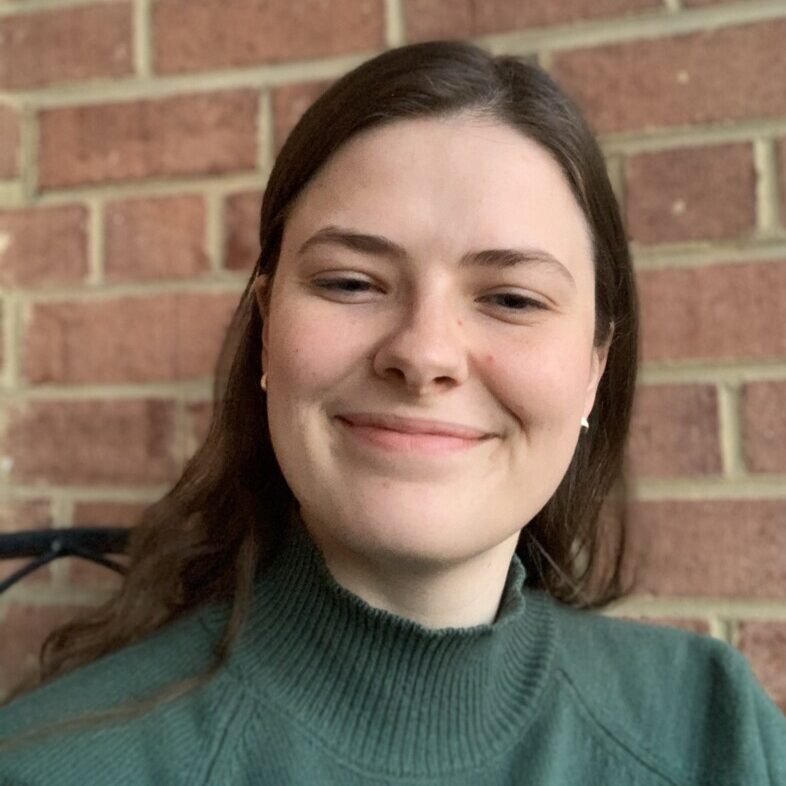
Christina Ribbens (’19) studied history, studio art, and data science at Calvin and public humanities at Georgetown. She now lives in the part of Virginia that’s almost Washington, DC where she helps award grants to arts nonprofits. She takes a lot of walks to admire the landscaping in peoples’ front yards, mostly listens to British comedians’ podcasts, and likes to make friends via sports.


Such a great description of what it feels like to visit those special places that are a part of “home”. When I have the chance to go back to where I grew up, I always take a walk down memory lane and visit my old haunts. I love your line: ” it’s intertwined with all the previous versions of myself”.
Your readers may not know your Bug Park, but I would venture to say we all have secret places of our past that can call us back just by their very continued existence–ever changing yet always the same–helping us to integrate all of the “previous versions” of our soul.
Very well said! So glad it resonated 🙂