
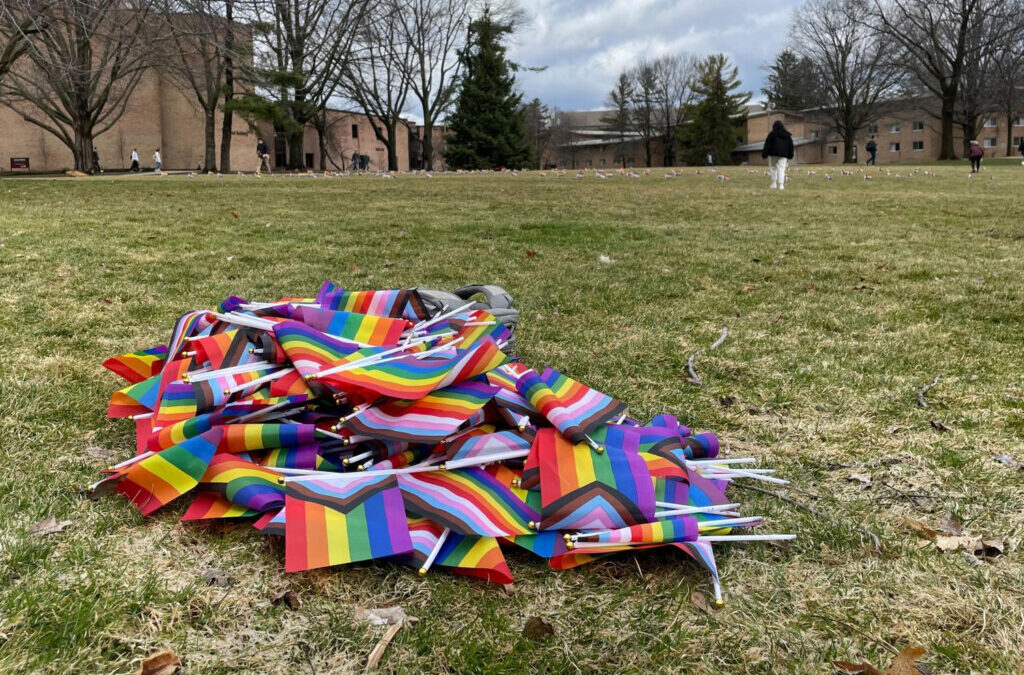
Photo credit to Levi Huizenga for Calvin Chimes
Around this time last year, I was reeling from the infamous tabling event; both the event itself and the aftermath. That it happened didn’t surprise me all that much, given what I know about the breadth of beliefs represented in Calvin’s student body. But that students could be so boldly, openly hateful and receive next to no repercussions—and that the administration effectively refused to decry their ideology—made me face the vivid truth of the institution’s misguided, pandering centrism.
A year later, as all the same discussions crop up again in the wake of Calvin’s decision to split the CSR off as its own entity, and the University shows their hand once again regarding LGBTQ+ issues, I find myself torn between two impulses.
One is to be angry. Of course I’m angry. For years now, Calvin has been a hostile place for queer people, living under the charade of being a non-hostile place for queer people, leaving those that are hurt the most to suffer in near-silence while the people who don’t want to think about that suffering can live comfortably in the narrative that Calvin is inclusive but simply holds true to their values, or whatever the line might be.
At this point, Calvin has made it abundantly clear that while there is certainly room there for versions of faith that are exclusive and judgemental of queer people, there is not room for versions that are affirming.
So I’m angry. I’m frustrated and hurt and as impatient as ever with the leadership at this university.
But I spent four years revisiting this anger for various reasons, and by now I’m… exhausted. It’s invariably draining to be angry about things over which you have no control, and despite Calvin’s comparatively small size, the control I did have as a student always felt extremely negligible. The kind of things that guide the decisions of Calvin’s administration—things like faith, morals, power, money—these are forces truly beyond my purview. And the same is equally true now, except I’m also not a student anymore.
So, naturally, a part of me wants to just be done with it all. I graduated, I’m never on campus anymore, and if I wanted to I could simply cut all ties with the school and live in blissful apathy to what goes on there. I’ve seen friends of mine spurred to do this by Calvin’s various missteps, and I can hardly blame them at all. It would be a relief from the frustration, and it would give me some not-insubstantial peace to be entirely unaware of Calvin’s ever-increasing issues, especially regarding queer people.
But choosing to completely ignore Calvin would be, though very tempting, still a difficult choice for me to make. I do have remaining ties there, not the least of which is this publication, and despite having no loyalty whatsoever to the institution, I can’t help but care about the students who attend, even beyond my friends who have yet to graduate.
Sure, at my most cynical, most bitter, I wish that queer students would just avoid Calvin entirely and save themselves the frustration. But I also know that that’s not how it works, because people discover themselves in college, and queerness is so often a part of that discovery.
When I started at Calvin, I didn’t know I was queer. But I did when I left, and I am living proof that Calvin’s attitude of dismissal and thinly-veiled condemnation towards LGBTQ+ people doesn’t turn queer students into straight students, or even into more faithful queer students. It just turns queer students into frustrated, neglected, disillusioned queer students.
I’m queer and non-binary, and my pronouns are they/them and he/him. I see myself in the queer students at Calvin—the ones who don’t yet know they’re queer, as well as the ones who do, and the ones who will in years to come— and I want to support them. I want them to know that they aren’t alone, and that they aren’t wrong or sinful or bad for being queer. I want them to feel empowered and encouraged, even when their efforts to protest are quelled. And I want them to find, somehow, despite it all, the space to be authentically themselves. I’m angry, and I’m exhausted, but I don’t think I’m ready to be done with Calvin just yet.

Phil Rienstra (they/he) (’21) studied writing and music, and since graduating has developed an interest in labor rights and coffee. They’re an amateur chef, a perennial bandana wearer, a fledgling dungeon master, and an Enneagram 4. He lives in St. Paul with his spouse, Heidi.


This greatly saddens me. Calvin is a Christian institution that is making some of Gods creation feel less than who they were created to be. Embrace them and show Christian love.
Thank you Philip, for writing this. I am an employee at Calvin and have been so distraught the last few weeks about everything that has happened at Calvin. How can I, a fully affirming, cisgender female Christian, stay working at a place that clearly does not practice what it preaches. Equity and inclusion?! Not so much. So—- I want any queer student at Calvin to know there are staff who care and want to make a real difference. I just feel so powerless as an individual. How do we make change unless we ban together? How do we start?! A start is to display pride flags in every affirming person’s office, signaling that it is a safe place. If anyone has bigger ideas, I’d like to help.
I think it really does make a difference to students to see faculty being outwardly supportive, especially when it’s clear that Calvin would rather faculty just keep it to themselves. So I think that’s a great start!
Calvin will only change if we hurt them long enough in their wallet. Faculty and staff need to organize and engage in sustained labor strikes. Form a union while they’re at it. Current students need to transfer. Prospective students need to be warned upfront of the bigotry present here. Alumni and other donors need to withhold financial contributions. Vendors and sponsors need to pull their business and support. Calvin will submit to any demand without that sweet sweet dollar.
Pieces like this make me less ashamed of Calvin–if only because of the alumni, students, and professors who speak out against the CRC’s regressive, abhorrent policies. Thanks for writing this and putting words to that feeling of enraged loyalty.
“The kind of things that guide the decisions of Calvin’s administration—things like faith, morals, power, money…” Calvin is guided by those things, but you have them in reverse order of prioritization. The CRC is dying off because Dutch ethnic culture can’t sustain it anymore. Calvin is in the same boat. So they embrace bigotry more fiercely, hoping that will connect them with new pots of conservative money, a new constituency and sustainable financing. The new president is sort of Byker 2.0. It won’t work. It was nice while it lasted.
Thanks for this, Phil! I realized I’m bisexual and asexual several years after graduation, and it tickles me to tally up the sheer quantity of my Calvin connections who are now out as queer and/or gender-nonconforming. Sometimes I wish all the queer Calvin alums could storm the campus en masse to show the administration (and, by proxy, denominational leadership) how many of us are out here. Then they’d have to take us seriously!
Calvin’s absolutely falling apart. You and I have a mutual friend and were in the same year, and I only know what they’ve told me anymore. I’m queer (sexuality and gender) and even at times SAGA felt a little isolating. I remember the sermon Pastor Mary gave our freshman year and how angry it made us all. I remember feeling like I was walking on eggshells all the time even when with my group of queer friends. I’m not surprised that things seem to have only gotten worse.