
As I ate lunch the Wednesday after returning to work from Christmas break, a thought occurred to me: I have two classes of kids who were kindergartners when the US went on COVID lockdown.
In my first year working as an educator, the ‘22-’23 school year, I worked with seventh and eighth graders, who were fourth and fifth graders in March 2020 and therefore had experienced pre-COVID public education. Considering the massive disruption to their academic experience, I was saddened but understanding at the number of kids well below grade level.
Now, in the ‘25-’26 school year, I’m in my third year, the sixth-grade students I work with only had about eight months of pre-COVID education, and a question I occasionally pondered my first year I’ve begun asking again more forcefully: what’s happened to education, and when did it start?
Disclaimer: I ponder the following questions knowing there are plenty of things skewing my perception. Considering I:
- will have been out of middle school for thirteen years this June,
- are and always have been a huge literature/English nerd,
- have an English degree, and
- work in Detroit Public Schools, a school system I was never a student in,
all of these factors might
- color my view of the past, superimposing my current expertise over my genuine experience.
That being said, first question: when did the tech overkill start, and when did the tech education stop?
I first heard of (TW to any educators) i-Ready in high school. When my brother, who was in elementary school at the time, got home, my mom would walk through his homework for the night, and she’d usually mention i-Ready. Since I’d never used i-Ready, I assumed it was an educational game site–think Coolmath or Study Island. The closest I got to having online modules was my eleventh grade history teacher occasionally assigning Newsela articles. In elementary/middle school, all my computer usage happened on desktops, mostly in the computer lab, but sometimes on the one or two computers most classrooms had. High school introduced laptops, but they were mostly for assignments: essays, presentations, etc. And we still had computer labs: one run by music teacher Mr. Cain and one by the designated computer teacher Mrs. Carni.
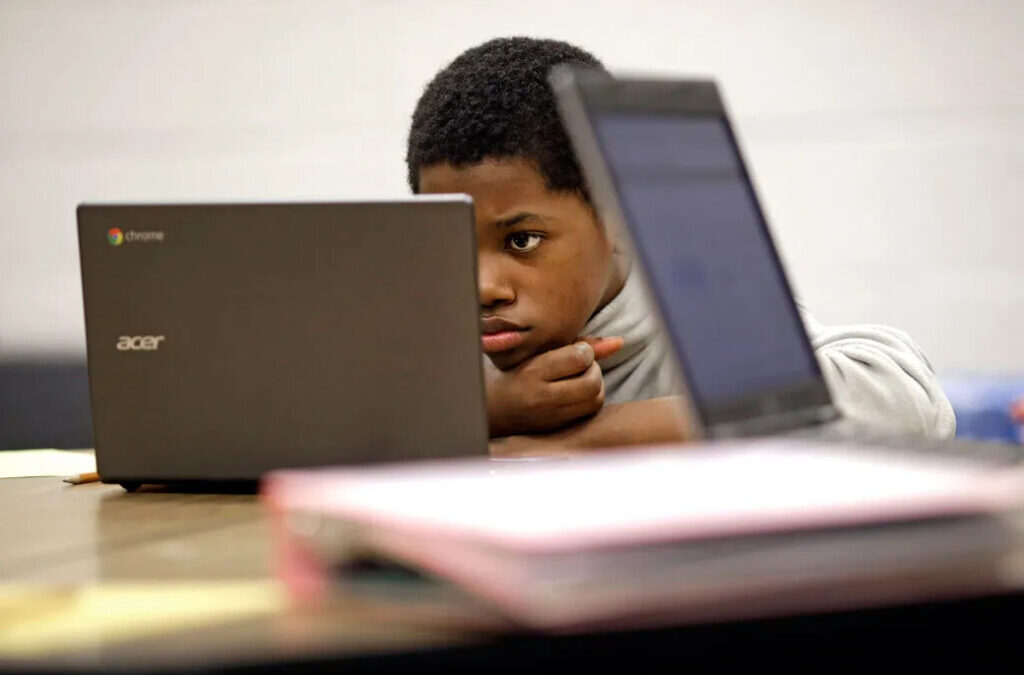
Working with middle-schoolers today, what’s immediately noticeable compared to my middle school years is the prevalence of personal computers. Kids carry laptops from the start of the day to the end, and ELA, my subject, is divided into an hour of CORE (the curriculum) and an hour of small group instruction (i-Ready+Newsela). What’s glaringly missing is teaching kids how to use their computers, which is most obvious whenever a presentation or typed writing assignment is assigned. I learned the ins and outs of PowerPoint and Word in my elementary/middle technology elective. My students haven’t had technology classes, and boy does it show when I’ve explained to the tenth student in six minutes how to add a text box to their PowerPoint slide.
Based on that, my second question, a rhetorical one: if you’re going to make computers so important to students’ education, why would you remove instruction on how to use the darn things?
Third question: are we not holding kids back anymore?
I said back in January I missed some overcorrections, and this is one of them. I’ve read stories of kids committing suicide due to academic pressure. That shouldn’t be happening. A kid should never be so obsessed with their grades that a B on their report card is a reason to overdose. What also shouldn’t be occurring is kids moving to the next grade level if they can’t grasp key concepts for the next grade. Not only is this a rampant problem in my school district (more so in my first school than my current one) but it’s a self-reinforcing one. Kids who aren’t on grade level can’t keep up with the material. They get lost, give up on trying to catch up and start distracting the people around them. Behind Student stays below grade level, and the students around them (some of whom are below grade level themselves) are distracted away from what they need to learn. No one wins.
My fourth question is about a possible reason kids fall behind: is our curriculum being written by human beings?
Spring semester at my first school, we spent several months slooooooooowly, paiiiiiiiiinfully reading Katherine Paterson’s Lyddie, a book that would’ve made my list of Badreads if we’d completed it. Lyddie is a book about a girl working in a textile mill in the 1850s to pay off her family’s debts. Seemingly every page, Lyddie talks about how she’s a slave, how she wants to escape her enslavers. Slavery? Could never be her!
Lyddie is white.
Every single student in my two seventh-grade classes was black.
That, along with other curriculum frustrations, made me rant to my partner teacher in-between classes one day. I hedged my bets that the curriculum decision-makers are some species of otherworldly creature with only vague understanding of human affairs. To this day, I’m half-convinced that if I went to district headquarters and asked the curriculum makers about their thought process, I’d have a room full of people pointing and screeching at me like Donald Sutherland at the end of Invasion of the Body Snatchers.
Administration being full of Pod People might answer my fifth question: where is all the fun stuff?
I’m trying to make this post as un-boomer-y as possible, but: bAcK iN mY dAy…
…we had things that were educational and fun. I mentioned Coolmath and Study Island earlier; remember them? Remember the Scholastic Book Fair coming to your school every year? Or that Scholastic order form your teacher sent home with you? What happened to science fairs? (Edit: In between drafting and publication, we had a science fair. Progress!) To Book It!, where if you logged your reading, you could get a coupon for a free Pizza Hut pie? I have an epidemic of kids playing Minecraft during work time, and I tell them to turn it off whenever I catch them, but secretly, I get it. More school-appropriate fun stuff seemingly joined technology classes on the cutting room floor.
All these questions lead to my penultimate inquiry: who are these adults?
Back in 2019, when all eyes were on Greta Thunberg, I found a spectacularly smoothbrained meme that–no joke–claimed since Greta Thunberg went to schools with heating and air conditioning, her being an anti-climate change activist was hypocritical. Ignoring all the logical fallacies baked into that disingenuous husk of an argument, how is Thunberg responsible for her schools’ amenities? Was she balancing the budget in first grade? Meeting with the school board over Christmas break? Taking a high school HVAC elective where her final project was finding the cheapest Freon supplier? No, those responsibilities lie at the feet of adults.
The same goes for the state of education. Are kids demanding to move to the next grade when they’re mixing up question marks and exclamation points? No, it’s parents in denial that their precious angels are behind and administrators enslaved to the almighty dAtA. Did my past seventh-graders crowd into the principal’s office and demand to read a tone-deaf waste of time like Lyddie? No, that was decided by adults who (probably) dread the sight of Harrison Ford in a trenchcoat. (That’s a Blade Runner reference.) Adults made the call to insert computers into every conceivable facet of education except classroom instruction on how to use them.
“Are the kids alright?” people ask.
I…guess so? I wish they’d read books beside the current unit novel and that they wouldn’t come to school in only a hoodie when the temperature is single digits, but by and large, I like the kids I work with.
One last question:
Are the adults OK?

Noah Keene graduated from Calvin University in December 2021 with a major in creative writing and a minor in Spanish. He currently resides in his hometown of Detroit, Michigan. He spends his free time reading and putting his major to good use by working on his first novel. See what he’s reading by following him on Instagram @peachykeenebooks and read his other personal writing by going to thekeenechronicles.com.


All I can say is that I’m really glad you are asking these questions. It will take a LOT of teachers, parents, and kids raising similar questions, over and over, to effect change and fix what seems to be a very broken system. I’m glad students have you in their lives.