

I don’t typically read much poetry, but the other day I picked up a book of Luci Shaw’s poems that’s been on my desk since I moved in (and was on another desk in another room for three years before that). I mostly cracked it open as a way of avoiding work, but I enjoyed a refreshing few minutes, reading a couple out loud for maximum drama and because silence is the enemy.
Most of that collection is descriptions of ponds and trees and other scenes of nature, but to be honest, I tend to skim through those. You know, things like:
The melon-colored harvest moon
polishes its way, arcing up through the branches
of maples, oaks, over the wooded summit
that forms the ragged hem of sky.1
Okay.
It’s hard work to try to envision her descriptions, creative and apt as it may be, and I’m not experiencing that scene anyway. I’m much more drawn to poems that capture and convey emotions and inner-workings. Because… maybe I can relate, maybe I have experienced that, maybe I really needed words to describe that experience. Things like:
…Even though she feels like
the cloud too flimsy to let down
the rain that the whole county needs,
the peony bud withering on its stalk,
the soul too frozen to cry, the one
whose prayers never seem to rise higher
than her desk lamp.2
Poetry is hard work, and mostly I forget it exists. But every once in a while I return to a certain podcast that helps me like it again.
Frank Skinner, in his aptly titled Frank Skinner’s Poetry Podcast, reads and puzzles through a few poems by a different poet each episode. He is 1) invitingly enthusiastic (instead of off-puttingly or eye-rollingly enthusiastic) and 2) the episodes are usually around thirty minutes long. Plus he’s British and his day job is comedy, so that doesn’t hurt—but he’s not trying to be funny, he just really, really enjoys poetry.
Skinner introduced me to Kay Ryan, who I had never heard of despite being the US Poet Laureate from 2008 to 2010 (I wasn’t paying attention). My favorite of hers was “Blandeur,” and it’s a short poem so you should go ahead and read the whole thing, but the opening punched me in my emotional gut:
If it please God,
let less happen.
She asks for physical highs and lows to be leveled, like she wishes for less difficult emotional terrain, for him to
Even out Earth’s
zondure, flatten
Eiger, blanden
the Grand Canyon.
I don’t think I’d go so far as to make the Grand Canyon bland or the Alps flat. I quite like a varied geography. But there are certainly days where I wish less were happening.
I wish my to-do list was shorter. I wish the couple in the apartment below me weren’t yelling at each other. I wish miscarriages and divorce and deforestation would stop.
Some days it just feels like too much is going on—in the world, in my life, in my head. I want less to happen because it seems like the massive wave of world events is made up of awful, scary things. And we can know more about more of it than in any other century in human history. She stays with the physical landscape:
remand your
terrible glaciers
and silence
their calving
If the clock ticks forward, more bad things come. Those many things that are happening, those are bad things.
But of course that’s not the whole truth. That massive wave of world events is full of good and bad. The clock’s ticking brings closer both death and Christmas, spring and winter, elections and birthdays and ripe tomatoes and influenza. And the good things are just as real as the bad. And, one day, there will be only good things and there will be restitution and redemption of all the bad.
But sometimes it feels like it would be easier for there to just… be less.
Thankfully, it’s not up to me. I can’t freeze time (and, if my typical days off are any indication, I wouldn’t use it well if I could). Ultimately, I don’t want a flat life. I don’t want the canyons or mountains to go away. I don’t want the beige, plastic-furniture-and-room-temperature-beer existence of the purgatorial Medium Place, as imagined by NBC.
But it feels helpful, on some days, to say—to listen to a poet say—
If it please God
let less happen.
1“The Color of September”
2“A Cry for Possibility”
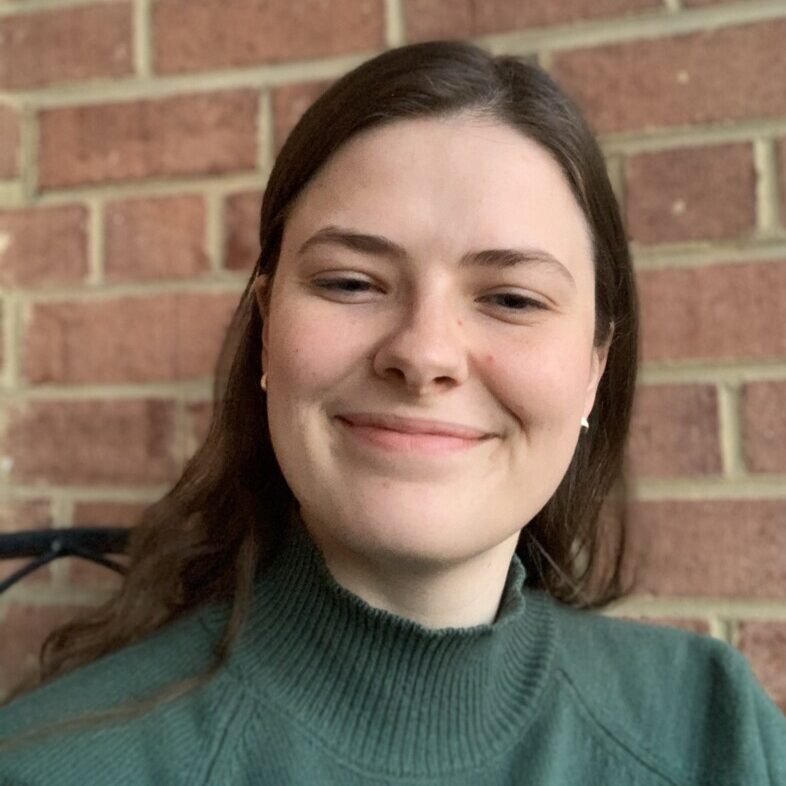
Christina Ribbens (’19) studied history, studio art, and data science at Calvin and public humanities at Georgetown. She now lives in the part of Virginia that’s almost Washington, DC where she helps award grants to arts nonprofits. She takes a lot of walks to admire the landscaping in peoples’ front yards, mostly listens to British comedians’ podcasts, and likes to make friends via sports.

