
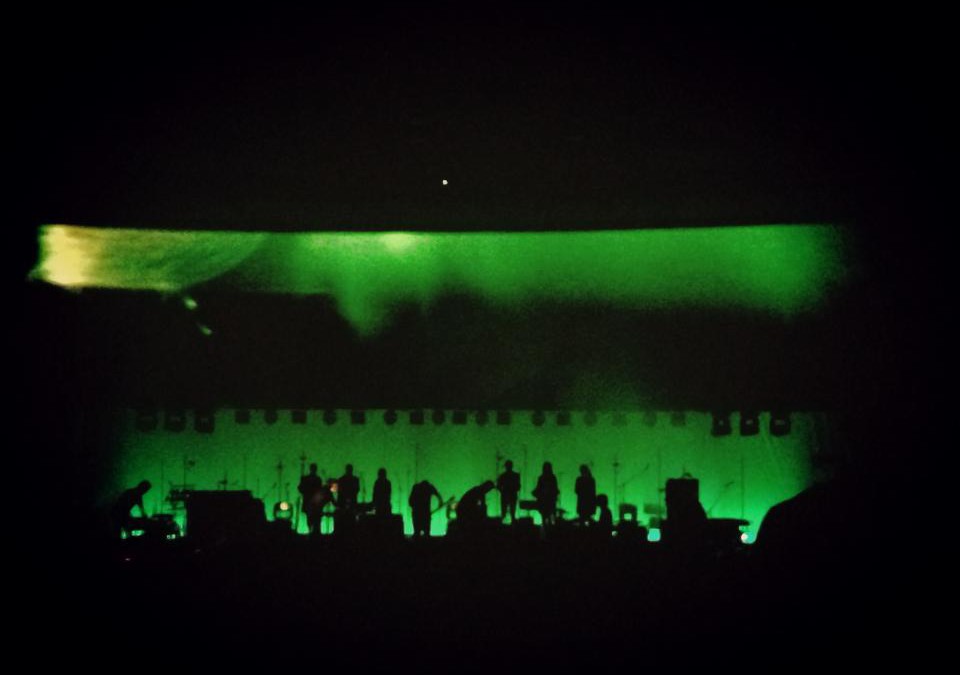
Icelandic quartet-turned-trio Sigur Rós released their seventh album, Kveikur, on June 12, 2013.
(Pause for happy dance.)
I doubt I need to introduce Sigur Rós to your reformed and refined musical radars. However, in the interest of full disclosure, I write this as a fan with a post-rock soft spot. Turn on some Mogwai, Explosions in the Sky, God is an Astronaut, or This Will Destroy You, and I’ll stick around. Consider me biased. You’ve been forewarned.
Though the incomparable “Hoppípola”-esque keyboard hooks are noticeably absent from Kveikur since Kjartan Sveinsson’s departure from the band, the album nevertheless surges with a newfound (or, rather, criminally latent) strength in the band’s rhythm section. Never fear: Jónsi’s vocals still propel the group’s music into the exosphere. Darker than most of their previous efforts, Kveikur abounds with driving beats and minor chords in the lead track “Brennisteinn” and in “Bláprádur,” for instance, yet this heaviness does not mire the album. “Isjaki” and “Rafstraumur” attest to the band’s ability to return to their characteristic form, and these may very well be some of their strongest songs yet. The album’s descents, in fact, make the lighter moments seem more dramatic and especially well earned, leaving Kveikur a surprising (even suspenseful?) and highly listenable effort.
… Which leads me to ask: what is it about their music that’s so appealing, that je ne sais quoi, the (sorry, Ms. Lovato) epitomized X factor? Bear with me while I let this quandary bubble in the cauldron for a bit. The precipitate will out.
…
In the mean time, a controlled digression. Certainly, some of the band’s magic comes from their orchestral arrangements and insurmountable crescendos. But these features dominate post-rock as a whole, so maybe that’s not quite it. Instead, I’d argue it has something to do with an irrepressible impulse to sing along to the band’s vocals, a feature distinguishing them from their mainly instrumental contemporaries. A complication arises, however, because Jónsi sings a mix of Icelandic and of “Hopelandic” (the band’s own made-up language), neither of which I understand. So I’m left to my deficient “doowabeedoooooowaaas” and my “hyarrdeedees”—amusing, sure, but a suitable approximation? Hardly.
So, yes, I do sound foolish. Hence my hunch that Jónsi may be the biggest troll in music. But that’s beside the point. The thing is, when singing along, I don’t mind playing the fool. There’s something transparent, and thus freeing, about these escapes into unmediated nonsense. I spend much of my time parsing poetic language, but I spend more time surrounded by a toddler’s hybrid babbles and a newborn’s coos. You can count my impromptu sing-alongs among this household chatter. I’m fine with that; it’s my barbaric yawp yearning for a little sophistication.
…
Okay, just got back from the cauldron. And I think I have my answer: in brief, Sigur Rós instantiates Walter Pater’s conviction that “All art constantly aspires towards the condition of music.” Short and sweet, but that’s what I think it all boils down to. As much as it pains me to admit, language just doesn’t cut it sometimes; though words may act as avenues into the world, their shortcomings and ruptures of misunderstanding prevent us from a pure captivation (in the best sense of the word). But with music and voice—indeed, the unexamined mechanisms of our bodies in general—we can find ourselves grounded in the real, in unsullied sensory experience. Somewhat paradoxically, such an immersion can leave us feeling levitated, suspended. When people describe Sigur Rós’ music as soaring or angelic, I imagine this experience is what they’re in the midst of; at this juncture, this privileged space, a note is really a note and a raised voice is just that. In this sense, the aural experience of Sigur Rós is an escape from appearance and illusion, an opportunity to “let be be finale of seem.” They let the music sing for itself, but, thankfully, they don’t mind our attempts to sing along too.

Jacob Schepers (Calvin ’12) is the author of A Bundle of Careful Compromises (2014), a winner of the 2013 Outriders Poetry Project competition. His poetry has appeared in Verse, The Common, PANK, The Destroyer, and others. He lives in South Bend, IN, with his wife, Charis, and two sons, Liam and Oliver. He is both an MFA student and doctoral candidate in English at the University of Notre Dame.


I’ve always wondered what folks who speak Icelandic think of Sigur Ros. If you look up any translations, the lyrics seem average and don’t make much sense. But that might be the point, yeah?
For me, Jonsi’s vocals have always been about the sounds. Maybe he’s a masterclass post-modern poet disguised as a frontman for a post-rock band 😉
I love this album.
Nice insights, Brad. Perhaps “hopelandic” is their way of creating a semantic disconnect, however slight, for their own native Icelandic speakers? I definitely think that part of the band’s appeal comes from the lack of lyrical sense, thus heightening the musical “sounds” of the human voice.
Wonderful review Jake.
I just saw Sigur Ros perform in April and the tracks from Kveikur were astonishing. You’re right that the album still fits with their earlier work and part of it’s greatness is precisely because it builds on their previous sound.
I’ll have to ponder the question you raise some more because I find myself singing along in nonsense words and yet I hesitate, or it pains me too, to say they present “pure” or “unsullied” experience. Experience of what? I don’t rightly know but I think it’s a good question to ask.
Or maybe I do agree that the appeal, the achievement, of Jonsi’s voice and Sigur Ros’s music is to hear the voice imitating language and yet refraining from semantic content. Former Archbishop of Canterbury Rowan Williams argues for human personhood on a communicative basis but communication as grounded in the body. So, a human face communicates something personal even if that person is incapable of speech. Maybe a similar communication happens in Sigur Ros’s music, as if we are listening to angelic words. Thanks again.