

Our theme for the month of March is “monsters.”
I have a Hydro Flask coffee mug I’ve used for years, and on it is a single sticker which reads Steminist. Over the course of the last four years, I have slowly but surely become a Radical Steminist, often saying that if making a nuisance of myself is what it takes to make change for women, I am glad to do it.
As a result of my slow-but-steady radicalization, I’ve gotten a chance to learn a lot of the research about women in STEM—attrition rates, harassment statistics, and long lists of what works and what doesn’t when it comes to advocating for and supporting women. And I wouldn’t change a thing. But part of knowing the research (and hearing the anecdotes and watching the TED talks, plus my own experience) means that I can never turn it off. I’m always afraid of, and noticing, the ways people around me might realize I don’t belong.
Recently, I had a tearful conversation with a good friend about my experience as a woman in a male-dominated field. Our chat was fueled by an offhand remark he made: the joking gist was that my dislike of office politics and my intimidating nature would make a high-level leadership role a poor fit.
He’s not the first person to call me intimidating. It’s happened most of my life, and if you know me, maybe you agree. But when I hear that word—intimidating—I can’t help but wonder why. Is it because I’m competent? Confident? Direct? Not afraid of conflict? Because I ask lots of questions?
Whatever the reason, I can never help but wonder if those same traits, if demonstrated by a man, would lend them less derogatory monikers. Strong? Assertive? Leader?
And that’s the fear my friend was inadvertently fueling with his unintentional comment. I don’t fault him for it—he’s one of my most zealous supporters, and I am always sure he loves me and believes in me. I have no doubt he would fight anyone who judged me for my gender, and I know he would never ever intentionally feed the fire we call imposter syndrome.
But it’s those little, unintentional things that make a pit in my stomach. Comments by friends or family, or the actions of coworkers, that make me wonder if I’m not doing enough. Or doing too much. Or being too mediocre. Or standing out too much. There’s really no winning the constant game of Do I Belong Here.
In moments like those I wonder: am I a monster? Is the monster society, for making me feel this way? Is it both? Neither? Some nebulous amalgamation of every one of us?
To his credit, my friend brought it up with me. He noticed my chuckled comment and discomfort, and he asked if we could talk about it. But as I prepared for our conversation (unusual for me, since he’s one of my best friends), I realized that as vocal as I am trying to advocate for women in STEM, I don’t often share my experiences with the people around me. My default expectation is that I won’t be supported. Part of that is pride, with a dash of shame and an (un)healthy sprinkle of fear that sharing my insecurities will make me … less valuable. Less worthy. It will reveal that I don’t really belong.
In an effort to help him understand, I tried to explain what my day-to-day is like as an engineer:
When I ask a question, I listen to the answer but also watch to see if he answers me, or the guy sitting next to me (it happens more often than you think).
When I want to make a point, I drop my voice an octave to be taken more seriously. I fight uptalk so vigorously my friends have commented that my speech patterns are too commanding.
When I write an email, I proofread for “just,” “maybe,” and “when you get a chance.”
When a man says the dress code is “business casual,” I follow up with a female colleague to clarify.
More than once, I’ve asked a coworker to use his Man Voice on my behalf (which is as simple as saying the same thing I just did, but while being a man).
When my new supervisor casually mentioned that the required sexual harassment training “is really long and tedious, but for some reason we have to do it every year,” I wondered if I would be safe in my new work environment.
When I sat in my safety seminar for new hires, I was the one woman in a room of fifteen men.
When I’m in the field (or the office, now that I think about it), I intentionally take up more space than makes me comfortable—I stand with my feet wide apart, set my hands on my hips, and rock back on my heels looking as nonchalant as I can.
That’s just the tip of the iceberg, and I would be remiss if I didn’t note that I, as a white, straight, cis, educated, and financially stable woman can’t begin to express the devastating multitudes of microagressions faced by my peers. I’m sure I’ve been part of the problem too.
With a monster as viscous, insidious, and ubiquitous as The Experience of Women in STEM, it’s easy to get lost in one detail or another—the STEM pipeline, representation, sexual harassment claims, giving women credit for their work. And I’ll be the first to admit that it is impossible to focus on all of those things at once, but I am encouraged to know that there are resources and tiny steps forward.
Read resources on allyship, engage with peers and colleagues about their experience, join me in my Steminism. Most important of all, please, please remember that you’re not alone, and you do belong. The work is exhausting, but important.
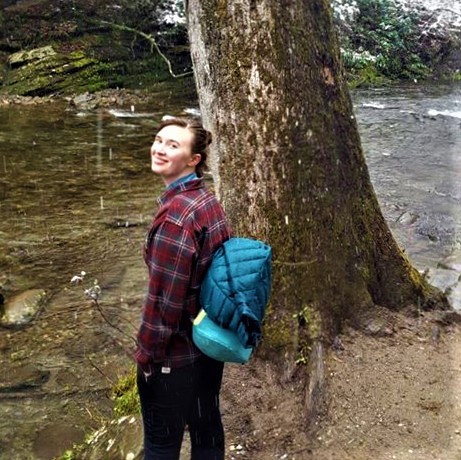
Lillie grew up on a forty-acre hay farm in Central Oregon, making the trek to Michigan to study mechanical engineering and sustainability. After graduating in 2020, she moved to Rochester, NY, where her day job as an engineer for the local gas utility funds her outdoor adventures, love of books, various craft projects, and investment in her new community.


Oh I love all of this so much; you articulate so well the exhausting tension of being “too much”/“not enough.” I know it’s not just women in STEM, but this resonates deeply with my own experiences as a STEM woman, trying to take up space only to be gaslit by others and gaslight myself after the fact.
I so appreciate you taking up the fight. One of my two daughters has a “STEMinist” shirt and I appreciate you and others picking up the fight so hopefully when my girls are adults Engineering and other STEM careers are quite mainstream if they should choose to pursue them
It really does come down to empathy, doesn’t it? To actually be able to look at someone else as a person and not be so caught up in ourselves all the time. All the walls we put up to suit our own needs surprisingly backfire.