

Our theme for the month of March is “I was wrong about.”
This piece is a continuation of one I wrote back in September. You should probably read that first.
When the vast swath of community discussion about a show, product, or property tends in one direction, my instinct is to look for and share perspectives that contradict the dominant narrative, or at least show nuance. That was my goal in September, but In the last six months I’ve turned a corner on Universes Beyond. It’s cool to have cards representing external intellectual properties in Magic: the Gathering, but the philosophy Hasbro and Wizards of the Coast has toward these sets favors profit over sustainability.
There have been issues with individual UB sets. I mentioned previously how Final Fantasy was hard to get ahold of because it sold out so fast, and November’s Avatar: The Last Airbender set was weird to play with, since the show’s four elemental nations didn’t easily fit into the five colors at the core of Magic. Worst of all was Marvel’s Spider-Man, a set which focused on showing as many characters as possible over creating engaging gameplay. The cards were only released in paper, but mechanically identical cards with different names and art were released on Magic’s digital platforms. This two-in-one release was odd, and while the reason for it hasn’t been confirmed by anyone at WotC or Marvel, common wisdom among the Magic community is that WotC neglected or wasn’t able to get the rights to publish digital cards of Marvel characters, as Marvel has its own digital card game, Marvel Snap. This dual-release will continue to be an issue, as the companies have a multi-year partnership, and another Marvel set is scheduled for this year.
The issues caused by Universes Beyond run deeper than individual set releases though, including the problem presented by powerful Universes Beyond cards like The One Ring. Magic has a thriving secondary market, so after you open a sealed Magic product, you’ll more than likely be able to sell the rare or high-power cards in your collection. Over time, as older sets get opened less frequently and there are fewer copies of old cards on the market, their prices go up. While Wizards of the Coast does not acknowledge the secondary market exists, format staples and cards that see a lot of play often get reprinted, which drives the cost of the cards down as fresh copies enter the market.
This brings us to The One Ring, from Lord of the Rings: Tales of Middle Earth.
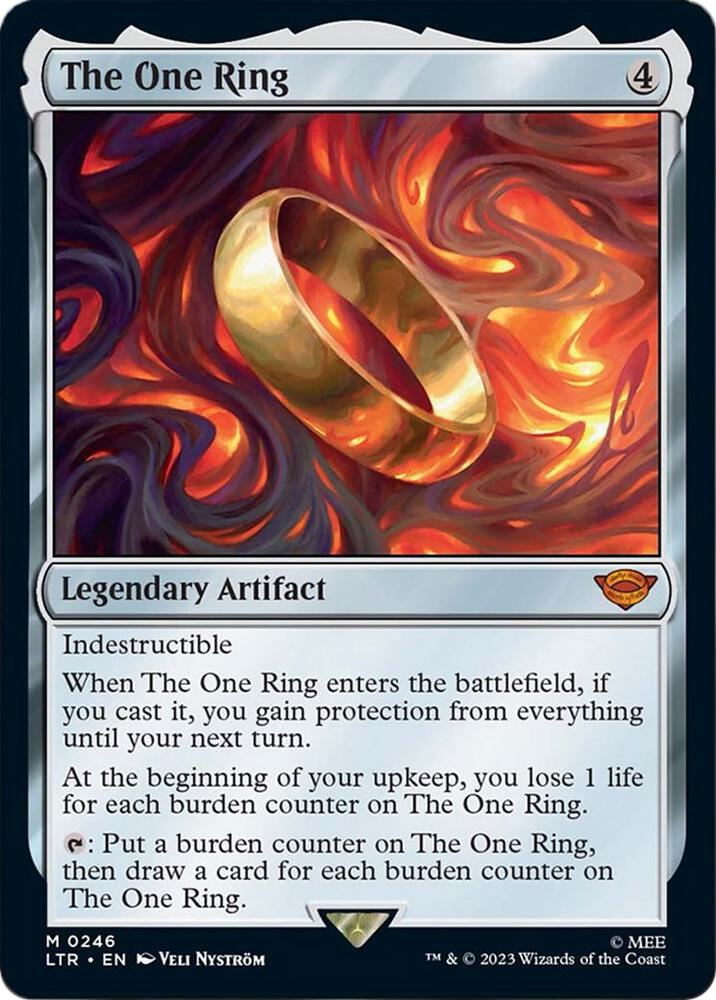
The One Ring is a good card. It goes in any and every deck, gives your opponents a turn they can’t do anything to you, and draws you cards, making you more likely to win the game. The One Ring should be a good card. It’s the MacGuffin at the center of The Lord of the Rings. It would be weird if a LotR Magic set didn’t feature The One Ring in some way, and disappointing if it wasn’t a powerful card.
On the secondary market, the cheapest printing of The One Ring will currently run you $87.68, up from around $50 the last time I checked in mid-2024. That’s not too bad for a card when most players who want one will only want one copy, but in a couple of years that cost will balloon if the card isn’t reprinted. It’s unclear if most UB cards can even be reprinted, since they reference non-Magic IP, and though something like the digital version of Spider-Man could be employed here, it’s confusing to have two cards which count as the same game piece, especially since legality is determined by a card’s English name.
This problem is compounded when considering a UB card like Badgermole Cub, which has become a staple in multiple formats, and will set players back $200 for a playset at time of writing. Badgermole Cub features the mechanic earthbending, a term inextricable from Avatar: The Last Airbender, and given and given that the mechanic “web slinging” from Marvel’s Spider-Man was renamed “enweb” in digital formats, the chances of reprints for Badgermole Cub aren’t looking good, meaning that prices will keep increasing as long it remains a format staple, and resulting in a higher barrier of entry to those formats.
There are other structural problems with Universes Beyond too. It makes sense that UB cards are legal in Standard, the game’s premier competitive format, so that people who get into the game because they were first a fan of Avatar, or Teenage Mutant Ninja Turtles, or Star Trek, can start playing. However, when there are now six sets a year (compared to four per year in 2016) the total card pool becomes too much to keep track of even for casual online play. The folks who make Magic often say “not all sets are for all players,” but that’s a lot harder to believe when every set can be relevant to competitive players.
Despite the issues with Universes Beyond, I still love Magic. The non-UB sets in the last year have all been knockouts. Lorwyn Eclipsed brought back and reinvigorated a fey setting from 2007, Edge of Eternities wonderfully incorporated a sci-fi space opera setting into a game that has long focused on fantasy, and Tarkir: Dragonstorm refreshed to a personal favorite setting while keeping what made the original cool. The web fiction published alongside all three was engaging and enjoyable, even when the breaks between for UB sets makes it tricky to remember what was going on previously.
Even if there’s a year of bad sets released, that won’t stop me from enjoying the game. I’ve still got my group of friends who regularly play, and I’m happy to sleeve up some old cards and play with those. It’s been said many times before, but the real meaning of the game comes in the gathering.


Scalpers are a blight to humanity. I’ve heard some celebrities at cons have started charging for autographs, on the grounds that if “fans” are going to get autographs solely to sell them online, the celebrity should make some dough too.
I know nothing about MTG, so it’s always fascinating to hear from inside that world.