
A woman holds a sign on the street corner. It reads something along the lines of, “Jesus is love. Holy justice.”
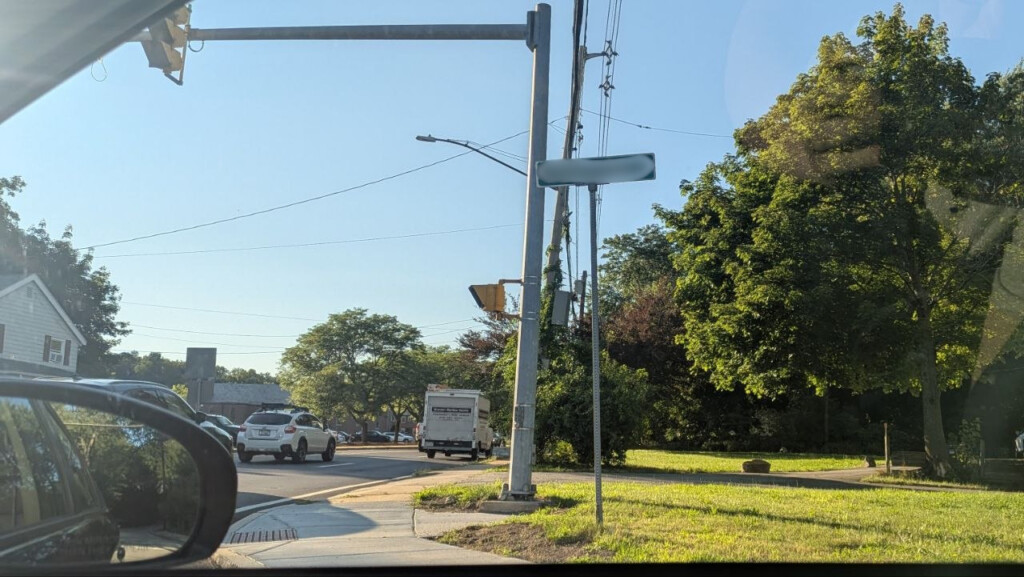
She stands alone on a street corner where the main road of our town becomes a highway junction, opposite of the massive parking lot for the Catholic church that all my elementary school classmates attended. The sign seems to be about as tall as her—even though she holds it raised above her head, its size dwarfs her, which I guess is the intention. I can barely spot her face as I drive home from work, shaded in the evening light.
The first time I remember seeing her, or at least the sign, was about a month ago. I thought it was strange that someone was pounding the pavement for Jesus, by themselves, at 5:30pm on a summer evening. I didn’t expect to ever see her again, but then I saw her another night, and another.
My first question, as it always is when it comes to public showings like these, was What is the point here? Was this woman manipulated by leaders to believe that she must be proselytizing, that other people will go to hell if she doesn’t speak the good news? Is this a burgeoning protest, starting small and going to bubble over? Why this corner? Are there others? What is she getting out of this?
There is something inside me that is deeply distrustful of people who perform acts of Christianity to the general public. A hazy sermon on Matthew 7:21–23 given in the youth room of my church surfaces, one of the times I most clearly felt my eternal life hanging in the balance due to the fact that I wasn’t brave enough to cry Jesus’s name from the rooftops. The fear that Jesus would look at me and his eyes would slide over my face, turning coolly to the next person after casting me out, shook me. An altar call at a funeral asked people to raise their hands if they wanted to go to heaven, if they wanted to see their dead loved one again, and ran straight to having the crowd repeat a repentance prayer for their sins. I stood, teeth gritted and hands curled into fists, struggling to see why I should be quelling the rage rising inside me. The obvious images of hateful Christians, from protesting Ruby Bridges to the Westboro Baptist Church, as well as all the other times Christians have stood on the wrong side of history all bring me to view acts as simple as a sign proclaiming Jesus’s love with skepticism. In these public declarations, I find it too easy to see the cultural narrative around Christians: that they are fundamentalists who hate all gay people, worship at the altar of Donald Trump, love to detail all the ways that you are messing up straight to your face, and then turn around and ask you to live the same life that they do because it is better than anything else.
Right before a council meeting a few years ago, my pastor showed me a poster detailing how evangelism strategies should be shifting. She excitedly pointed out the part that focused on how relationships, built small and over time, are an incredibly effective tool in bringing people to faith. “This is what we are doing!” she said, her finger stabbing the paper and her eyes twinkling. Something leveled inside me—something that was disrupted inside me all those years ago in that youth group room and quietly agitated over years in Christian spheres. These days, the story I sell myself is that I demonstrate God’s love in my love, in how I show up for my friendship and how I serve in my workplace and how I treat strangers. I don’t need to do the public gospel pavement pounding thing.
This woman on the corner though, she gives me pause. Her fists gripping this sign aloft—are her hands leading people to curiosity, to faith? Am I wrong to sit contented in my story?
A recent video from F.D Signifier continued to hammer home that content consumption is not equivalent to activism. The way to make the change you want to see in the world is to go out and do it in your immediate community, not to post on social media or watch YouTube videos about it. This woman, in her insignificant way, is living that out.
Yesterday, I turned around after I got home. I wanted to grab a picture of her sign, get the actual words (and maybe a cover photo for this post), and I even considered rolling down my window and having a conversation with her. “Who are you? Why are you doing this?” Are you making a difference? But when I pulled up to the corner, she was gone.
Tomorrow, I won’t pull into the church parking lot on my commute and cross the street to talk to her. My fists on the steering wheel will guide me straight home. I think, though, my hands can hold more than just judgement for other’s public actions. They can raise in a church that celebrates God’s love for queer people; they can write the truth in the best way they are able to in my little corners and in my classroom. I’m still figuring out what is worth yelling out to the world and which world exactly to yell it to. When I do, my fists will curl around my own sign too.
Post script: the sign actually says “Jesus Christ is Lord of All” and is about the average height of a sign, not enormously long, reported after another evening drive. The original details are left to remind the writer that her memory is still prone to holes as everyone else.

Alex Johnson (‘19) is a high school English teacher in Massachusetts. She spends her days being an uncool adult who enjoys reading romance novels and explaining niche rhythm game strategies.


This is definitely relatable. It’s hard to be a Christian!