
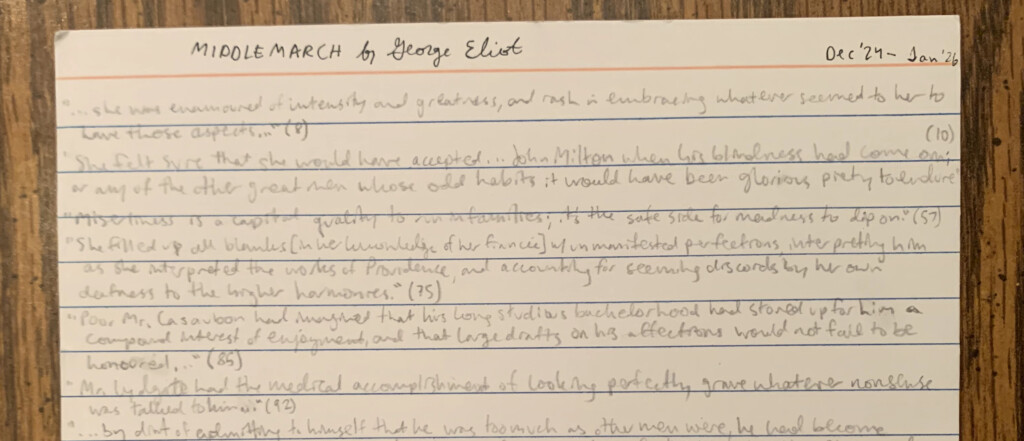
Last year I read Middlemarch, and I haven’t tried to elicit nearly enough admiration from others for it. I barely read it at all in public, at coffeeshops or on Metro rides, and I don’t maintain a Goodreads account to post a thoughtful four-star review to. I just marked it “finished” in my personal little spreadsheet and placed it with pride on my bookshelf. (And I definitely did talk to some people about it)
For the past few years, it’s been my habit with big and/or fancy books to use a notecard as a bookmark and write down good quotes as I read. I got this idea from some writer referenced in some article at some point. He wrote down quotes as he came across them and filed them by category in a filing cabinet to reference in his own writing later.
I’ve been filling up notecards and sticking them in a plastic box for awhile now, and though I have yet to refer back to them, they are a helpful substitute for underlining if I’m reading a borrowed book.
Middlemarch nicely filled up the front and back of one card with my tiniest writing and, though I don’t remember the context for most of these quotes, it turns out I can find a way to force them to resonate with my life. Without attempting any further analysis of the work, I’d say the book is at least somewhat about the everyday problems of everyday people who aspire to be greater than their everyday lives, so I think the following is an appropriate exercise.
“Miserliness is a capital quality to run in families; it’s the safe side of madness to dip on,” I mutter under my breath as I sniff the milk, convincing myself it’s good for a few more days.
“We have all got to exert ourselves a little to keep sane,” I huff on my way up two flights of stairs instead of taking the elevator and while I watch my friend run a marathon.
The dear matrons of my church try to set me up with a nice young man they just met, and they lament the previous foolish and lamentable men who failed to see my worth.“If youth is the season of hope, it is often so only in the sense that our elders are hopeful about us….”
“What do we live for, if it is not to make life easier for one another?” I ask as I obey the ragged paper sign in the hallway and take my cardboard boxes to the recycling dumpster in the parking lot instead of wedging them into the overflowing bin on our floor.
I cajole the printer past phantom paper blockages in this and every job. Like Ladislaw, accepting “his bit of work, though it was not that indeterminate loftiest thing which he had once dreamed of as alone worthy of continuous effort.”
“…[F]or the growing good of the world is partly dependent on unhistoric acts; and that things are not so ill with you and me as they might have been, is half owing to the number who lived faithfully a hidden life, and rest in unvisited tombs,” and maybe just read big and/or fancy books for their own sake.
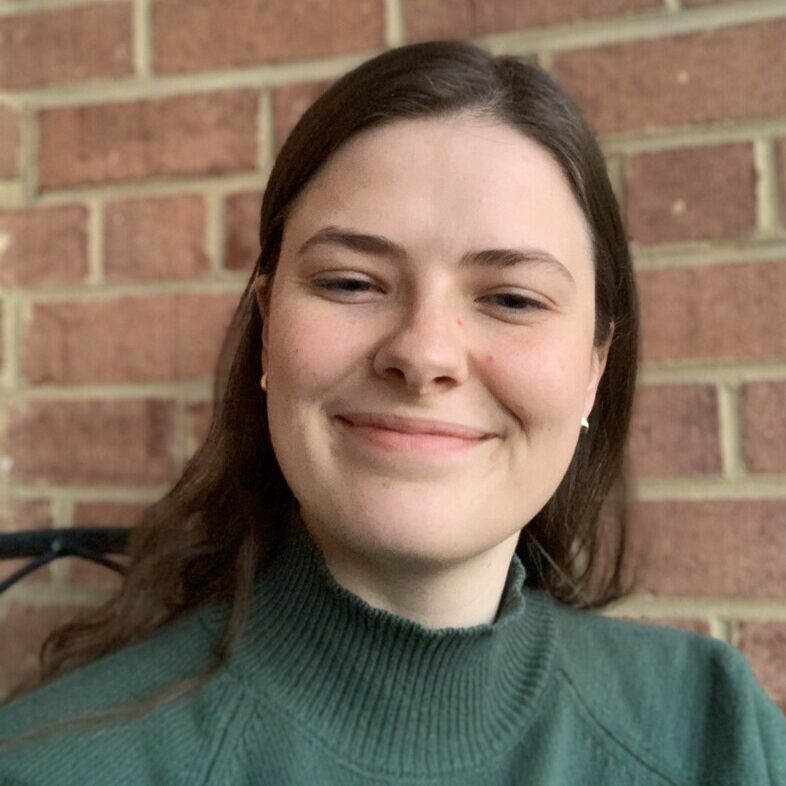
Christina Ribbens (’19) studied history, studio art, and data science at Calvin and public humanities at Georgetown. She now lives in the part of Virginia that’s almost Washington, DC where she helps award grants to arts nonprofits. She takes a lot of walks to admire the landscaping in peoples’ front yards, mostly listens to British comedians’ podcasts, and likes to make friends via sports.

