
Our theme for the month of June is “spirits.”
Temperance, Michigan is a nowhere-town. My grandpa lives there with his six apple trees and woodshop-garage, a couple miles down the road from the Ohio border and, as of 2018, at least three dozen marijuana shops. This is where my family has spent every Sunday since before I was born. When I was waist-high, my grandma used to send me and my brothers each home with a tiny paper cup filled with mini marshmallows (the colored ones). Since she passed away, the kitchen has always smelled like semi-traditional Southern biscuits and gravy in the morning, though my grandpa is eighty-eight now and has gotten used to using the pre-made Pillsbury dough tubes. He always makes bacon and eggs to go with them, and complains when my mom and I fry our own eggs well-done rather than sunny-side-up. “You’ve killed ‘em!”
“Yeah,” I would reply with characteristic fifteen-year-old swagger. “Well, I like ‘em killed.”
Over the years, the wide yard with the six apple trees has also hosted two pear trees, a chicken coop at one point, a bonfire pit, a small playset with a broken swing, and several attempts at a vegetable garden, all of which I would mow around when I was put in charge of cutting the grass. I would pluck a pear straight from the tree as my mower passed under it, rub it on my shirtfront for a couple seconds, and spend the rest of the mow gnawing on it till I tossed the core past the fence and returned the mower to the garage. The garage smells like sawdust; the yard smells like smoke from the fire pit, or whatever is on the grill (picture: ribs, hamburgers/hot dogs, corncobs), or sometimes cigarette fumes from one of the aunts. If the temperature’s above sixty, some twangy bluegrass or pickup-truck-country song will almost certainly be playing from beside the grill. If the sun’s out, probably so’s my grandpa and my family’s cheeky Pomeranian who tails him around everywhere.
I write this from Japan, where there is no bluegrass music. When I first moved here, this being the first country outside of America I’ve ever been in for more than a couple days, you might imagine my attention was full of things like the new forms of speaking, transport, class schedules, sunlight schedules. And it was. But there were other things, too, like cicadas, which are so loud in my neighborhood that the more sensitive people wear earplugs when they walk across campus in the evening. I silently noted the tiles on the sidewalks, the salty flavor of miso soup, the glimpse of a persimmon tree behind the chapel.
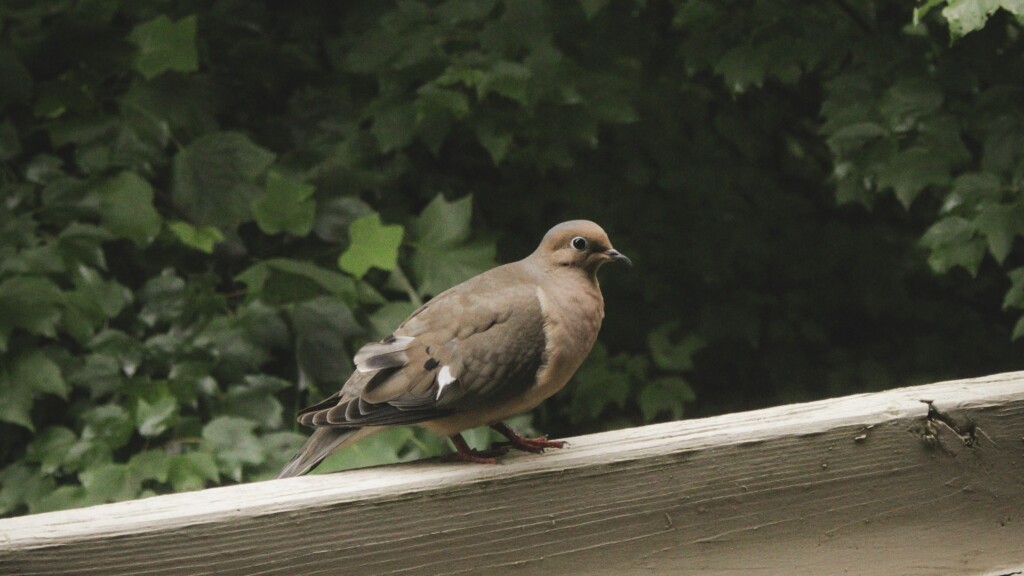
You’d also think it would be something like hamburgers or a country song or someone’s turn of phrase that would remind me of Temperance. But actually it was a bird—the mourning dove.
The birds here in Japan are still largely a mystery to me, but several have become quite distinctive in my memory, particularly the desolate caw of the crows and the alarmingly scream-like cries of another unnamed fowl that comes out to wail into the empty night every now and then. In the midst of all the other parts of daily existence, the background noises of birds and bugs and frogs often fall below notice, change wordlessly and seamlessly with the season. I didn’t know there’d been a difference in Japan myself until one morning when I was listening to BBC News on my phone. I was still half-asleep, mummied in my futon sheets, when the news program played a sound clip of birds and crickets, what someone imagined one of Picasso’s paintings to sound like. But it snatched my attention like a fish yanked out of water: the low coo of a mourning dove. Never had that sound been so loud in my brain—I hadn’t heard it since the last time I sat on my grandpa’s porch, almost a full year ago. I was once again sitting in the green metal chairs where we had cookouts, out with the wooden benches by the fire pit, the cherry tree and the maples and the white pines lining the fence. And with the warm, still afternoon, the mourning dove.
One of my friends who returned to America from Japan back in December mentioned a similar experience, being in America and waiting to hear sounds she only heard in Japan: the thrice-daily chapel bells, the train station announcements, the nightly cicada chorus. I’m trying to notice as much as I can of these nothing-noises now, before leaving this place, too, and returning to the place with mourning doves and bluebirds but no chapel bells. I commit the tastes to memory of this place with sweet red beans and hot rice tea but no spiced apple cider.
The soul of a place, I’m realizing, is often what I notice least—it’s the eyes and ears of it, the smell of it, the taste. What I cannot bring back with me. It is everywhere and nowhere, out of sight and mind but suddenly there as soon as I realize it’s gone.
In only a couple months, there will be woodsmoke and bluegrass again. But today, there’s steaming rice tea and chirping Japanese warblers. As quick as the smells and the tastes and the sounds themselves, they will be gone, but for now, I will seek to learn their names.

Emilyn Shortridge (’25) spent her Calvin years studying English linguistics, Asian studies, and ministry leadership, and intends to finish her Asian studies program in Chiba, Japan, in 2026. When at home in Plymouth, Michigan, she thrives anywhere near fantasy novels, houseplants, hot tea, or her calico cat, Genie, but she plans to live and learn in many cultures before deciding which corner of the world needs her most.


This is beautiful, both your writing and the feeling you’ve captured. Thanks for sharing
we spend so much time looking ahead to what’s next that we miss out on the “soul of a place” until its too late. well written!
This is such beautiful writing!