
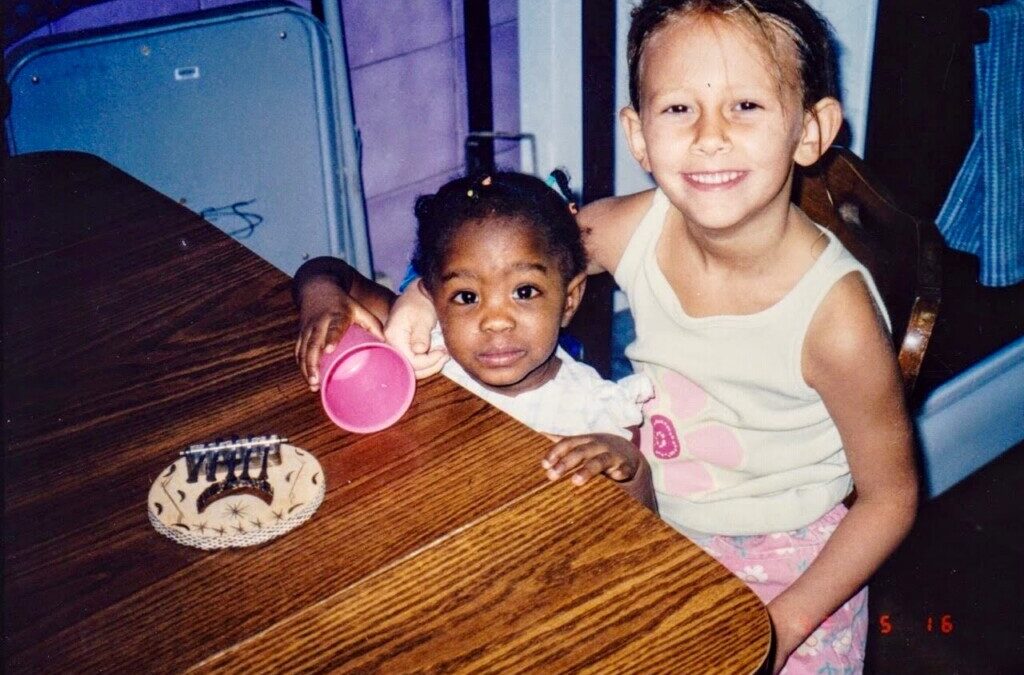
Please welcome today’s guest writer, Alicia (De Jong) Bradshaw. Alicia graduated in 2017 with majors in geography and English writing. She now lives in Tacoma, Washington, where she works as an analyst for the local transit agency. When she’s not thinking about public transportation, she’s usually tinkering with an art project or weeding in the garden.
Dear T –
When I caught a glance of the post on the Facebook group—a picture of a whiteboard in the KE apartments on Calvin’s campus where the word “ALL” was scribbled over the word “Black” in “Black Lives Matter”—I cringed, but I didn’t think twice…until you texted to ask if I had seen it.
I opened the post again. This time, I really saw it: through your eyes and skin. I watched briefly as waves of reactions, comments, and arguments rolled in. It reminded me of a moment at a recent peaceful protest. I was marching beside two Black children no older than five and seven Someone had handed them megaphones, and they were leading the crowd in a chant: “Whose lives matter?” Suddenly, a white woman broke into the crowd and began angrily screaming, “ALL LIVES MATTER.” …So I called you, and all I could think to say was: “I’m sorry.”
Initially, I meant: “I’m sorry that the value of your life is somehow controversial.”
But you know what? I have a lot more to apologize to you for.
In November 2015, during my junior year at Calvin, two Calvin students drew a swastika and wrote “white power” in the snow on a car. President Le Roy made a public apology and asked students, faculty, and staff to stand in solidarity against racism. This response was far from enough. A key indicator of that should have been the reactions from many white students, including a friend of mine who remarked: “I don’t see why we need to make such a big deal about it.”
I’m sorry because my reaction, as your white sister, was to occasionally respond to those comments. A year later, I wrote an essay about it for class. In retrospect, I should and could have done so much more while I was a student at Calvin.
I could and should have attended more events and conversations that I was invited into, like during Unlearn Week. But I didn’t. I thought I was somehow exempt—because I grew up in other countries or have Jewish blood or have a sister who looks different than me. I realize now that attending was for you as much as it was for me. I just needed to show up and listen: such a simple sign of support. I’m sorry, because I wasn’t there for you.
I am guilty of going through four years at Calvin without actively engaging in what you experience all the time, just because of your skin. I’m sorry that when you do bravely share about your experiences at Calvin—from the strange looks to the subtle, yet piercing comments—this is often met with rebuttals like:
“That’s not what they meant.”
“No one looks at you like that.”
“Well, run for student senate!”
First of all, regardless of anyone’s intentions, the fact that you find yourself questioning these interactions is significant. Each story adds to the picture of a deep and pervasive issue that is far too easy for white people, like me, to ignore or deny. I’m sorry for the times I’ve made excuses for people instead of acknowledging how these interactions make you feel.
Secondly, you shouldn’t have to run for a leadership position in order for your voice to be acknowledged or represented. The responsibility of listening and working to address racism is a burden that should weigh heavily on leaders and decision-makers—particularly those who are white. And white people, like me, should always be working to hold these leaders accountable. You, as a college student, should have the same freedom as your older, white sisters to focus on your education, if that’s where you need to devote your energy right now. I’m sorry if that doesn’t always feel like an option.
I know my apologies don’t change anything. But I hope that others can learn from my faults.
You know what happened with the woman at the peaceful protest? Strangers in the march stepped out, linked arms, and formed a barrier between her and the passing crowd. As the children beside me continued to lead their chant, those strangers responded to their calls, but this time even louder: “BLACK LIVES MATTER.” I hope that white students at Calvin—and white people everywhere—can learn to be those strangers who will step out and challenge the words and actions that stifle and degrade their siblings. I hope that you find people like that at Calvin.
Racism didn’t start with whiteboard commentaries or swastikas in the snow, and it won’t end with a bandaid statement or essay. It has been built over generations, and it will take generations of action to dismantle. Your work in undoing it is also my work. Your experience matters to me.
Love,
Alicia


This is beautiful. Black Lives Matter!
Beautifully written Alicia!
Beautifully written Alicia. You spoke from a heart that is connected not by blood or skin color, but heart that is fearlessly fair. You have always stood for truth and all battles are not ours yo fight and some are overlooked due to circumstances surrounding our lives at a place and time. Black Lives Matter. When hearts are removed from a body, they have no color. Continue to speak out against the inequality and injustice. Just maybe in our life we will se the change that we are being.
Thoughtfulness. Well said Alicia
This brought tears to my eyes. Beautifully written.
Alicia, what a letter of pure love! I had tears in my eyes as I read it.
I am hopeful that the generation of T and you are bringing us a better world, but it’s not going to be easy.
Love to you both!
Black Lives Matter
Judy
So beautiful and so honest. Yup tears in my eyes too.
Dear Alicia, this is beautifully written! I am so proud of you and particularly proud to have taught such a caring student!
Bernadette Fox
It really is all too easy to get caught up in the “me” aspect of it all. “Oh I’m not racist” or “I don’t do those things.” When really it isn’t always about us. “Showing up” really does say a lot about a person’s character and where their heart lies.
Thank you for sharing with the post calvin. Keep writing as your heart leads.
Dear Alicia,
I hear your heart’s cry. I, also, have been reflecting on how as a Christian, I have never felt that I have been racist, but I have never had to walk in their shoes. To truly listen to someone with black skin and HEAR all the fear and ‘put-downs’ that they constantly live with is to begin to understand why we need to say, ‘black lives matter.’ It is so sad that it is a movement that has become something that is not good. I believe that the movement is being used by the devil to drive us apart. There is so much hate in the streets. The cry of the black people should have nothing to do with violence and destruction. It should have nothing to do with destroying other people’s lives. BUT, we need to hear the cry. We, as Christians, need to support the rallying cry of the hurt and pained brothers and sisters who are black and stand by them and say, “No more! Being treated as lower class citizens has got to stop.” Even a turn of the head or shifting of the eyes can be painful to someone who sees it EVERY DAY. This is what we have to educate people to. Love does not allow this to happen. We need to truly love as Jesus did. He called out the hypocrites and called them vipers and snakes. Do we dare to do the same? Love you, dear nieces.
Beautifully written, Alicia. YOU GET IT! So proud of you!
Wow. Thank you for being humble. I was recently listening to a podcast where a black speaker was speaking about her frustration that all of a sudden people seem to be caring about Black Lives Matter. She wanted to know why we hadn’t been caring about it all along. Your willingness to admit that so many of us have remained idle or silent against injustice in the past is beautiful. It’s hard to admit to wrong. It’s hard to admit that I am wrong. But I have been wrong. And I will be wrong.
So thank you. I just want to say thank you.
Alicia these are true words spoken from the heart Natanya is Blessed to have such a caring sister. Yes ALL LIVES MATTER