
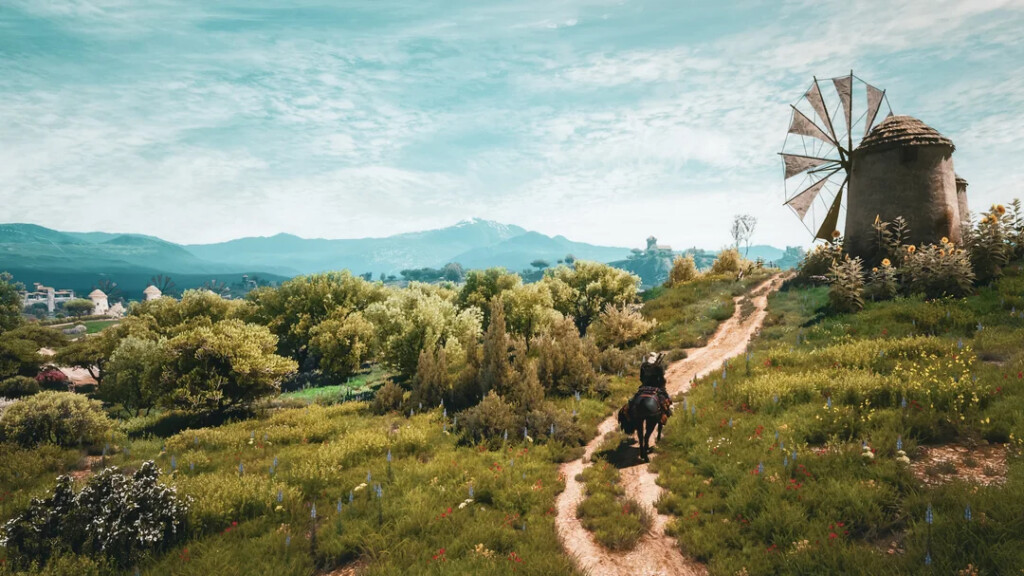
I’ve never considered myself a “gamer.” I had very strict thirty-minute-per-day time limits for video games in my childhood, and the harsh shriek of the oven timer upstairs proclaiming when that limit was reached is still etched in my memory. So why, now, am I spending dozens of hours of my life replaying 2015’s game of the year, The Witcher 3: Wild Hunt?
The world of The Witcher began with a collection of short stories published in 1993 by Polish author Andrzej Sapkowski. A fantasy anthology set in a landscape akin to fifteenth-century central Europe, Geralt of Rivia is one of the few remaining “witchers,” a dwindling caste mutated and trained to aid humanity as specialized monster hunters. Bearing a silver sword for monsters and a steel sword for humans, Geralt wanders the world for hire. He dispatches ghouls, strigas, bruxas, and all manner of monsters born out of Slavic folklore—but oftentimes, it’s the humans that turn out to be the most monstrous in the end. Sapkowski went on to write a total of eight Witcher books, transitioning to novels as Geralt and his adopted daughter, Ciri, become entwined with the powers of kings, sorceresses, and the end of the world. The story continues over the course of several video games and most recently found new audiences with Netflix’s 2019 show adaptation.
Sapkowski’s writing is far from above critique, but his stories have found resonance for a reason. Certainly, if the nation of Austria is featuring your characters on a commemorative postal stamp, you must have done something right. Sapkowski’s works and their spin-offs are praised for their celebration and representation of Slavic culture and heritage. They also each stay remarkably consistent in honoring the themes and social commentary grounding his fantasy narrative, such as the destruction brought about by xenophobia and racism or the failings of corrupt and self-serving systems and individuals. The most popular theme, though, revolves around Geralt’s choices and their impacts as he struggles to do what is right in a morally ambiguous world, one which often simply pits a lesser evil against a greater one.
This emphasis on choice is a significant part of why The Witcher 3: Wild Hunt remains in the conversation as one of the greatest role-playing games of all time. Each decision you make has an effect on the game. Some small choices simply trigger an alternate cutscene or quest reward, while others have larger, game-affecting implications such as whether a village survives, family members are reunited, or nations succumb to an invading force. These choices, and how you interact over the course of the game with one key character, steer the game towards one of three possible endings regarding the protagonists’ ultimate fate.
The first time I played The Witcher, my completionist personality led me to move far too quickly through the game as I rushed to complete all the quests I came across. I skipped through dialogue, missed context around intricate character interactions, and often found myself woefully reaping the results of carelessly sown decisions. But, thankfully, salvation was never more than a few clicks of the controller away. It is a video game, after all, and there was always a previous save file to load and manifest a new chance to make the “right” choice. Did my decision of which arguing peasant to believe land the wrong person in jail? Oops, reload! Oh, I accidentally just escalated a disagreement with an ally and killed them? Oofta, let me give that another go. Wait, by not freeing that spooky tree spirit, I allowed a group of orphans to get cooked up and eaten by some crones? Yeah, let’s roll that one back, king.
I think, however, that playing the game this way cheated Sapkowski’s world of one of its biggest and most valuable messages. In my own life, I find myself often chasing that perfect, “right” decision—rethinking, hesitating, or regretting an action or lack thereof. Will hiring this team member help my program thrive? Did I neglect my nephew the other weekend by not driving across the state for his birthday party? Will waking up early on Saturday to go to the gym make me feel more or less rested in the midst of some busy weeks? Thankfully, the implications of these decisions aren’t life-and-death or potentially globally calamitous like Geralt’s are. But my life doesn’t have saved checkpoints that I can reload to try again after I’ve gotten something significant wrong, either.
The Witcher franchise is quick to highlight that, sometimes, there is no “right” choice. For example, that tree spirit decision I mentioned two paragraphs ago? Well, turns out if you do free the spirit, you save the orphans…but the spirit goes on to kill an entire village of peasants, also resulting in the death of a character you originally set out to save in that quest. From the start, Sapkowski wrote Geralt as a conduit for a philosophical ideal that when faced with a choice between a greater and lesser evil, it is better not to choose at all. Regardless of how some philosophical and theological heavyweights might rise to contest that, though, Sapkowski is also pragmatic enough to write that Geralt’s hand is often forced, regardless of his attempts to not engage.
So I’ve been playing The Witcher differently this time around. I’m paying attention where I wasn’t before, gathering context and clues from characters and environments to make the best informed decisions. Sometimes the result is one I’m happy with, sometimes not—but regardless, I’m not booting up my most recent save data to give a situation another try. Perhaps sometimes all we can do is make a thoughtful decision with the information available to us. And I’m certainly grateful that instead of serving at the whims of child-eating crones or vengeful tree spirits, I serve at the pleasure of a King who will redeem my small, feeble actions into works that are truly beautiful.

Luke Brandsen graduated in 2019 and uses his business/HR degree to inform directing mission-focused programs. He currently lives in Ann Arbor, Michigan, where he squints at the players on his bootleg soccer stream, breaks guitar strings, and desperately tries to recall where the last D&D session he ran left off.

