
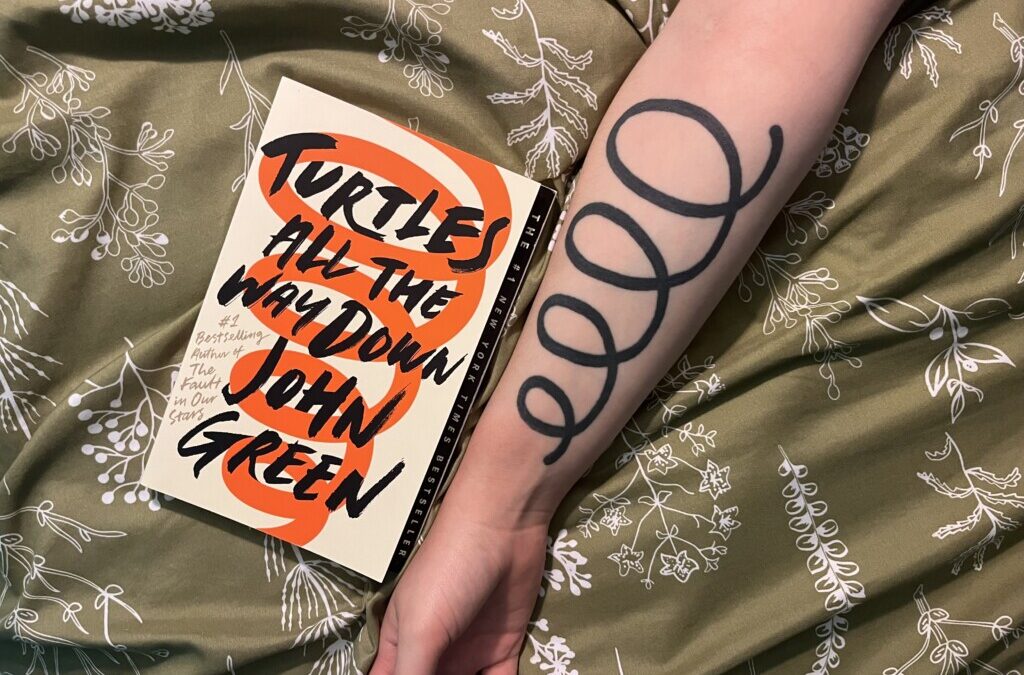
Warning: Spoilers for the book, Turtles All the Way Down by John Green
My first tattoo is usually the first one people notice. It’s the biggest, snaking down my forearm in one thick, spiraling line. Unlike the orange slice on the back of my arm and the snapping fingers on my bicep, my spiral is a little harder for people to decipher.
I don’t always like explaining it when people ask, especially when they’re a stranger and we’re just having a few seconds of small talk. I usually explain that it’s cover art from my favorite book, hoping this doesn’t devolve into an explanation of why Turtles All the Way Down means so much to me.
During the thick of COVID, Mom ordered some books for us to take turns reading. Both of them happened to be centered around obsessive-compulsive disorder, though I don’t think we had meant to create a theme.
Turtles All the Way Down is by the one and only John Green and focuses on high schooler Aza Holmes as she immerses herself in a mystery surrounding the disappearance of a local billionare. While the book is filled with classic John Green whimsy as two best friends try to hunt down a billionaire for the $100,000 prize, Aza’s struggles with mental illness dominate the book.
In the book, it’s never explicitly said that Aza has OCD, but people who’ve lived through it can recognize the signs right away. Her intrusive thoughts and irrational fears of germs and contamination flood her mind constantly, pushing her to engage in compulsive behaviors like excessive hand washing and excessive research on the bacteria, C. diff.
Throughout the novel, Aza describes her intrusive thoughts as spirals that tighten as they grow more intense. The smaller the loops get, the more frequent the thoughts become, making her feel terrified and out of control.
The end of the book shows an adult Aza reflecting on the ups and downs of her mental health. She talks about how she had children but had to go into treatment twice, her OCD making it near to impossible to care for them properly.
Mom didn’t like the ending. It filled her with sadness to think about how Aza’s obstacle-filled life would continue. That the obsessions that took up the pages of Green’s book would also take up periods of Aza’s life, sometimes to a debilitating degree.
I didn’t hate it.
My OCD doesn’t look much like Aza’s. My brain doesn’t focus on how C. diff can ruin my life. It instead dwells on the many ways my actions can ruin the lives of others. What Aza and I are both familiar with is the helplessness that comes with the onslaught of intrusive thoughts—the feeling of power slipping from your fingers as a spiral tightens. But the one thing that gives you control, the compulsions, is also the one thing that will make the spiral become smaller and smaller.
Across the spectrum of mental illness, I’m sure many people can relate to the high and lows it takes you on. It’s disorienting, how you can feel relieved one day and utterly defeated a week later.
Aza’s story doesn’t conclude on a happy note, but it felt real to me. It feels more real to me now, six years later. High school senior me had no idea that my ups and downs with OCD had only just begun.
If you’re familiar with my student work at Chimes, you may find that I talk about this book, and my experiences with OCD, a lot. Maybe that’s because I tend to write what I know.
It’s also a testament to the connection I felt when I first read this book, even though my overall memory of the book is foggy.
This connection prompted me to get into a reclining seat and grit my teeth through pain for an hour and a half.
My housemates were in shock of how large the tattoo was. I kind of was too. I kept on staring at it, running my fingers down the raised flesh, the surrounding area still red and tender.
It makes me happy whenever I see it, when my sleeve rolls up, revealing the curving tip of the end of the spiral. I had spent years visualizing the tattoos I had, and then another few months thinking about how the spiral would look on my arm.
I liked wearing short sleeves after that day. I wanted compliments, wanted people to look down at the piece of art. Though I quickly realized that questions about my tattoo may be a bit too personal for some interactions.
One day in my philosophy class, a classmate sitting a few seats over lit up when they saw my arm. “Wait, is that from Turtles All the Way Down?” they asked.
I may have sounded overly excited when I told them yes. No one had ever identified the spiral before. I had to be the one to tell them what it meant.
We didn’t talk long about my tattoo, so they probably will never know what exactly the spiral means to me. But perhaps the book meant as much to them as it does to me if they could identify the cover art so quickly.

Liana Hirner graduated from Calvin in 2024 with a bachelor’s in writing. She currently lives in her hometown of Aurora, Illinois and works full-time in a warehouse filled with books waiting to be sorted. Writing is her first love, followed swiftly by lattes and dark chocolate.


Liana, the thing I love about your tattoo is how it tells me you feel the pain and the success of your OCD. I love your writing and hope you can love it also.
I love your tattoo. And Turtles All the Way Down is such a good book that I know resonated with a close friend of mine with OCD! I love how open and candid you are with writing about your mental illness.