
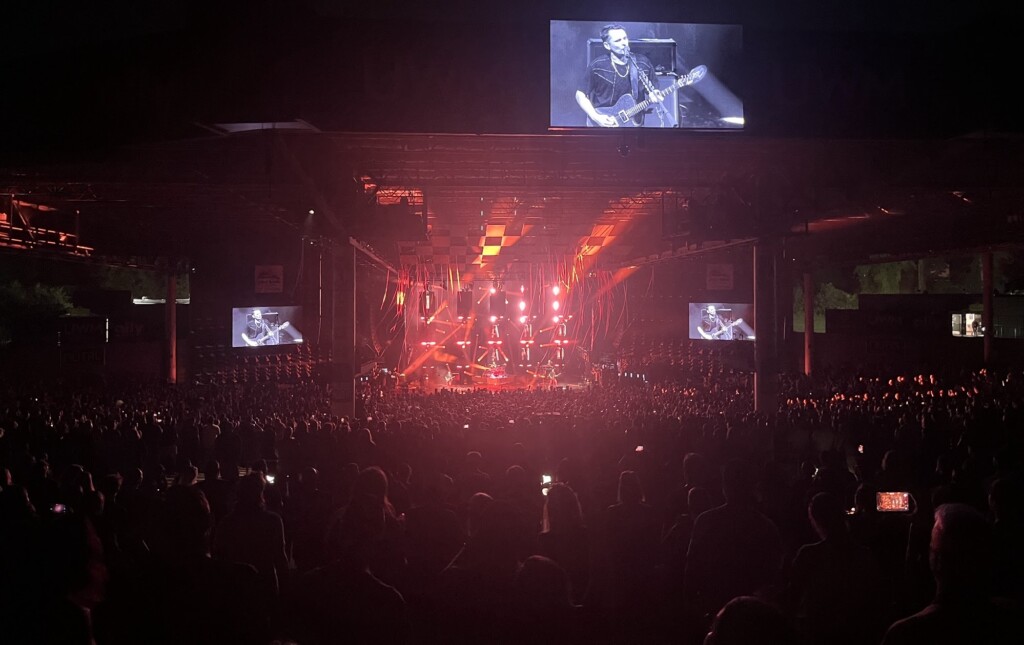
In high school, I remember playing Psychiatrist, a game where the designated “psychiatrist” has to guess a predetermined group quirk based on how people are acting. That round, our quirk was that we each were acting like the person to our left. It didn’t take long for my impersonator to simply blurt out “Muse!” before aggressively scatting a bass line with accompanying air-guitar motions.
Uncanny.
Muse was, after all, the band I claimed as my own after realizing the world’s musical landscape was larger than JQ99 Christian radio. The English three-piece rock band was well into their discography by the time I shaped my adolescent personality around them, debuting in 1999 with the album Showbiz. Since then, they’ve had nine albums to balance iconizing and evolving their songwriting prior to their latest record, The Wow! Signal, releasing last month. Those nine albums cover a lot of territory—they contain powerhouse guitar and bass riffs, mass-appeal anthems and pop-rock slow-burns, Rachmaninoff- and Chopin-inspired piano interludes, zany synth leads, and more.
Creating art at a high level for twenty-seven years, though, is difficult. For a band built on creative songwriting and poignant lyrics, Muse’s recent albums have suffered from seemingly uninspired, formulaic composition with generic lyricism that has failed to capture praise from new and old fans alike. So, how does the latest creation from the titan of alternative rock measure up? Is Muse doomed to a feeble death spiral, or can they show they’ve still got the sauce? Let’s take a look at The Wow! Signal’s musical style and lyrical focus, and how a fusion of elements in both sectors serve the album’s artistry.
The Wow! Signal solidifies an era of Muse with heavier tracking. Seven-string guitars lend themselves to chugging rhythms and distorted tones, while hints of blast-beats break through from Dominic Howard’s drumming. The band pioneered their heavier sound production in 2022’s Will of the People, but The Wow! Signal ultimately succeeds where its predecessor failed: fusing new genres with traditional style in a way that doesn’t unproductively jar its listener, but celebrates both the history and present of the artist. Lead single “Unraveling” serves as a case study—scorching riffs combine with electronic ornamentation that harken to Muse’s predisposition towards synth programming, with a song structure that allows time-tested elements like their anthemic choruses to drive the song home amongst the intermittent breakdowns.
A heavier sound is not the only reinforcement on the album. Muse also has never been afraid to play with influences from funk and pop over the years. The group doubles down on this territory with their first major guest vocalist feature, trading off melodies with pop icon Ellie Goulding on back-end track “Hush.” This time, riffs shake hands with hypnotic synth bass patterns and power-pop vocals as the band finds a cohesiveness in their diverse array of influences. Frontman Matt Bellamy describes single “Nightshift Superstar” as the latest attempt to perfect that synergy, tight falsetto melding with Chris Wolstenholme’s aggressively-gained nylon-string bass line to create a unique concoction on the sonic horizon.
Long-time listeners of the band will be pleased with a return to form for stylistic choices that have been absent from Muse’s last few album releases. Opening track “The Dark Forest” gallops forward with Romantic string orchestration, something not heard prominently since 2011’s “Exogenesis: Symphonies.” The arrangement supports the drama and gravitas of a Latin-chanting choir, who petition alien life to be merciful to our foolish human race. The group’s atmospheric prog-rock also makes a comeback, with the aptly named “Hexagons” using mixed meter in patterns of six to weave through a more extended track length.
What Muse listeners have encountered for the first time, however, is that The Wow! Signal might be best described as a break-up album. And sure, a band with song titles like “Time Is Running Out” and “Stockholm Syndrome” have never exactly nested their lyrics in the happy-relationship tree—but Bellamy’s separation from wife Elle Evans has certainly moved the needle towards new levels of vulnerability. While “Cryogen” labels the downwards romantic spiral in classic-Muse fashion, ballads like “Shimmering Scars” and “Space Debris” sketch a partner who is openly wrestling with the remains of their broken relationship. Bellamy’s lyrics turn inwards, addressing his shortcomings and loss not through frustration, but through a maturity of accountability and mourning that listeners have not heard before.
But Muse’s true lyrical forte has never come purely from their romantic assessments, nor just their prophetic sociological themes—it comes from the way the two inform each other. The 2nd Law identifies love as the only sustainable system amongst collapsing economies and energy grids. Drones rejects a culture of detached fear mongering in favor of empathy and compassion. Simulation Theory encourages human faith and connection as the antidote to a growing reliance on unfeeling technology. The Wow! Signal similarly ties themes together, although perhaps a tad more subtly. As Bellamy feels the familiar warmth of love fade away into a hollow void, Muse turn their eyes to the stars. What awaits us in the cold foreign heavens above? Is it likely to be something dangerous, dark, even sinister? Or is it possible that there is something more—something bounteous, bright, even healing? For now, we must sit without an answer, and wait with apprehension for the unknown to be revealed.
Now, all of this dissection ultimately begs the same question as the click-bait-y videos in my YouTube algorithm: is Muse back? Well, I don’t know if any artist is ever really “back.” But if you pop your headphones in and hit play on The Wow! Signal, you can expect to find an offering from a band that tactfully pushes their identity, relishes in exploration, and have achieved a remarkable weaving together of diverse and distinctive threads. The result? A unique, artful tapestry that could only have come from the hands of Muse.

Luke Brandsen graduated in 2019 and uses his business/HR degree to inform directing mission-focused programs. He currently lives in Ann Arbor, Michigan, where he squints at the players on his bootleg soccer stream, breaks guitar strings, and desperately tries to recall where the last D&D session he ran left off.

