
Our theme for the month of June is “spirits.”
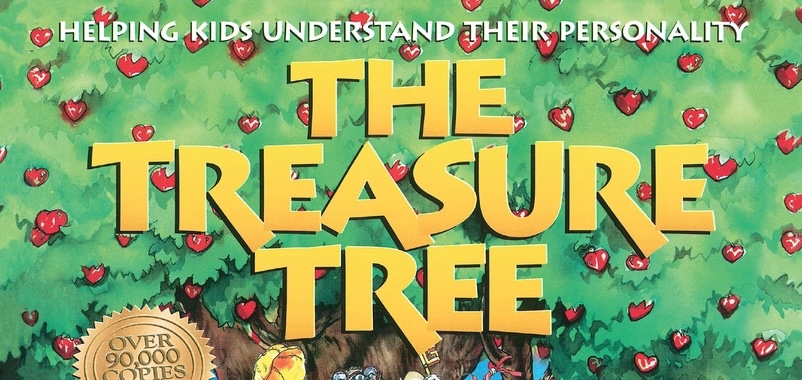
I walked downstairs into my parents’ living room last week and was greeted by a familiar aural cadence I didn’t know was cataloged away in some dusty, cobwebbed corner of my mind. It was the voice of my mom, seated on the same couch I grew up sitting on, cuddled up with my four-year-old niece and nephew. She was reading to them from The Treasure Tree, a children’s book created by John and Cindy Trent and Gary and Norma Smalley.
I hadn’t thought about The Treasure Tree in quite some time. The picture book follows the adventure of four friends: bold Lance the Lion, kind Honey the Golden Retriever, calculated Chewy the Beaver, and vibrant Giggles the Otter. They set off on their quest to find the legendary Treasure Tree, encountering various situations that give each member of the group a chance for their unique personality to shine as they overcome the obstacles.
This tale was a favorite story of mine when I myself was around four years old. Fast-forward twenty-five years and I can see why. Whether studying organizational psychology or designing engaging Dungeons & Dragons plot hooks, it seems I’ve always been drawn to the idea of self-aware individuals appropriately leaning on each to become greater than the sum of their parts. The Treasure Tree itself is clear about what it hopes kids take away from the story, its cover art often including a tagline like “helping kids understand their personality” or “helping children celebrate each other’s strengths.”
As I continued to hear my mom’s narration in the background, she took a beat to lay out for the young ones this idea that the book is getting at—and while I personally prefer my exposition on the subtler side, I guess I won’t hold the preschoolers’ lack of critique against them. My mom began explaining the concept of what personality is to my niece and nephew. I didn’t hear her full definition before wandering out of earshot, but as I walked, I thought about how different parties describe that idea.
Popular frameworks like the Big 5 or Enneagram take their stabs at it, the former defining a few statistically backed key traits while the latter digs into a more spirit-focused approach of how an individual responds to stimuli in movement toward self-protection. Psychologists add ornamentation to the concept, such as it requiring “stability over the lifespan,” and cement it as a petri dish where each person’s thoughts, feelings, and behaviors uniquely combine.
Yet as I recalled these frameworks and qualifiers, I found my thoughts primarily returning to The Treasure Tree and the distinctiveness of spirit with which each character approaches the obstacles met on their quest. The emotive illustrations are still clear in my memory—the self-assuredness with which Lance pulls down a tree to launch his friends across a dangerous river, the contagious grin on Giggles’ face as she tickles a clam, the empathy in Honey’s expression as she listens to friend in distress, and the twinkle in Chewy’s eye as he solves a riddle. Each carries their respective spirit not just into their problem-solving, but holistically into the way they enter into relationship with each other and the larger narrative of their world. Perhaps personality could also be defined as the spirit in which we engage the worlds we find ourselves in.
I don’t know if it’s realistic to expect that this read-through of The Treasure Tree will be as formative for my niece and nephew as my childhood read-throughs of it were for me. Maybe some of it will resonate the next time they work through big feelings in small bodies about whose turn it is to sit on the mutually desired stool at dinner. I wonder what elements of their spirits that I see now will be the same in twenty-five years. I wonder how they will be engaging with the worlds they find themselves in and the obstacles they meet. Beyond their own spirits, I don’t know what spirits they will be surrounded with. But I hope they are ones that, like the four friends found in The Treasure Tree, will help them get farther than they could have on their own—spirits like Lance’s to pick them up, like Giggles’s to make them laugh, like Honey’s to give them a hug, and Chewy’s to help them prepare to tackle the next challenge on their road.

Luke Brandsen graduated in 2019 and uses his business/HR degree to inform directing mission-focused programs. He currently lives in Ann Arbor, Michigan, where he squints at the players on his bootleg soccer stream, breaks guitar strings, and desperately tries to recall where the last D&D session he ran left off.

