
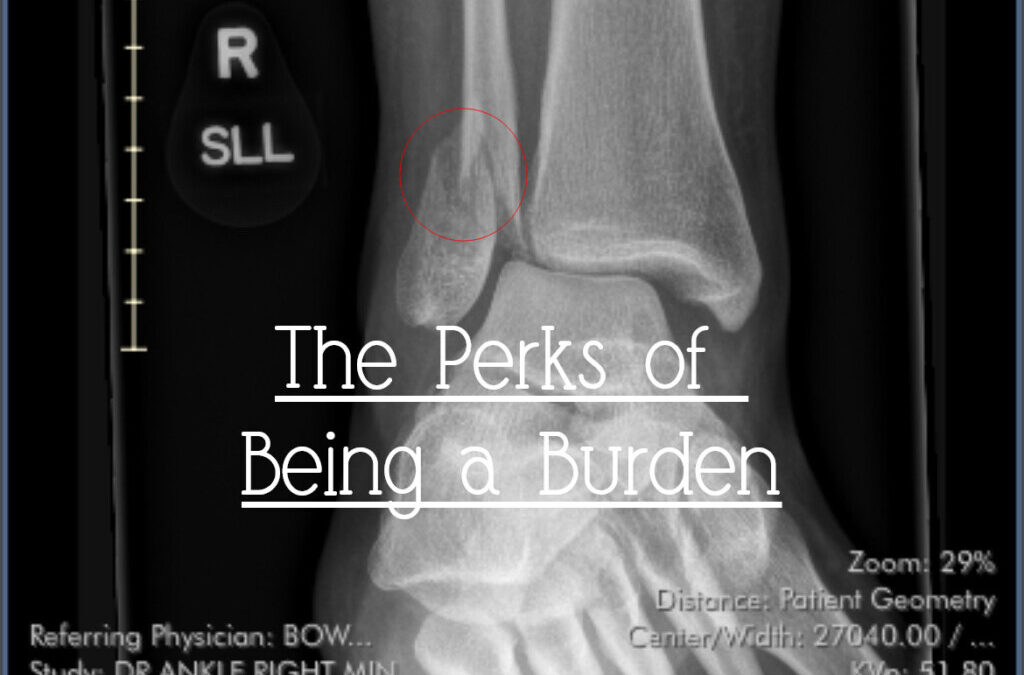
Fun fact: Roller Derby has a higher injury rate than many other sports. In the 2019 Women’s Flat Track Derby Association’s Player Risk Survey Summary of Findings, “more than eight in ten skaters have ever experienced an injury as a result of their involvement in roller derby.” I myself have sprained both my ankles while playing, an unfortunate but understandable injury that is more annoying than anything else.
A broken ankle, however, demands a bit more attention.
Yes, I’m officially no longer in the “Never Broken A Bone Club.” Me and my fractured fibula were promptly escorted out and into an ER during a practice exactly month ago when my last piece went live. It felt a bit like a cruel joke: I put out a nice piece about trying to find new ways to measure success, and someone upstairs apparently decides that is a challenge.
Overall I’d say I’ve gotten the best of a bad situation: no bones came out, no blood was spilled—even the pain wasn’t so bad! My teammates were able to get my skate and pads off without having to cut anything, I was able to get a ride to the ER without having to call an ambulance, and while waits were a bit long, the people we did see were huge helps who really made a scary situation much more bearable. They wrapped my leg in a splint, gave me crutches, and sent me home with some pain killers if I needed them.
By the time I was home, it was just me and my mom (my number one emergency contact). Since my bedroom is on the second floor, she immediately started setting up the living room into a makeshift bedroom for me. I remember standing at the foot of the stairs watching her carry down my comforter, a blanket, my laptop, and my sleep mask in one massive bundle. My immediate reaction was to say “Here, let me help,” but I couldn’t. I literally, physically could not. I had to just stand by and let her move everything for me.
And boy did I hate that.
Days went on while we waited for the surgeon’s office to call us, and I spent my time lying on the couch with my foot up, occasionally sleeping as the need arose. Meanwhile, my mother was getting me lunch, driving forty minutes out to pick me up a knee scooter and a shower chair. She was always five steps ahead of me—checking in on me, calling the pharmacist, driving me to doctors appointments, and I…did nothing.
I’d like to think I was raised pretty well. I didn’t need to be told often that my mother isn’t my maid. I did my share of chores around the house and was always quick to help out with cleaning up after dinner. Everyone does their part around the house so no one is taken advantage of. I remember overhearing someone’s mom tell my mom how sweet it was that I would offer to help out at a friend’s house when I was staying over. It was a point of pride! Since then, I’ve been the rescue friend, the person who can get you a ride, or the adventure friend. I show up and help where I can because that’s what makes me a good friend!
So being physically unable to do any of that was infuriating. If I wanted to get something from upstairs, someone had to go get it for me. If I wanted to leave the house, someone had to pick me up. I eventually started getting up to my bedroom by carefully scooting up the stairs, but I had to recruit my friends to come move everything back upstairs that my mom had taken down. I kept making comments to my friends about when I was back on my feet I’d take them out to dinner or some other promise of payback when I physically could again. I was assured it was unnecessary, or they’d say sure with a face that clearly suggested they expected no such thing from me.
As much as I want to “earn my place” or “do my part,” no one is expecting that from me right now—or ever. My relationship with my friends or my parents aren’t transactional. I might feel like a burden for not contributing, but that’s not how they see me at all. I’m not a burden—I’m their friend. I’m their friend who’s currently going through a pretty major situation. None of them are judging me for it, and none of them are mad at me for asking for help. Most of them are jumping up to help me move my scooter downstairs or pick up something I need from the store for me.
I’m a few weeks post surgery now, and my recovery is going well! I’m able to take my scooter up and down stairs, make my own meals, and empty the dishwasher by myself. When my therapist asked me how I was doing with feeling like a burden, I cheerfully told her all this, which did not impress her. It turns out the solution to feeling like a burden isn’t to simply stop being such a burden. Right now, I do still need help. I still need rides if I want to leave the house. My desk is in my second floor bedroom so I still need someone to bring me food while I’m working. It’s nice I can do more things myself, and I’m glad to be making the physical progress that I am. I’m still very limited about the things I can do by myself and that is okay.
There’s a phrase I saw years ago on a list of advice for young adults: “Never buy a dress you can’t zip up by yourself.” I understood the sentiment and frankly have lived by it. I generally don’t buy any kind of clothing if I can’t figure out how to assemble it on my own. But I also think of my friend who took me with her to her wedding dress fitting specifically so I could be taught how to secure the dress for her. It was such an honor to be the person she wanted for that moment. I was delighted that I could be there to help with such an important garment on such an important day. I didn’t resent her for needing my help; I thanked her for choosing me to help her.
Even when my ankle heals and I can do everything on my own again, there will be times where I can’t “do my part,” and it will be okay. I will continue to show up for my people where I can. I will be a good friend by being a good friend, and not by trying to earn anyone’s love. I’m not a burden—I am just a person who is learning to accept help.

Sam is unsure what exact words describe them best: Lunatic has been used, Gothic Romantic is apt, and Big ol’ Nerd is reductive but true. Mostly they just like stories in whatever form stories can be found. Sam specializes in Frankenstein, running “The Uncanny Productions” on YouTube, but they also dabble with podcasts, singing, and theatre as well. They have a DVD collection that’s long outgrown its shelf, a coffin they use as a desk, and an unrelenting joy for things that are spooky, ridiculous, or magical.


Being injured right after writing your piece last month is crazy! Hope you heal well, and I know being it sucks ti feel helpless.
Thank you for sharing, Friend! The themes of not wanting to be a burden, learning to accept help, and wanting to be a good, present friend are so relatable. It was a joy to see you trackside and I’m glad I get to be in your orbit!
I loved this story!