
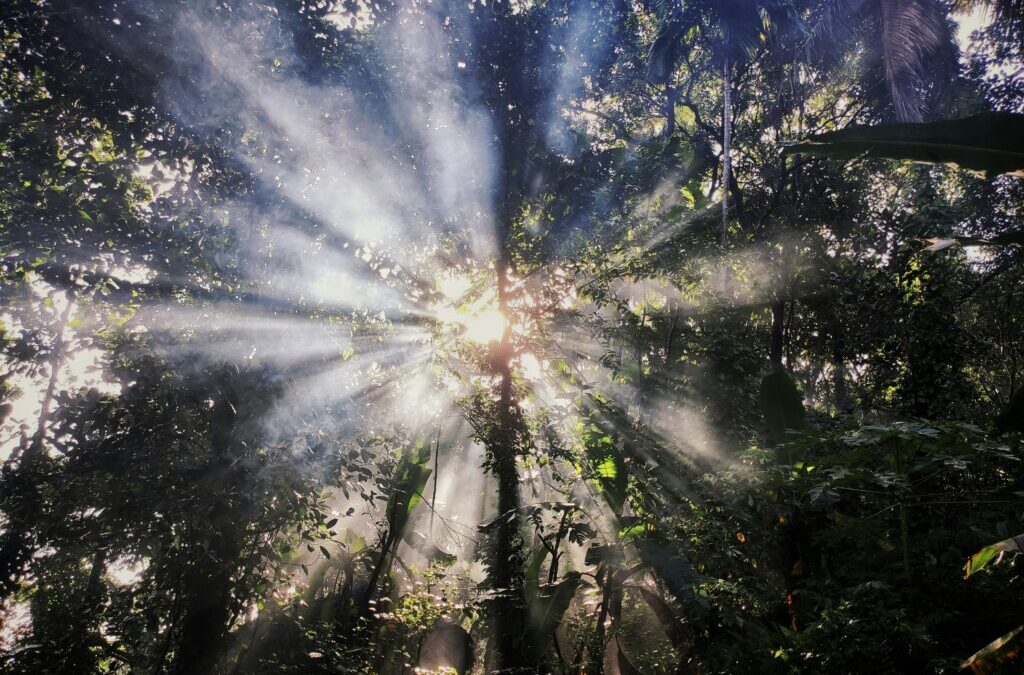
Our theme for the month of June is “spirits.”
As Christians, we are taught that there is an unseen spiritual world out there just beyond our vision; a world that has just as much influence over our lives as the sun does the temperature. And Christians are not the only ones with this worldview. Look into any religion and something about spirits will probably be an integral part of its system. Whether that’s the existence of a spiritual version of ourselves that inhabits our bodies or external spirits that can make or break your life, much of the world subscribes to this idea that what we see is not all that there is. In fact, the basis of Christianity rests on the existence of a God we cannot see.
Of course, there is a rather large quantity of anecdotal and personal evidence towards the existence of this spiritual world. In Christian circles, much of it is rooted in an emotional event, where people feel the presence of the spirit of God in their moments of desperate need, one that brings peace in the midst of pain. I cannot deny the existence of this phenomenon. I too have felt a presence of an inexplicable peace in the midst of turmoil when I call upon God’s name.
But I have doubted the core force behind that peace before. Have a conversation with any atheist, and they will tell you that they just cannot accept the existence of something with little to no empirical evidence. Offer them any anecdotal or even widely accepted evidence for spiritual influence and experience, and they’ll probably take you on a journey through deductive reasoning that will have you questioning whether everything is simply a result of chemical reactions in the brain. And I have to say, it’s rather convincing.
I’m going to get real here and say that, for much of my life, the spiritual elements of the Christian faith have always been the most difficult for me to fully embrace. No matter how many times I have felt something similar to the descriptions of a spiritual experience with God, I couldn’t help but wonder if what comforted me was simply a placebo; a reaction from the body that just wanted to let go and rest. Unfortunately, as a pastor’s kid turned missionary kid, I could never really express this doubt to anyone. The God we believe in—the one who created me, saved me, and still exists to guide me through life—is supposedly an unseen, intangible, three beings in one who exists beyond time and space but also within me? Comforts me? Influences my decisions? Yeah, I would never say this out loud.
The Concrete Operational stage of my life just couldn’t afford to think that hard about it. And the honest part of myself couldn’t say I fully believed in something I didn’t think hard about.
Even as I have grown and matured into the world of abstract thought, I still live mostly by logical and analytical processes. I think most people do. You don’t leave for your thirty-minute commute to work five minutes before you have to clock in because you feel like it’ll take you five minutes. You leave forty-five minutes early so you have time to find a good parking spot (because the parking sucks), fill up your water bottle at the fountain (there won’t be time later), and settle into your office for a few minutes before someone drops another project on your lap.
Funny enough, even as our minds finally begin to open up to abstract ideas and the possibility of things beyond our senses, the world has conditioned us to rely on what is known and understood. Risking too much on something intangible is simply too costly. A quick browse through the internet will show you that things rooted in emotion, such as love and friendship, have failed in delivering on their promises over and over again. Feelings are too risky. We’ve even found physical, chemical ways to alter feelings that may lead to disastrous consequences. The things we know, see, touch, experience in the physical realm on a daily basis—these are the things that we can rely on.
Yet, with no credit to reason or logic, I still choose to believe that the spirit of God is really out there and within me, serving as an active agent in the events of my life. I still choose to believe that my body isn’t all that there is to me. Isn’t this the basis of faith? Choosing to believe something we cannot see, touch, or experience in a tangible way and sticking with it?
I like to believe that God gave me a brain that likes logic because it intensifies the need to rely on faith. The choice to let go of my reliance on logic is the leap of faith that I think brings me more peace, joy, fulfillment, and love every day. If that isn’t a miracle, then I don’t know what is.

Priscilla Chang (’25) majored in English literature and minored in linguistics at Calvin. She now works as a missionary teacher in Thailand, teaching language arts at Chiang Rai International Christian School. Apart from her love of reading and writing, she is also obsessed with learning languages, dancing, and watching the latest Korean dramas.

