
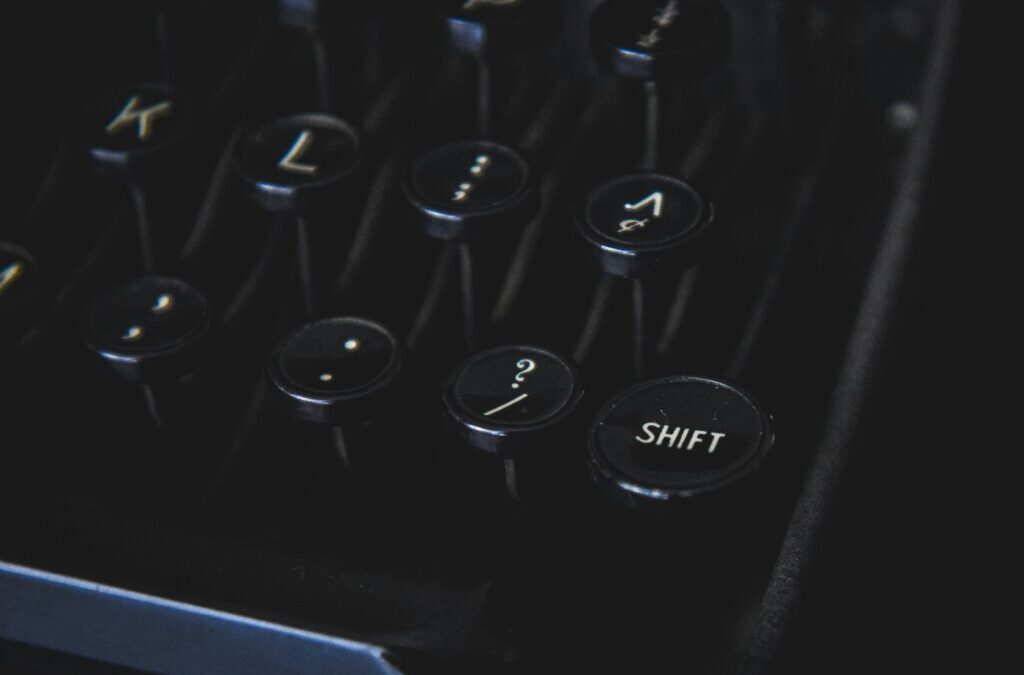
A year ago, if you had asked me what I thought of the semicolon, I would’ve said it was unnecessary. Good writers know how to explain complex ideas in simple words—no fancy punctuation required. My bias comes from seeing many well-crafted sentences sounding incredible and saying barely anything. I’ve read countless books containing fluff, and I can’t stand it. And in my mind, the semicolon is the epitome of this phenomenon: sounding smart when you don’t have anything substantial to say.
Now perhaps you are thinking, Michelle, didn’t you learn in English class the purpose of a semicolon?
Yes, I did. I watched a silly song and learned enough rules to pass the grammar tests. But I never dared to use them in my writing—not because I had a principled stance against them, but because I already struggled so much with grammar. My writing in school was often marked up for clunky wording and misplaced commas. As a result, I wasn’t focused on making pretty sentences; I was focused on avoiding mistakes. Short, choppy sentences became my default. Why add another punctuation mark when I was worried about getting the basics right? And habits stick. My default is still simple sentences, and for a long time, I didn’t believe changing would make me a better writer.
Then I saw a writing influencer complaining about how modern books suck because of their simple sentence structures, and I immediately rolled my eyes, dismissing her as an elitist. But what she said next stuck with me months later: she claimed that people don’t think in short and seemingly random spurts, but that stream-of-consciousness thinking is filled with qualifiers, tangents, and connection to other ideas. While I can’t claim to know how anyone else thinks, I can say that this resonated with me. I have big, overarching thoughts with many connecting, messy ideas—not scattered thoughts that eventually make up a big idea.
Recently, I started reading The Count of Monte Cristo, a well-known French classic, and I was shocked by how many semicolons there were. Alexandre Dumas must have had a phobia of periods because the sentences just would not end! I am aware that this is partly due to the conventions of the nineteenth century, but even compared to other writers from around this time, his excessive use of the semicolon stands out.
(For legal purposes I’m aware that I’m reading a translation from French and I know it’s not a one-to-one conversion.)
When reading, Dumas challenged my previous assumption that semicolons are used to sound smart. The Count of Monte Cristo is an accessible book—the language isn’t overly complicated, and there aren’t overly flowery descriptions of obscure details. But the semicolons serve a purpose: they allow him to include descriptions, reactions, and actions in a sentence without losing momentum, and because each detail is separated by punctuation, it remains distinct. As a reader, I felt as though I were reading complete thoughts, while the semicolons kept the ideas coherent and organized. Suffice it to say, I was impressed.
Simultaneously, I was writing a research paper for my class, and I had it in the back of my mind that the semicolon could be a useful tool. I naturally saw more places where the punctuation fit and knew I was experimenting with my writing—but when I was done, I looked back and was stunned. Semicolons were everywhere, and my sentences were longer and more dense than I was used to. While I’ve always heard that our writing is a product of what we read, seeing it happen in real time was fascinating.
While I was aware that my writing sounded more intelligent, I took a step back and asked a more interesting question: was my writing actually improving? I’m clearly biased, but I think yes.
For example, take a look at this sentence.
“These disparities are not incidental; research is consistent in showing that socioeconomic status and literacy are linked; kids in poverty score 20-35 points lower than those in middle-class homes, and 75% of U.S. homeless children were below grade level.”
This sentence is packing a lot—a claim, an explanation backed up by research, and two pieces of evidence—and the semicolon is able to keep the ideas separate and connected. It’s a full, complete thought, and unlike other pieces of writing, I didn’t finish it and think, “How do I add this connecting piece?” In addition, the semicolons were doing enough heavy lifting that I didn’t need transitions, and that’s always been a weakness in my writing.
Now, I did look back at my paper and wonder if I really needed that many semicolons, and honestly, I don’t think I did; I got overexcited. But they did help keep my writing organized.
So I admit it.
My English teacher wasn’t just serving me propaganda; semicolons are cool.

Michelle Ferdinands (’22) graduated from Calvin University with degrees in mathematics and computer science. She lives in Kansas City and works as a software engineer. She loves to run and read, and she’s always up for an adventure.


Me: I wish there was a way to connect two sentences that don’t necessarily flow together, but present ideas I want to present together.
The indispensable semicolon: ;