
Imagine with me the ideal agora, or public square.
Everyone is milling about, and some are shouting at the masses, trying to get their ideas heard. Of the shouters, some have only their voice, raised with confidence. Others brought a box to stand on or a megaphone to yell through. But, the authorities are patrolling, limiting the height of the box or the volume of the megaphone. They do not silence any voices. They just cap the disparity between the quiet and the loud.
Now imagine that one day the authorities disappear, and vendors roll up selling microphones and megaspeakers that promise to reach every corner of the agora. The price is steep, but the tool is there. In short order there are a select few that are heard above all. From opposing corners of the square, ideas are shouted at each other. As a result, those that cannot buy a megaphone are drowned out of the conversation.
Which of these is preferable? Which of these is a greater risk to the public good?
Right now our public square more closely aligns with the latter, and it is certainly not doing us much good. In 2010 the Supreme Court ruled in Citizens United v. FEC that banning certain entities’ donations to political campaigns was a violation of the first amendment.
They overturned a 1907 bill that had initially banned donations from corporations and national banks. These entities were now treated as individuals for the sake of spending. This, in combination with a series of small changes over the past century, ushered in a new era. The super Political Action Committee (PAC) was born.
Super PACs are political advocacy organizations that accept huge sums of money and are allowed to spend that money to indirectly support candidates. The Future Forward PAC spent $559,289,966 on the Harris campaign in 2023/24. MAGA Inc. and America PAC spent $376,948,611 and $171,961,130 on the Trump campaign during the same time frame.1
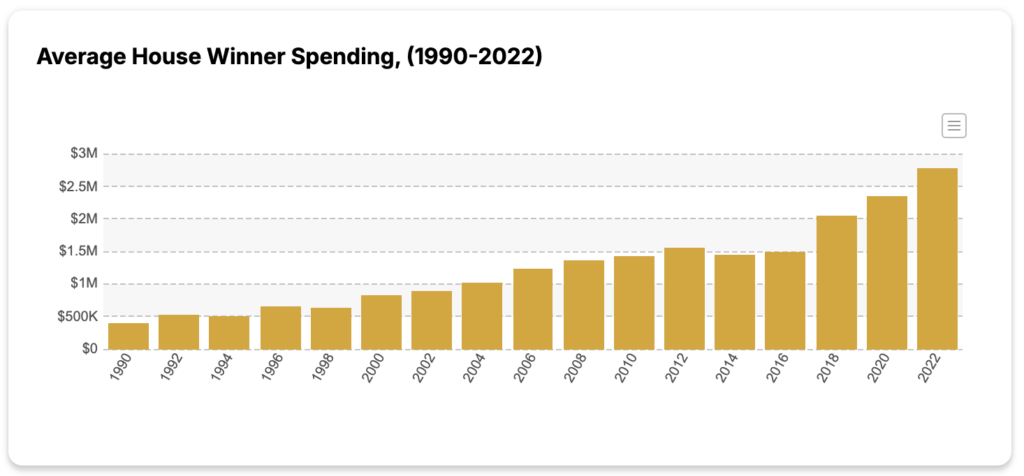
They spend most of their money on attack ads against the opponent, while only pitching their preferred candidates as the alternative to something worse. It sows division with sleight of hand, obscuring what it really is, which is the preference of those who can afford to donate extraordinary sums of money to politics. And it works. The average winner in both the House and Senate spends twice as much on their campaign as the average loser. The rich can buy seats in congress.
The senate controls the government’s purse, and when government spending can be controlled so easily by private interests, what’s stopping those in power from siphoning money from the poorest and padding already stocked coffers? Just ask the BBB passed last July, which so obviously weaponizes bureaucracy to justify neglecting those who otherwise could not care for themselves.
As a young twenty-something, it’s wild to see such blatant corruption that seems to defy the standard narrative about political division that I come across that implies everything is blue vs. red. This to me points to something a close friend said recently, which is that “our real struggle is not across the aisle, it’s the top vs the bottom,” which follows from the idea that our legislature is for sale.
This problem isn’t new with the 2010 rulings, but it exacerbated a problem we already faced. It’s made things easier to manipulate from the top and harder to fight back against from the bottom. It feels pretty grim.
When it comes down to it, I always ask myself, “So what can I even do?”
This always seems to be the answer, but I can vote accordingly. So, I urge you, as we head into primary elections, please spend the extra effort to try and figure out who is funding your favorite candidates.
And, if you think the super PACs have your best interest at heart and want to vote for who they’re endorsing, then by all means, let’s see how the election goes. We’re a democracy, and the ultra rich should have a say in how our country is run, but their voice shouldn’t be so disproportionately influential that it drowns out opposing ideas.
Be informed.
Advocate accordingly.
Show up to the primaries and be the annoying friend trying to (tastefully) convince people that your favorite candidate is actually the best .
Add to the chaos of the agora, because without all of our voices, those on the margins will continue to be squeezed out.
1All election spending data found on Open Secrets

Clint Wilson (‘23) graduated from Calvin with an official degree in philosophy and unofficial degree in outdoor rec. They currently live in Denver and are working remotely for an LSAT prep company. You’ll likely find them slowly jogging a trail, belaying their wife up some rocks, or reading beneath a heap of blankets.

