
Please welcome today’s guest poster, Samuel Fynewever. Sam(u) (he/him) graduated Calvin in 2024 with majors in mathematics and Spanish, and currently lives in Minneapolis, MN. He currently works as a pianist at United Church of God in Christ and as a Teaching Assistant at University of Minnesota, Twin Cities, while earning an MA in music theory. Besides teaching, musicking and presenting ideas about Gospel vocal harmony at conferences, he enjoys spending time with family, roommates, and in the outdoors. His family cat, Rasmika, brims with newfound affection these sunshiny days; she helps him remember that unconditional love is the best kind of emotion.
Content warning: brief mentions of depression and suicide. If you or anyone you know are struggling, there is help. Call or text the Suicide & Crisis Lifeline at 988.
The grief of early 2020 only hit me in earnest after my second Calvin semester, Spring 2020, which came to a screeching halt as scheduled in May. I emerged from two months of online school exhausted, yet relieved that my usual coursework had continued, more or less uninterrupted. Even over Microsoft Teams calls, I could count on back-to-back hours of intriguing academic adventures. I could count on mornings spent meticulously splashing chromatic colors on dusty centuries-old Euro-Western rules about chords. I could count on middays spent crafting proofs for dancing through Escheresque hyperbolic geometry. I could count on afternoons spent contemplating multifarious relationships between Spanish language, Hispanic culture, and the U.S., which lives somewhere between gringo Anglophone oppressive empire and exquisitely beautiful multicultural salad-bowl home. Most of all, I could count on keeping busy, relishing the freedom that school’s structure paradoxically guaranteed. Namely, I could count on doing things I loved, confident it mattered, while school endured. When I ran out of school, I crashed into grief.
But no, I misremember: trading schoolwork for late-teenage gigs, warehouse-shelving and lifeguarding, provided continued occupation and connection. Jobs ensured ample things to do, people to see. No, somehow, neither the end of the world nor the end of school brought me to the edge of depression. The end of responsibility, when summer jobs were done with me—that brought me to the edge of depression.
Again, paradox: going camping with my family in August 2020, a privilege and respite from the world’s woes, dragged grief to front-of-mind. I could no longer avoid thinking about loss, and it came in waves.
Our dorm floor’s premature scattering. My floormate’s suicide. My suitemate’s dropping out. My roommate’s painstaking gradual distancing. My breakup with a controlling partner (though overdue and quite healthy long-term, still a loss).
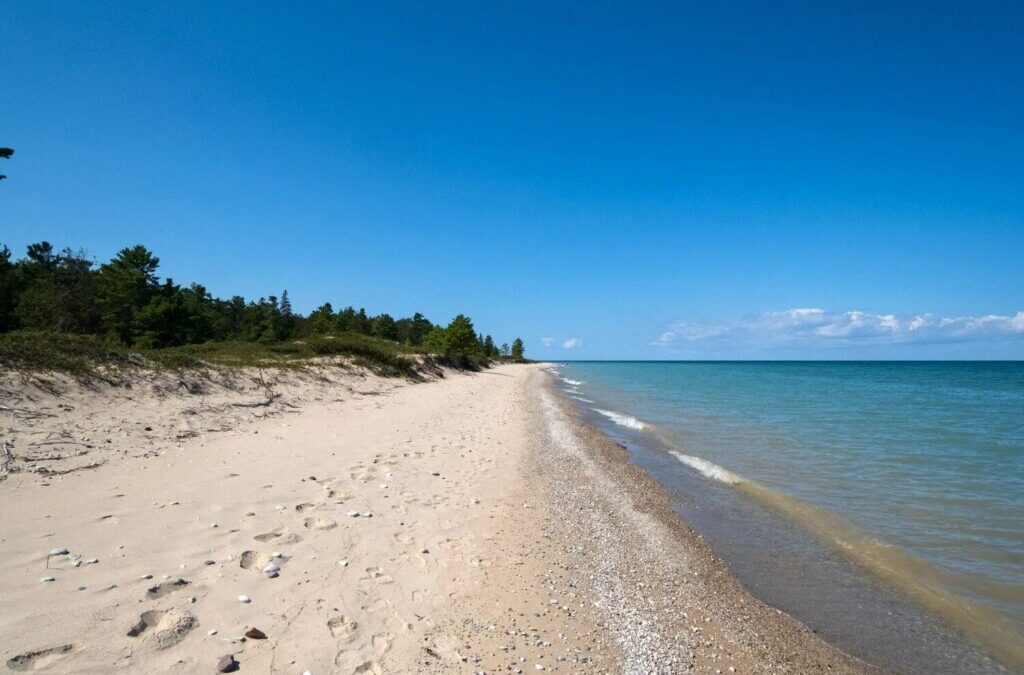
Distractions evaporated while camping. I’ve never really taken up scrolling, and my whole family successfully endeavored to avoid screens altogether. I would read, but had somehow lost sight of the spark immersive fiction once offered. I bore only my own small share of the easy work to sustain camping living (chopping vegetables, hand-washing plates, rigging hammocks, building campfires). I took in Lake Michigan’s majesty as an old friend, but somehow found little comfort in the unending water. Summer, usually ablaze with joy, had at last exposed my deep-blue grief.
The four years following involved similar cycles—invigorating work, fulfilling academic adventure, mild exhaustion, ample connection, frenzied move-ins and move-outs… and grieving isolation in the summertime. Would-be friends from my new, cliquey, dorm found new places to live (without me) after sophomore year. Yet, they were truly my friends at one point, no? (Were they just friendly to me because I happened to live nearby? Did they often invite me to join them for dinner only since I [strategically] sat in the lobby as dinnertime approached?) And interim’s long, slow death spawned complementary wintery weekslong stretches of minimal responsibility.
Regardless, I found sustained, deep peace and joy at Koinonia House in following years. (You can read more about Koinonia, now in its last days, here and here.) Still, only mentors lived there during the summer, and as I stretched my Calvin career into something resembling a sixth year, my dear housemates seemed perhaps half a life-stage removed from mine.
I enjoyed a measure of sunshine lasting that whole sixth/gap year: friends my age in a Bible study that stuck together, meeting weekly. We shared three simple acts: naming highs, lows and buffalos, i.e. moments of randomness or hilarity; deeply nuanced, open-minded discussion of Scripture; and a round of prayer requests. This liturgy cultivated warmth that had once seemed irrecuperable, a depth of connection that friend-group-fragmentation across high school and college had threatened to place out of reach.
I’m only one academic year removed from my Calvin circles, and my upcoming first summer away from Grand Rapids inspires equal parts trepidation and hope. The people of Minneapolis, where I teach and learn music theory, have assembled such power through collective song, organized as Singing Resistance, staring death-by-authoritarianism in the face, refusing to blink, voices not missing a beat. (They’ve inspired a national movement which has reached Grand Rapids. Chances are, you can join the fun!) Weekly rhythms of protest and poetry reading and Gospel singing will continue uninterrupted.
So, as my family now embarks towards Zion National Park, I feel less anxiety than gratitude. Despite the unpredictability and apropos lament paramount to being young in 2026, I am grateful for the chance to exhale. To drink in intoxicating blue sky and red-orange rock. To unplug. To welcome grief and all our emotions with unhurried honesty. To receive anything God may have for us amid slowness, palms open.
I hope many of us get a chance to do the same this season.


