
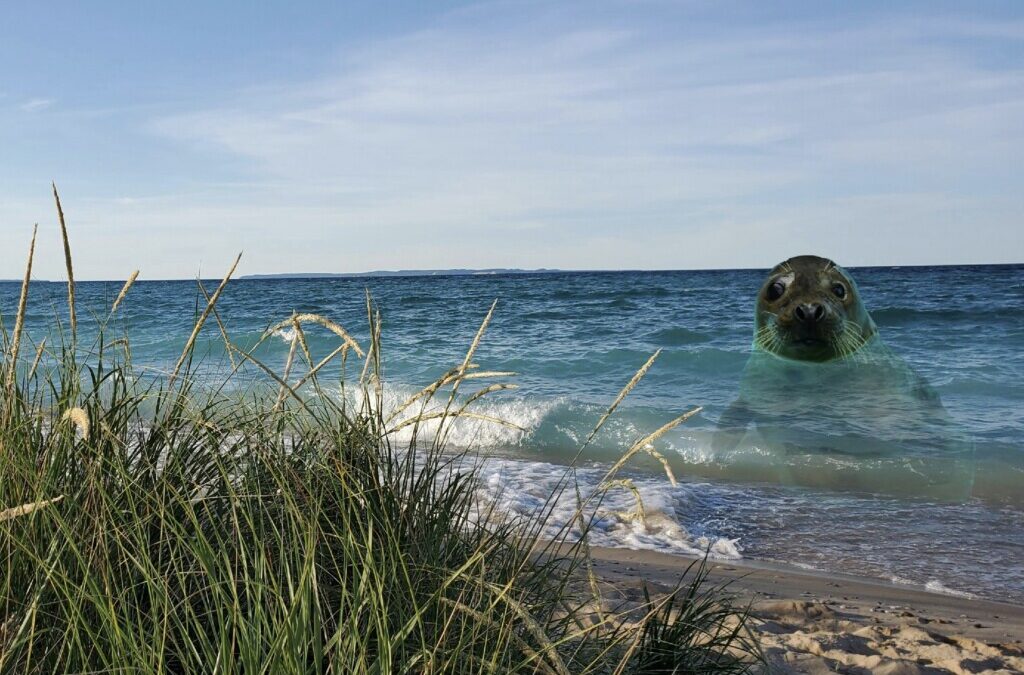
Hello, and thank you for being here. Today we will be talking about the Great Lakes and what we can do to make them Greater. There is much work that needs to be done. Adjustments to our ways of life, large restoration projects, and climate resiliency actions are all important. But I believe there is a more important move. A radical move. Something that will elevate the Great Lakes to the Greatest Lakes.
We need to *cue powerpoint* introduce freshwater seals.
We’ve airdropped Canadian wolves into Michigan before, so I think seals are the next logical step. Surprisingly, there are a few options when it comes to freshwater seals for introduction. A handful of large freshwater lakes across the world support seal populations. These lakes are typically large and close to the ocean.
Iliamna Lake is the largest lake in Alaska and the only lake in the United States with seals. A small population, currently estimated at 400, of Pacific Harbor seals was first noted in the early 1800s. These seals survive off of salmon and other fish, and use the small, isolated islands as a safe location to give birth. The Northern Quebec lakes of Lacs Des Loups Marins, Petit Lacs Des Loups Marins, and Lac Bourdel also have an endemic population of Ungava seals, an endangered subspecies of Harbor seal.
In Eurasia, ringed seals are the name of the game. Lake Lagoda of Russia and Saimaa of Finland both contain ringed seal populations. Both lakes are less than one hundred miles from the Baltic Sea, which is nothing compared to Lake Baikal. Approximately one thousand miles from the Pacific Ocean, Lake Baikal plays host to the aptly named Baikal seal. Diverging from their closest relative the ringed seal two million years ago, no one is certain how these seals arrived so far inland. Lake Baikal is both the largest lake by volume and the deepest lake in the world, and it unsurprisingly supports the most robust freshwater seal population in the world. Baikal seal numbers are estimated at up to ten thousand strong.
Now which seals to choose? I believe any of the options will suffice. When it comes to seals, the more the merrier. I believe we could receive federal funding to support introduction efforts. What politician is going to say no? National and State Fish Hatcheries could begin seal pup raising programs along with their fish efforts.
Seals will thrive in the Great Lakes, especially the rugged coastlines of Lake Superior and northern Michigan and Huron. (We’ll ignore Erie for now.) The many remote islands and rocky shorelines of the Great Lakes will be perfect nurseries for seals to raise their pups. Salmon and trout species are perfect prey for seals, and they may even help curtail the alewife population. All we have to do is convince them to eat zebra and quagga mussels and we’re golden.
Let’s do a quick pro and cons list for seal introduction:
Pros
- Seals are really cute
- Seal watching tourism boom
Cons
- Potentially collapse the entire Great Lakes food web
As you can see here, the pros clearly outweigh the cons. Imagine hopping on a ferry in Leeland on a cold and foggy morning and heading out to the Manitou islands with your binoculars to look for baby seals resting on the beaches. After scanning the shore for what feels like hours you finally spot a few dark shapes in the sand. Thrilling. Returning to Leeland, you buy a Tshirt and a plush seal for the kids. This is what the Great Lakes are missing.
Thank you for listening. I will not be taking questions at this time.
Tune in next week for “Orcas: Can they Survive in Freshwater? Let’s find out!”

Nathan Hilbrands (’21) graduated with degrees in geography and environmental health and conservation. He is currently working for the Allegan Conservation District as a watershed technician. He enjoys collecting National Geographic issues that he rarely looks at again, playing disc golf a lot without improving, and trying new board games.

