
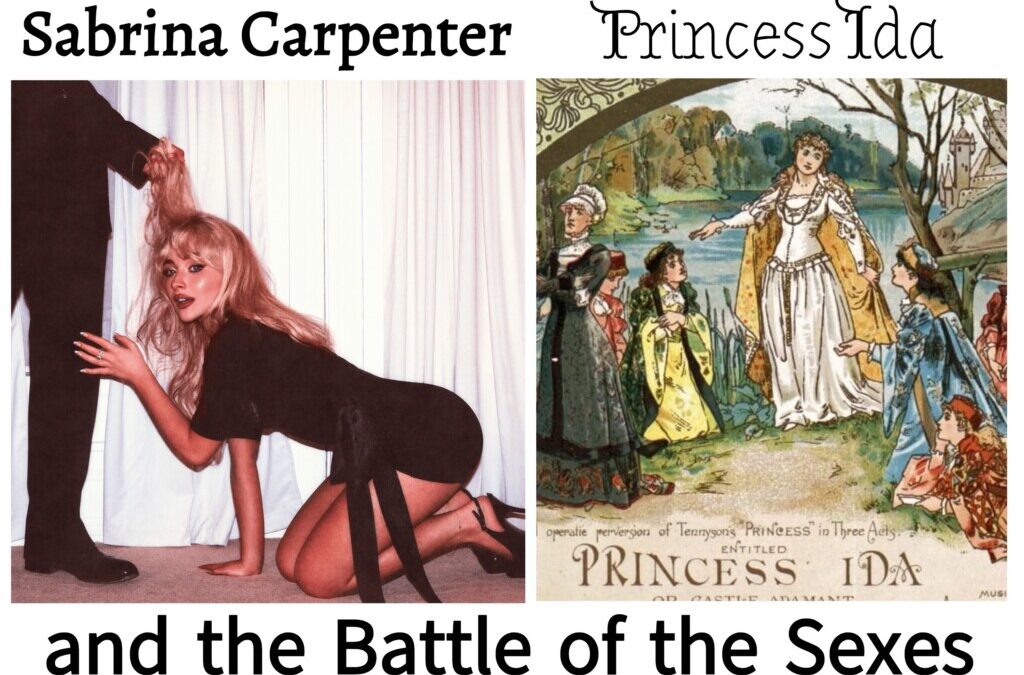
As someone whose Spotify age is usually double my real one and whose top genre is usually Goth or Cabaret, it was a little jarring to realize I’d fallen down the rabbit hole of Sabrina Carpenter. She is truly one of the most pop stars to ever pop. I can’t lie though—she’s got some good songs! On top of that, she really has an eye for stage craft that makes her performances more than just a girl with a mic. She’s a five foot bundle of charm, talent, and perfectly crafted aesthetics.
There is, however, something about her work that I can’t seem to click into and that’s the subject matter. Every song winds up in some way being about a relationship with a man that usually doesn’t go well. This isn’t a crime, of course. She’s a song writer writing about the things in her life and as a straight woman it makes sense that’s what she would draw from. But it’s also a bit draining, if I’m being honest. How many songs can we write about how much we hate and/or love boys?
A term I’ve seen come up is heteropessimism, which is a performative hatred a straight person will express about their identity. It’s the “I hate that I’m attracted to men” attitude that some straight girls will have that I think is meant to seem self aware but to me comes across as relishing in misery if I’m being honest. It’s this constant complaint of “there are no good men anymore” while still actively chasing after men. Sabrina Carpenter does this all the time, making little comments in her songs about “since the Lord forgot my gay awakenin’” she’ll just be “bitchin’ and moanin’” about the men in her life who romantically fail her.
A joke among the queer community is “are the straights okay?” and the answer has really always been “no, not at all.”
There is some tongue-in-cheek to Sabrina Carpenter in this, like in her song Manchild where she sings lines like “Manchild/Why you always come a’runnin to me?” “Won’t you let an innocent woman be?” and “I swear they chose me, I’m not choosing them,” alongside lines like “I like my boys playing hard to get/and I like my men all incompetent.” She wouldn’t be in these kinds of situations if she wasn’t also actively pursuing them. It’s meant to seem like she’s in on the joke—and to a degree I think she is—but honestly it still leaves me feeling a bit haunted. This amount of rise and fall, chasing and running just sounds exhausting and worrying. If you’re truly this upset about this situation you keep finding yourself in, why don’t you do something about it? It’s starting to seem like the cycle is the point: the performance of Man and Woman falling in and out of love.
I was listening to almost exclusively Sabrina Carpenter for about a month—and then I went out to the theatre with a friend and we saw a marvelous performance by the West Michigan Savoyards: Gilbert and Sullivan’s Princess Ida. It’s an operetta about a princess who starts a women’s university. The prince to whom she was betrothed when she was a literal baby decides (under his father the king’s orders) to go to her to convince her to leave the university and be his bride. He and his companions dress up as women to sneak in and shenanigans ensue. It’s a delightful show with great music and was brilliantly performed by the Savoyards. But it left me feeling similarly rankled with the way it played with ideas of gender.
Princess Ida originally opened in 1884 and was playing to a Victorian British crowd who had distinct ideas about the roles of women in a society. The happy ending here is Princess Ida leaves the university that she started in the hands of a woman who’s comically strict in order to go marry the man she doesn’t know on the order of a king who threatened to kill her father and brothers. That’s the good ending. That reads like a horror story to me. The one leg they give me to stand on is they do say if she hates married life, she can return to the university. However given how king Hildebrand reacted to this whole situation (what with the imprisoning of her brothers and father and the promises to hang them) I’m not so sure that guy would be normal about divorce—not to mention what Prince “I’ve known you for ten minutes but would ‘Rather perish by thy hand/Than live without thy love’” would do.
There’s other things too: the way the idea of a woman’s university is treated, the way the women are shown to be absolute cowards in the face of any kind of danger, the way truly creeper behavior is played for laughs, the dismissal of why any woman wouldn’t want to be with a man. It all infuriates me a bit. I know it’s a comedic show and shouldn’t be taken seriously as anyone’s real beliefs of how a relationship should look, but there’s some real ideology baked into the groundwork here—the same way there is with Sabrina Carpenter’s work: they are both deeply hinged on this framework that is Gender.
Which as someone outside of the gender binary, it’s very weird watching so much fuss over this really silly idea! For literal centuries humanity keeps playing into this “inherent divide,” this “boys are from Mars, women are from Venus” mentality that feels maddening to behold. It gets used to justify sexist systems that perpetuate themselves and we refuse to fully shake. Instead, the modern take seems to be to pair it with the “self aware” glaze of heteropessimism, saying “Oh man, I can’t believe I’m attracted to THAT” that waves away any need to question the systems statements like those are built on.
In ‘the battle of the sexes’ the question seems to be “Who is better: Men or Women?” and the question I keep feeling like I need to scream is “Why do you keep wanting to find reasons to be better than someone else?!”
What is actually that different between ‘man’ and ‘woman’? Some superficial features that can be changed with the right hormones? A few parts which in a pinch can be swapped? At the end of the day the main differences are how we as people have decided to treat one label versus the other. These are categories built by us and we’re the ones who keep insisting there’s inherent meaning in them.
And let me just say: the scales of these categories are not even. Men have systematically oppressed women for a long, long time. The fight for equal recognition and rights should never be placed on the same level as the active oppression from the patriarchy. I’m not saying that no one should ever use gendered language or ideas again, just that our society’s reliance on gender as a means to divide people into categories helps no one. Not me, not you, Not Sabrina Carpenter, and certainly not Princess Ida.
Of course, I can’t expect Gender Liberation from Sabrina Carpenter or from an 1800’s operetta written by two men. And none of this stops me from listening to the fun art they made. It also doesn’t stop me from wanting more. I want more than just “bitchin and moanin’” about manchildren, and I want more than a good ending of happy heterosexual marriage. I want a world that doesn’t hang its hat on gender. I want a world that doesn’t make determinations on people based on arbitrary labels. Maybe one day we’ll get there.
In the meantime, I’m going to continue confusing my music algorithm and singing along to both pop and opera at the top of my lungs in my car—an activity that can be done by any and regardless of gender.

Sam is unsure what exact words describe them best: Lunatic has been used, Gothic Romantic is apt, and Big ol’ Nerd is reductive but true. Mostly they just like stories in whatever form stories can be found. Sam specializes in Frankenstein, running “The Uncanny Productions” on YouTube, but they also dabble with podcasts, singing, and theatre as well. They have a DVD collection that’s long outgrown its shelf, a coffin they use as a desk, and an unrelenting joy for things that are spooky, ridiculous, or magical.


Savoyard here! I’m too old to have any valid opinion on Sabrina Carpenter (was King Gama in Ida this year) , soo… First, thanks for coming to our show! Second – 100% re the underpinnings of Ida. We actually had discussions about this. One of the most loved an yet currently reviled shows in the G&S lineup in “The Mikado,” which is set in a Japan whose culture is entirely a fiction of the author of the play. It is generally considered racist by US audiences and critics today, and when performed requires substantial revision to change the setting to make it clear it is our OWN culture we are poking fun at.
While discussing our own options for a re-write of Mikado, we also talked about how Princess Ida is trapped in sexist troupes, and is it not as bad or worse? And we agreed that it was, but in the time we had we did not feel we had the ability to re-write, given we are a small group and were already exploring avenues for a Mikado re-write for next year…
Sir Arthur Sullivan was the composer of all these works, responsible for the music but not the words. Our group performs these in hope of getting this music to reach new generations, because the music itself is excellent. The Savoy Theatre, from which the group gets its name, was the first “modern” theatre with things like electric lights. G&S operettas are, in a way, the ancestors to the modern Broadway musical, and that is a history worth preserving. That said, we have to acknowledge that society has evolved beyond the simplistic man/woman dynamic in most of these works. The same can be said for some early Broadway shows 🙂
W.S. Gilbert, the author of these shows, was not a nice or good man. Has to be acknowledged. Much that is problematic in any of these works can be laid at his feet. About the best thing that can be said about him was that he was not afraid to tweak the noses of powerful people in a very public way, poking fun at them subtly, but as often with a VERY sharp point. Speaking truth to power can be very difficult, as we see in our own time.
Forgetting the works themselves for a moment, we attempt to be an inclusive home for all. We have members of many races, ethnicities, sexual orientation and gender preference, including some with none. As an audience member, I hope our group in no way made you feel excluded. If we did, tell us how, we’ll strive to improve. We love when we find new audience, and want them to feel as welcome as anyone in our cast. And we welcome articles like this, it helps us with feedback
we can take on board for the next time we put on a show 🙂
Oh my friend!!! I hope my analysis doesn’t make you think I had a bad time with the show–I ADORED the show! You guy were absolutely phenomenal!! I was honking with laughter. I’m not kidding that I went from listening to exclusively Sabrina Carpenter to exclusively listening to the 2016 Princess Ida official cast album. Yall got me hooked. Your troop did an amazing job and I had such a very good time. A thing I didn’t get into because I ran out of word count and time was talking about gender as a performance and how having trans people in the cast does inherently challenge some of the stated ideas in the text in a way that’s so simple but very very fun. I’m no stranger to loving old shows that have problems baked in. I’m glad you guys did discuss those ideas and I’m glad you put on the show you did. It was a great performance and I hope you’re all very proud of the work you did