
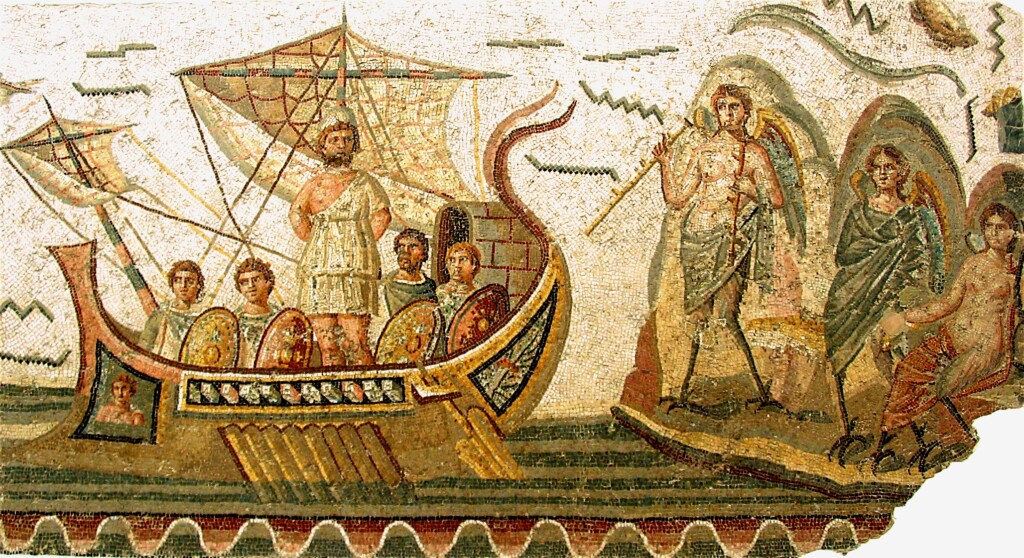
Christopher Nolan’s adaptation of The Odyssey is a film that pretty much everyone in a lit/film crit-adjacent role has felt the need to review. Most notably, scholar and translator Emily Wilson published a scathing write-up, titled “An Uncomplicated Man,” in the London Review of Books.
I went into the movie having read only the headlines of these reviews but with a solid baseline knowledge of Homer. In high school, I read both the Odyssey and the Iliad (Robert Fagle’s translation, if I remember right), as well as their much-later Latin counterpart, Virgil’s Aeneid.
I came out of the movie knowing I needed to read some reviews, and also to reread the poem, because the movie was inconsistent both with what I remembered of the poem and with itself.
And although I have nowhere near the credentials of Wilson, I too feel the need to contribute.
Some of my gripes are more general. The film falls victim to the so-called grimdark aesthetic, in contrast to Homer’s colorful world of feasts and fine fabrics. The celebrity cast is distracting. The dialogue is awkward and boring. An invented subplot involving a soldier named Sinon adds little to the story.
Also, why is there no sex? To my fourteen-year-old self, the poem was shockingly racy, and though my more recent reread of Samuel Butler’s translation did not quite live up to this recollection, it’s still a fairly sexy book.
But my main complaint is the film’s lack of thematic cohesion.
The film is centered around the idea of xenia, or Zeus’s law, which requires people to be hospitable to guests, partly on the basis that they might be entertaining gods unaware. (The poem, I would argue, is more focused on getting home, but the theme of hospitality is also key.)
Odysseus, played by Matt Damon, has violated xenia by tricking the Trojans with his horse, and he must risk violating it again in order to kick out the suitors who have, in his absence, taken to feasting in his house. These violations—along with similar violations by other Greek leaders—are leading to a breakdown in Greek social order.
In theory, this is a great narrative theme, even if it’s a little bit of a departure from Homer, but the movie itself doesn’t really sell the idea of xenia being some all-important value in Odysseus’s world.
For a movie ostensibly about the importance of hospitality, we see very little of it. Princess Nausicaa and her parents, the consummate hosts who aid Odysseus on the final leg of his journey, are absent from Nolan’s film.
Meanwhile, Odysseus’s bad hosts—Polyphemous, Circe, Calypso—have all been altered in ways that don’t really reinforce Nolan’s theme of hospitality.
Perhaps the epic’s most famous scene is that involving the cyclops Polyphemus. While looking for provisions early in their return voyage, Odysseus and his men stumble upon Polyphemus’s cave, full of cheese the cyclops makes from his sheeps’ milk. Polyphemus holds them captive, but the men manage to blind him, and escape through the wiles of Odysseus.
In Homer’s version, Polyphemus occupies a level of humanness similar to that of Tolkien’s Gollum. He and Odysseus exchange words, in which Polyphemus reveals that he does not care about the law of the gods, and Odysseus gives his famous “No-man” pseudonym.
Despite this sentience, Polyphemus eats several of Odysseus’s men, washing them down with sheeps’ milk and wine. He later vomits this meal up, regurgitating the remains of Odysseus’s fallen men in front of the survivors—an image burned indelibly on the mind of my fourteen-year-old self. (When I mentioned this scene, among others, to my mother, she was scandalized that my Christian high school had assigned this book.)
Nolan’s Polyphemus, on the other hand, is a brute who interacts little with his captives except to eat them. It seems implausible that he is capable of making cheese or keeping sheep, even as the film depicts him with his flock and dairy products.
This change in characterization undermines Nolan’s theme of hospitality. If Polyphemus is just a glorified, land-dwelling version of the shark from Jaws, he hasn’t failed his responsibilities as a host by eating Odysseus’s men. He’s just hungry. Odysseus, moreover, hasn’t violated any responsibilities as a guest, since he’s not one. He’s just a guy who killed a monster.
Circe has also been transformed. In the poem, she is a lovely trickster enchantress, who, seemingly the perfect host, takes Odysseus’s men into her beautiful house and feeds them a nice meal of cheese, honey, and porridge. Then, acting apparently for her own entertainment, she turns them into pigs.
In the movie, she’s more the kind of witch you might expect to get burned at the stake in 16th-century Scotland. Portrayed by Samantha Morton, she lives alone in a hovel with her crow, and she feeds Odysseus’s men a weird slop that’s implied to have been made from previous visitors whom she has turned into animals. She’s also frightened of Odysseus and his men, and for good reason: she fears sexual violence.
(Morton brings the character to life wonderfully well; as with much of the film, the problem lies not with the actors, but with choices made by Nolan as a director and screenwriter.)
While Circe’s fear could be a commentary on the reality of war and warriors, why make it here? There’s plenty of women in Trojan War-related myths who do face sexual violence. Cassandra and Andromache, both of whom have thematic relevance to Nolan’s Odyssey, come to mind.
Shortly after his encounter with Circe, there’s a scene where Odysseus talks to the shades of the dead. In the movie, the ghosts—mostly his own men, all male—are angry with him for his dealings in war, and they chase him back to his boat.
This is already a departure from the poem, where Odysseus gets advice from his mother and the seer Tiresias, both of whom are mostly just sad. Why not go a little further and have the vengeful spirits be those of the Trojan women? I personally would love to see Cassandra eviscerate Odysseus over how his confederates treated her in the temple of Athena.
It would also lend weight to Nolan’s assertion that Odysseus has violated xenia in his treatment of the Trojans. The moral disquiet of war is best explored through its victims.
Homer does this—not with Cassandra specifically, and more so in the Iliad than the Odyssey. His Trojans are fleshed-out human beings, and in the case of some (such as Andromache’s husband Hector), morally superior to their Greek counterparts.
The closest Nolan’s film comes to this is in its portrayal of Helen, played by Lupita Nyong’o. Unlike in the source material, where Helen is submissive and penitent, the film’s Helen is full of barely restrained rage—mostly at the treatment of her sister Clymnestra.
Unlike some of Nolan’s other changes, I thought this one added to the film. It makes sense that Helen wouldn’t be thrilled to be home, especially given the family dynamics in the house of Atreus. And Nyong’o is an excellent Helen. Her austere beauty befits a half-divine queen, and she does a great job conveying the gravity of Helen’s situation.
However, Nolan doesn’t go far enough. By making the focus of Helen’s rage Clymnestra, Nolan gives up an opportunity to explore how Helen views the destruction of Troy and its people. Helen probably feels some emotions on this subject. After all, she lived there for over a decade.
Instead, Nolan keeps the lens on an intrafamilial conflict in which Odysseus is mostly a bystander. As a result, the theme of xenia and guilt continues on the “tell-don’t-show” approach.
Meanwhile, Circe making this point about sexual violence is just kind of distracting. Why should we blame her for tricking Odysseus’s men if they’re such a threat? (Also, with how nasty that stew looks, why are they scarfing it down?)
Calypso, too, has been altered from the book. These alterations don’t pose thematic problems, per se, but they also don’t improve the source material. Poem-Calypso’s motives for keeping Odysseus, there oriented times four, are pretty straightforward: she wants him for her personal boytoy. If the gods can do it, why not a goddess?
In the movie, Odysseus is more of an amnesia patient, and Calypso’s reasons for holding onto him are unclear. Their frankly boring scenes together just clog up the plot.
And then there’s the ending. Movie-Odysseus is concerned about the ethical implications of killing the suitors in a way that Poem-Odysseus is not. In theory, this could be an interesting moral question. Unfortunately, the suitors are such awful people that it’s hard to see this as a pressing question. Sure, there’s xenia, but Antinous (a thoroughly slimy Robert Pattinson) and his buddies seem to have torn that to shreds already.
Once the suitors are gone, here’s where the movie should have had a dramatic sex scene. Canonically this is what happens. Penelope and Odysseus are finally alone, they’ve got twenty years of pent-up feelings…I’m not usually one for movie sex—the sound effects are annoying—but this is an exception.
But wait…now Odysseus and Penelope are sailing off into the sunset? To be sure, Homer’s poem also has some lines about sailing west to honor the dead, but to have him leave immediately undermines the whole point of the movie. This man has spent twenty years trying to get home. Let him have time to make love to his wife, visit his ailing father, etc.
Yes, there’s xenia. But Nolan’s movie hasn’t really convinced me that Odysseus did anything exceptionally wrong by the standards of his world. Odysseus may have violated xenia, but that value seems to matter to very few outside his own household.
Thus, it doesn’t make sense that Odysseus needs to redeem himself. Why can’t he just sacrifice a few sheep and call it a day? And then, of course, sleep with his wife.

After graduating from Calvin in May 2025 with a degree in writing and Spanish, G. E. Buller decided to stay in Grand Rapids. Currently, she is working as a special education aide. Her non-writing hobbies include fussing over her aquarium and reading about medieval/early modern nuns.

