
For me, America’s 250th birthday felt like running into an ex at the grocery store.
I tried to avoid it, plunging into escapism by reading my favorite book of the year so far—The Everlasting by Alix E. Harrow—and anticipating the release of The Odyssey movie. This strategy proved ineffective.
Two decades ago, I was a weird little kid obsessed with the American Revolution.
My infatuation might have begun with the American Girl doll, Felicity, or with the animated PBS kids show Liberty’s Kids, or with a book I repeatedly checked out from my local library about women who fought, schemed, and spied for the revolution. The book detailed the story of a young woman who, when caught, ate the paper on which a secret message was written. I chewed on a scrap of paper to see if I could do the same if necessary.
I was delighted to learn that the Adamses I was related to, who passed their name all the way to my maternal grandmother, were those Adamses—Adams like Abigail Adams, the writer, the mother, the elegant thinker, the eloquent correspondent.
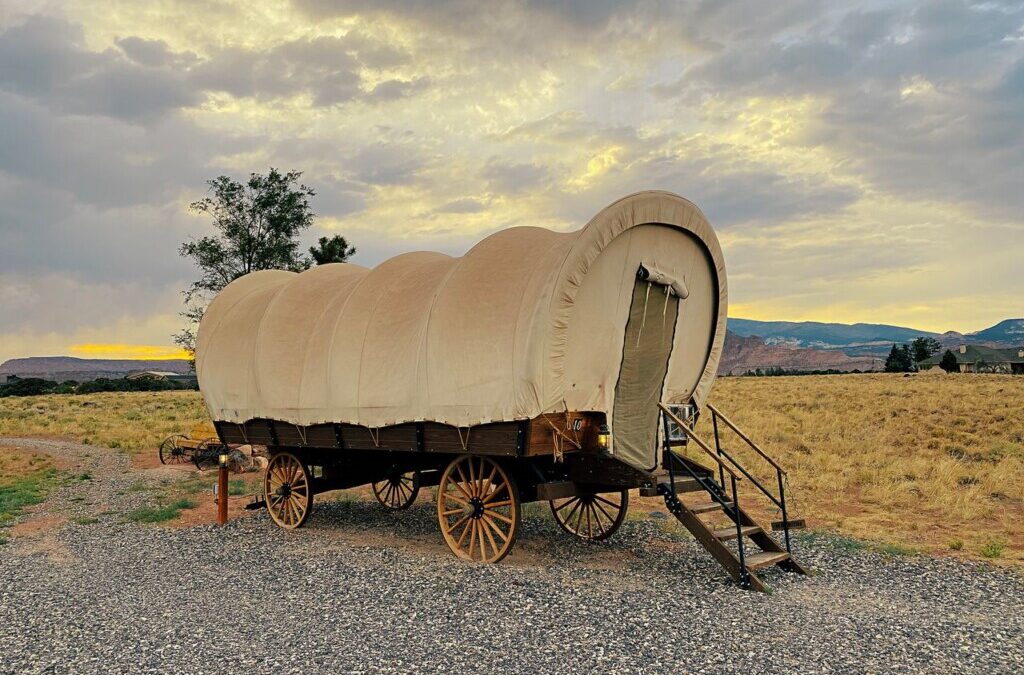
Roughly a century after Abigail, other ancestors (maybe other Adamses) took part in another episode of American history that captured my young imagination: the Oregon Trail.
The story goes, the wagon train came under attack. A foremother of mine took an arrow to the shoulder, but as a teetotaler, refused to blunt the pain with alcohol. She gritted her teeth; someone yanked. The story stuck in my brain because it was gutsy and a little gross and it also told me something about who I was and where I came from.
My siblings and I retold and reenacted a westward odyssey by setting up “camp” in the meager shade of a shrimpy cherry tree in our backyard and taking turns foraging for food and keeping watch for wolves.
But, like in a bad relationship, I did eventually see who the America I thought I loved really was.
On a family road trip to the Grand Canyon, we drove through the reservations of the American southwest. Later, I walked through the cabins where enslaved people once lived. I learned about the residential schools and Japanese internment camps.
When I was working as a costumed docent at a local historical site, I remember one of my coworkers made a comment about how the stories told at the houses built by white settlers differed from those our indigenous colleagues shared at the portion of the site representing the history of indigenous people in the area.
“There’s historical truth and emotional truth,” she said.
If I had to pick a moment, I think that’s when my rosy glasses shattered.
My coworker had implied that the history stewarded by indigenous historians was important but in some way less true than history through the lens of white settlers. But I was the one who for much of my life held an emotional attachment to a specific heroic narrative around my American history and identity, and that story was a myth.
The similarly disillusioned characters in the excellent and strange speculative novel, The Everlasting by Alix E. Harrow, are caught up in a circuitous quest to make history, make a nation, or make themselves by telling and retelling their foundational Arthurian-style legend.
At one point, it is the antagonist who says, “A nation is a story we tell about ourselves…”
In America, we certainly tell stories like we are our history, and we make ourselves in the telling. It’s very American.
History becomes myth and myth becomes history depending on your point of view. We excavate heroes from the past and then emulate them as if our ideal future is a recreation of our past, making us somehow both the inheritors and the makers of history over and over.
And in repetition and retelling, there is always the temptation to clean up the story and shave off a few more edges. Our heroes are us, and we want them to sparkle. It seems we are less and less able to bear nuance and complexity, much less ugliness, in the stories we tell about ourselves, whether history or myth.
That’s why I’m looking forward to seeing Christopher Nolan’s Odyssey; I want to see how “bad” it is.
By which I do not mean I’m chomping at the bit to weaponize my classical education into pedantic nitpicking about historical and literary accuracy. Homer’s Odyssey was a hero story for ancient Greeks. Christopher Nolan is unlikely to waste money telling a story for a long-dead audience. His hero story is probably for twenty-first-century Americans. How much will he comply with a modern, American understanding of heroism?
I wonder if Nolan kept Odysseus’s selfishness and arrogance. Will we see Odysseus slay Hector’s infant son to prevent a future blood feud or massacre the enslaved women of Ithaca? What will the judgement be on Odysseus’s affairs with Circe and Calypso? How much does Nolan want us to like Odysseus?
That seems to be a primary difference between history and myth or legend. History works to tell you the truth about how people are. Legends and myths tell us who we should aspire to be.
It’s human to love myths. But it seems backwards and upside down to love, yearn for, or aspire to the true past. What would that make us, to have the advantage of a wider perspective and still not be able to think of anything better? And anyway, we will no more find perfection in the past than we will achieve it in the future. Reaching in either direction only distracts us from the present, the only place where we can actually do anything.
That is not to say that we shouldn’t record our history or retell our myths. Most of us in the post calvin community are engaged in precisely that work. I wrote about my time as a historical interpreter in my first-ever essay for the post calvin. I have returned to the subject of history and myth perhaps more than any other, and, in almost one hundred posts, I’ve probably repeated myself.
But I am hopeful that the stories I tell will, in the telling, make me better. Not make me look better. I hope that, like the heroes in The Everlasting, with each telling, I will become a little braver, a little wiser, and a little more honest.

Emily Stroble is a writer of bits and pieces and is distractedly pursuing lots of novel ideas and nonfiction projects as inspiration strikes. As an editorial assistant at Zondervan, she helps put the pieces of children’s books and Bibles together. A lover of the ridiculous, inexplicable, and wondrous as well as stories of all kinds, Emily enjoys getting lost in museums, movies old and new, making art, the mountains of Colorado, and the unsalted oceans near Grand Rapids. Her movie reviews also appear in the Mixed Media section of The Banner and her strange little stories of the fantastic are on the Calvin alumni fiction blog Presticogitation. Her big dream is to dig her hands deep into the soil of making children’s books as an editor…and to finally finish her children’s novel.

