
Please welcome today’s guest writer, Mattie Hughey. Mattie almost graduated from Calvin in 2018 but instead dropped out of college and galavanted around the globe for a little bit. She eventually got a degree in environmental law and policy and now resides in Colorado. She is currently a full-time cowboy, part-time graphic designer, and all-time PB&J sandwich–maker.
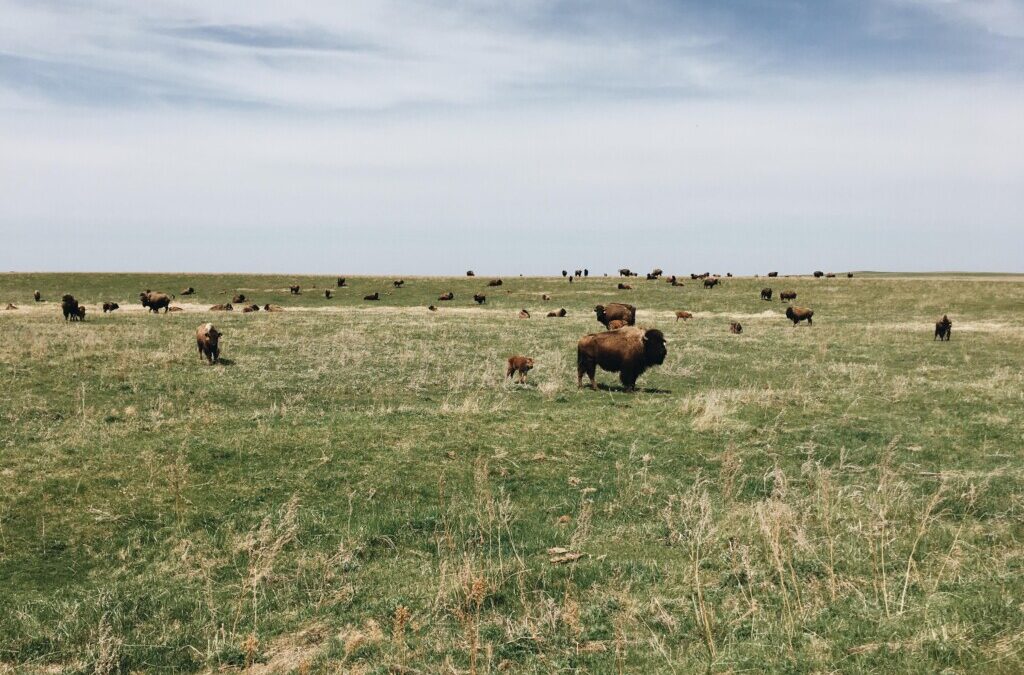
“Wait, wait, wait, he’s still alive!” I shouted as we pulled up in the pickup next to the calf laying on its side in the highway pasture. The sun shone brilliantly in the sky, the trademark ruthless wind of the South Dakotan plains was softer, quieter, gentler. Individual blades of green grass shot up through the brown woven blanket of last year’s. Clouds floated light and airy in the wide open blue above us. It was not a day to die.
“I’ll be damned,” Brett said as we stood next to it. The bull calf was motionless except for his eyes, which watched us halfheartedly. Brett grabbed the calf’s horns and tried to help it up. The calf wasn’t having it. It lay limp, dead weight, in his arms, refusing to even make an effort to stand or get away from us.
Buffalo are wild animals. It’s essentially the equivalent of trying to ranch white-tailed deer or antelope. Then imagine those deer weigh tons and want to kill you if you get too close and have the means to get the job done. The calf should never have even considered letting us that close to him. He should be high-tailing it back to the herd. He didn’t. He lay still, snorting out ragged breaths through his small, wet nose. He was the size of a golden retriever, a brown, coarse, curly-haired, horned golden retriever.
“What’s wrong with him?” I asked, trying to keep the concern out of my voice. We are ranchers, I told myself. We are tough in the face of life’s harshness. Brett shook his head and shrugged his shoulders.
“The thing about buffalo is that they’re hardy when they’re in good shape,” he said, wrapping a chain around the calf’s ankles. “But the second they feel sick and weak, if they think they won’t make it, they just give up. They just decide to die.”
He stood up and walked to the truck. “If we find an orphan calf, we can’t do anything about it. If we take it away from the herd and bring it to the house, they just call it quits and die. With cattle, you can doctor ‘em, you can put them on medicine or anything they need. With buffalo, the mere act of taking them to the house stresses them out enough that the journey alone could kill ‘em. Any doctoring we do has to be done out here.”
He put the truck in gear. “We’ll drag him over the hill so he can see the herd. He might try if he can see ‘em.” We drove gently across the prairie dog towns and dried grass, the calf sliding across the ground as if on a sled. We stopped at the bottom of the hill, the rest of the buffalo herd out in the distance. I jumped out of the pickup and unwrapped the chain from his legs.
“Come on, buddy,” I whispered to him, petting his shoulder. I grabbed his horns and lifted his head so he could see the herd. “Come on. Try. You can do it. You’re okay.” He was heavy in my hands, his eyes almost rolled back into his head. I propped his head up on my knee and tried to tuck his legs under him so he could stay sitting up. “Come on, come on, you can do it!” He wouldn’t. He lay against me, still and quiet. I turned to Brett. “Why are his eyes like that? Why isn’t he doing anything?”
“He’s made up his mind to die,” he said. “There’s nothing more we can do for him now.” My mind could not reconcile the brightness and hopefulness of the weather with the end of this calf. “He’ll probably be dead by the end of the day.” And he turned and climbed back into the white pickup.
I sat there for a beat. This wasn’t supposed to happen. None of this was right to me. I shouldn’t have been this close to a wild animal. He shouldn’t be so lifeless. There shouldn’t have been opportunity to run my hands across his fur and tell him everything was going to be all right. He shouldn’t be so young. I shouldn’t be this sad.
I laid his head on the soft grass and gave him one last pet. “You did all right, bud. Rest easy.” I picked up the chain and threw it up on the flatbed. As we drove towards the summer pasture gate that had been our original destination, I watched the calf slowly fade in the rearview mirror. The rest of the ride was mostly silent.
“Do you get sad about it?” I said, breaking the silence. Brett spat tobacco juice into the Bud Light can he kept in the cupholder for such purposes.
“Well, yeah,” he said, his voice short. “And I get pissed.” He paused. “It’s frustrating to not be able to help them, that they just decide to die and there’s nothing you can do about it. You can’t tell a buffalo to do anything.” He spat. “These fences? They’re just to talk them in to staying home. They could walk right through these any time they want to,” he said.
“I don’t know if I’m cut out to be a rancher,” I finally said, exasperated and embarrassed by how upset I felt. “I don’t know if I’ll ever get used to the dying.”
He turned and looked at me. “I sure hope you don’t,” he said. “You shouldn’t. It’s not a bad thing. It still bothers me and I’ve been doing this all my life.”
That wasn’t the first time I’d see death in those fields, and it won’t be the last.
A duck got killed by an eagle the other night. We shoot prairie dogs to keep ‘em from ruining the land. The pastures are decorated with bones: buffalo, coyote, antelope, pheasant. Newborn calves die. We lose colts in a blizzard. The dogs catch and kill rabbits. Mice get run over by tractors. It’s all part of this life.
Death has a bad connotation. Death is unwanted. Death is taking away. Death is an end.
The prairie has taught me otherwise.
It’s okay to be sad about it. It’s okay to be upset. It’s okay to wonder why. Ranchers aren’t numb. They aren’t heartless. They just have to be able to keep it in perspective, to be sad and keep going. We are ranchers and we are sad about dead calves, but there are new calves waiting.


I’m crying…
This was wonderful, Mattie! Thank you for sharing this! Very well written 🙂
Mattie. I think you have writing in your future. I could hardly finish it for the tears pouring down my face. Beautiful!!
This is lovely Mattie–thank you for sharing your experiences. This reminds me of the kind of writing I find in “Modern Huntsman”. Might be a publication that’s worth a bit of your time 🙂
This is beautiful.