
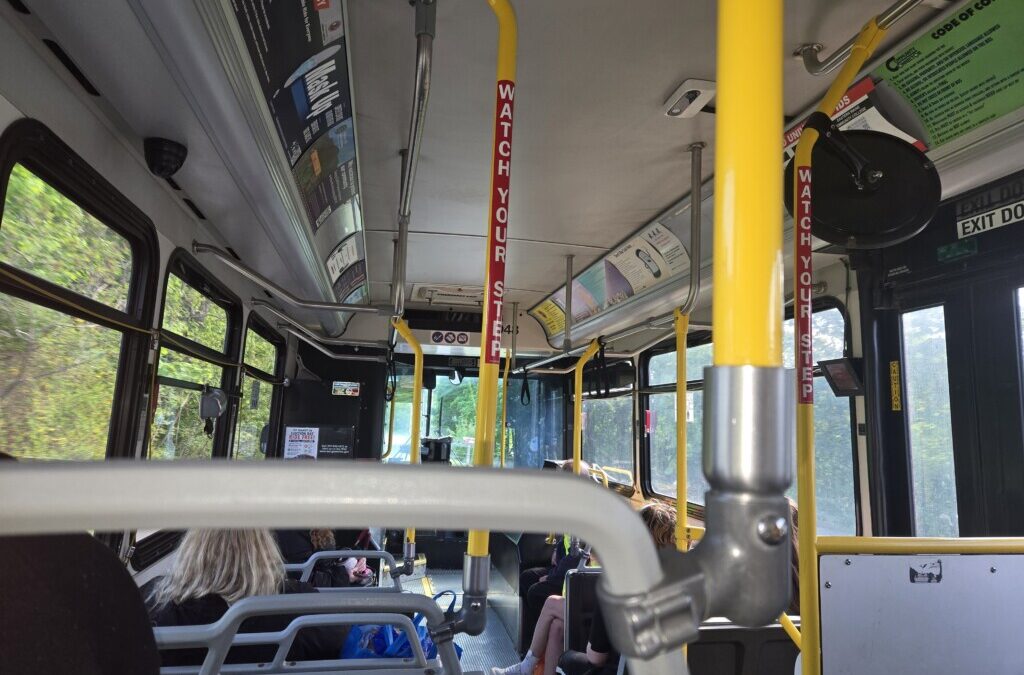
Of all the times I rode the bus this spring, only once was it so busy I had to sit directly next to a fellow rider. He was a middle-aged, average-sized man, bald, I think, wearing a quarter-zip and holding a black backpack between his legs. I had my backpack, a lunchbox, and my coffee, all on my lap. I sat diagonally, my knees pointing away, my back ramrod straight, pretending to read the posts I scrolled past on my phone. We never made eye contact. When the person in the two-seat row behind us disembarked, I moved myself and my stuff to that row for the final five minutes of my ride.
Another time, I rushed out the door of my house, coffee cup and lunchbox in hand, backpack on my back; I was afraid I would be late. As I stepped onto the bus and flashed my student ID to the driver, a girl sitting near the front—whose old pink and orangey-blond dye job topped by several inches of greasy root matched the hair of the man sitting next to her—said, “I love your dress!” I smiled, thanked her, and sat down in a free seat halfway back. I scrunched my nose, and tried to breath through my mouth. The girl and her two male companions conversed, their voices loud and unignorable, despite my earbud. Right before pulling up at my campus stop, the man without matching hair dropped a cylindrical cardboard container of the sort used for prepared grocery store sides. After gathering it up, he hunched over and started hitting the side of his head with jerky, rigid movements, his palm wide, fingers spread. I walked past the three of them, avoiding eye contact. As I exited the bus, I saw the driver get up and walk back to speak to the trio. I didn’t stop, but an aggressive voice, which I could only imagine belonged to the bus driver wafted towards me. As I walked to my office, I worried that people would be able to smell the bus on my jacket.
I started riding the bus in April because my car was on the fritz—the check engine light burned steady orange from the dash and in random moments of braking or acceleration, the whole car shuddered and shook. But now that my car is fixed, I still regularly ride the bus to school. Taking the bus requires me to be disciplined and on time, and it forces me into potentially uncomfortable, embodied contact with other people. For me, this contact is valuable in part for the reminder of my own self-centeredness. I believe choosing to be inconvenienced by others is a profoundly ethical choice required for building and maintaining community. What is taking the bus if not an inconvenience?
Many things, probably. But despite its inconvenience (the bus only comes once every hour, arrival and departure times from any but the most major stops cannot be found online) is taking the bus a community-building inconvenience? I don’t know. Making eye contact is unusual, speaking to a stranger even more so. I ride for free and it’s nice to save the gas money. I only ever take the bus to and from school, because it’s the easiest route. When I miss the bus, I just drive. Is this actually a meaningful, community building choice on my part or is it simply convenience?
I am privileged to have the choice to take the bus. I worry that my choice to ride is simply performative (writing about it here probably doesn’t help) or perhaps appropriative; I’m leveraging my projections or construals of other people as meaningful meditations to improve my own emotional or moral state.
My sixteen-year-old brother would say, “it’s not that deep.” Or maybe it is that deep, I don’t know. But I think I’m going to keep riding the bus.

Savannah Shustack graduated from Calvin in 2024 with a major in literature and plans to have the job of “books” one day. Rather like Ken, she is still figuring life out; the job “books” provides plenty of wiggle room, though she’s currently leaning toward being a librarian. Savannah is a New England native who enjoys watching hockey (Go Bruins!) and playing board games—especially ones she can win.


This post was a jarring throwback after getting used to Japanese public transport, which is super quiet and clean and also can be quite crowded. If I manage to snatch a seat, it’s usually between two strangers with several others standing in front of me, but somehow that feels way more casual than what you describe here. There’s nothing quite like almost being jostled out of the car when you stand by the door and a bunch of other people get off at once, but at least the social protocol for such an event is fairly straightforward. ( 0_0)
Really, though, I would agree that public transport is definitely a community-building thing. Thank you for your reflections, and for riding the bus! May we have more buses and formative awkward experiences in American transport system.