
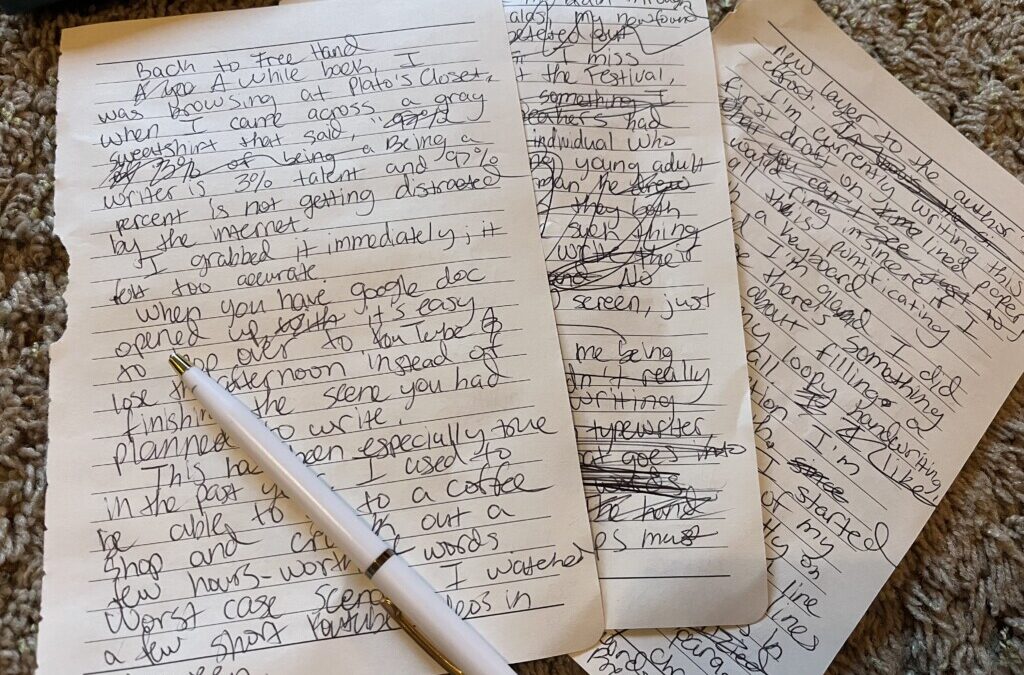
A while back, I was browsing at Plato’s Closet when I came across a gray sweatshirt that said, “Being a good writer is 3% talent, 97% not being distracted by the internet.”
The sweatshirt described me perfectly, perhaps to the point of sounding like a call out, so of course I had to buy it.
When you have a Google Doc opened up, it’s easy to hop over to YouTube and lose the afternoon instead of finishing the scene you had planned to write.
This has been especially true in the past year. I used to be able to hole up in a coffee shop and crank out a few hours-worth of words. Worst-case scenario, I watched a few videos in between.
Now, I’m lucky if I can do an hour of work during my coffee shop visits.
It’s frustrating, how quickly I give in to the urge to change tabs or pick up my phone the second writing feels too hard.
And now that I’m trying to wrap up edits on my first manuscript, staying in my doc feels impossible.
A distraction-free future briefly seemed attainable after I attended Calvin’s Festival of Faith and Writing. I left the Festival with my mind buzzing from various talks. Seeing authors explain their writing processes so joyfully made me ache to hold a published book and be able to call it mine.
Longhand writing reentered my brain through the Festival. I heard a few people mention how handwriting is a big part of their writing process. Maybe this is indicative of me being Gen Z, but it amazes me that some people write their first draft by hand. I’ve written a few scenes by hand, but it’s hard to imagine hundreds of pages filled with ink, not to mention the awful hand cramps that must come from all that work.
But maybe some discomfort is worth a distraction-free writing session.
Also, there’s something about pen and paper that makes the writing process more visible. Because even in a published work, writing can’t be reduced to a series of paragraphs in crisp, Times New Roman. Not only is there emotion and intent behind those typed words, but on the screen, you can’t see the author’s sloppy scrawl that becomes more illegible as she speeds up in excitement. You can’t see the things she left out, the fierce lines cutting through clunky phrases and misspellings.
This is not to discredit typing out your stories; most of my writing is directly from my laptop. Using a keyboard doesn’t erase the craft and effort you’ve poured into the project. But longhand work adds a new layer to the author’s efforts. It offers a behind-the-scenes look at all the mistakes and adjustments and decisions the author made that cannot be translated through a printed page.
I wrote my first draft of this on paper; it would ring insincere if I did all this pontificating through my computer. And I’m glad I did so, because there’s something satisfying about filling a page with my loopy handwriting, mistakes and all.
Back in college, I started printing out chapters of my work and editing directly on the pages. And not just line edits; I’ve crammed new lines of dialogue, fresh prose in the margins.
Soon the crisp paragraphs are surrounded with chaotic towers of written words, the columns teetering precariously since I’m incapable of writing in a straight line.
When it’s time for me to transcribe my handwritten edits into my Google Doc, I curse my former self for expecting me to interpret her cramped writing and frenzied arrows.
But I keep editing this way, even when it makes me grit my teeth and spend minutes figuring out where the new changes are meant to go. Because once the changes are made, it’s like a puzzle has been solved. Like the ache that slowly took over my hand as I cranked out the first draft of this, it’s a sign that I’m creating, and that’s enough of a reason to keep writing.
Now, I’ve finished transcribing my handwritten draft onto the screen, editing along the way. Did I get distracted by other tabs while doing so? Of course. I hope to improve my restraint over time, since writing with zero laptop presence will never be a possibility for me.
That being said, I’m going to keep my eye out for some thick Moleskine journals to fill in the near future.

Liana Hirner graduated from Calvin in 2024 with a bachelor’s in writing. She currently lives in her hometown of Aurora, Illinois and works full-time in a warehouse filled with books waiting to be sorted. Writing is her first love, followed swiftly by lattes and dark chocolate.


Your writing makes me happy. The words and phrases you spell are exciting and fresh. Love you.
Posts like this make me want to start a writer’s notebook again like all the English teachers tried to make you do in middle and high school. There’s something so magical about writing it down.
I go half and half. Nowadays, most of my writing I do on my computer. I have one of those double-stack notebooks, the kind that have 150-200 sheets instead of 70. In there, all my supplementary materials go: outlines, character profiles, brainstorms, etc.
That being said, you’re in good company going back to pen and paper. I’m pretty sure Maya Angelou did all her drafting and editing by hand.