
Our theme for the month of October is “childhood fears.”
“You’re growing up so fast, we’ll have to put bricks on your head,” my aunt told me at the tender age of three or four. One of my parents found me later with several of our large, cloth-bound encyclopedia volumes balanced on my head. I planned to implement a regular habit of this and neatly sidestep growing up. It’s funny: I vividly remember doing this, but cannot remember why the prospect of growing up terrified me.
I remember dreaded turning twelve the way many people dread thirty. That’s when one aged out of free cookies at the grocery store, and annual participation in Vacation Bible School. It felt as though I was in a small boat, caught in a rapid current, being propelled ceaselessly over the world’s edge into a less sweet, less kind, less joyous…mystery.
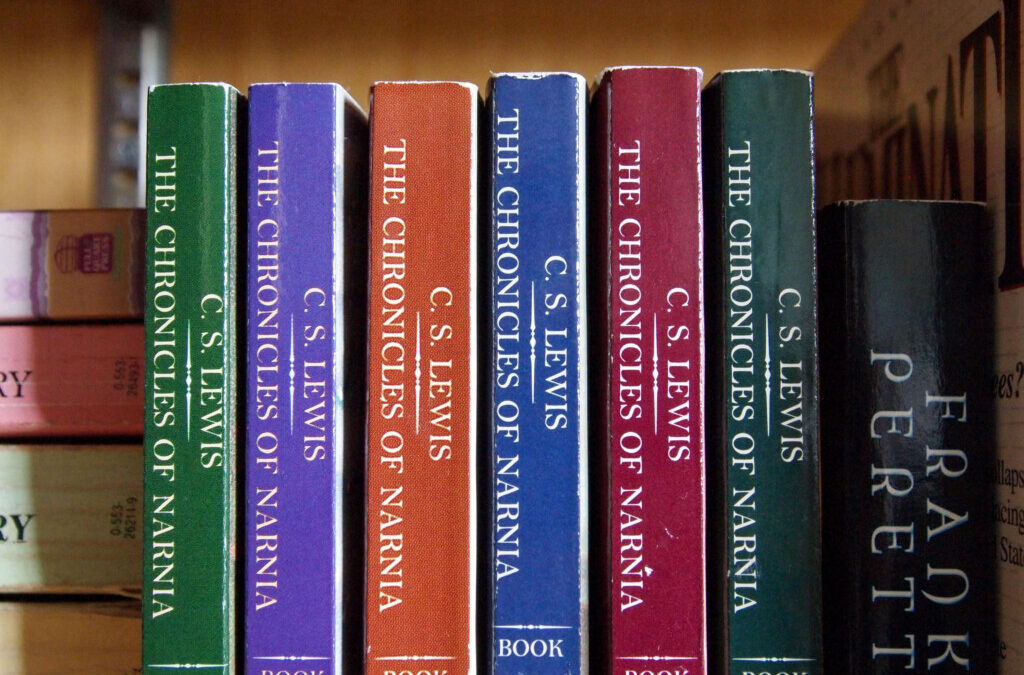
Around this time, I discovered Narnia. My nose tingled with the scent of spicy pine bows and snow. I heard dawn break with a Lion’s roar. My eyes welled up with tears to behold the ruins of Aslan’s How, glowing in torch light. I felt the rend of dragon scales torn off my skin. Being bookish, rational, and the elder sister of two younger siblings, I identified strongly with Susan, even though I liked Lucy better. I devoured the series up through the last page of The Silver Chair, and then I stopped. After I read the last book, it would be over.
Then I heard a terrible rumor: In The Last Battle, Peter, Edmund, and Lucy follow Aslan beyond death into the true Narnia, but Susan is left behind.
This cannot be, I thought, “Once a king or queen of Narnia, always a king or queen of Narnia.” Aslan said! But apparently, Lewis leaves Susan behind, no longer a friend of Narnia, chasing boys and wearing lipstick.
I was horrified. I would not grow up, and I would not read The Last Battle. The story could be preserved in stasis until a cure for the ending could be found.
For the next sixteen years, I put up a good fight. I threw myself into books–Paradise Lost, A Tale of Two Cities, Lord of the Rings, Howl’s Moving Castle, Sir Gwaine and the Green Knight, The Epic of Gilgamesh. I studied all the ways souls, lives, loves, and worlds could be made, bartered, won, lost, and saved, though that’s not what I would have said I was doing. I called it “Liberal Arts.” Though I did sometimes wear lipstick, I manufactured an uncrackable safe, and put all thoughts and feelings of romance into it.
Time still breached my walls. I changed, fell in love, burnt out. Perhaps now I was hardened enough to face the end of Narnia, or perhaps I was so starved for some full, thick, hearty beauty, I was ready to push through a little pain to get at it. So I read The Last Battle for the first time.
It did not feel the same as the other books. This provoked anxiety.
In The Last Battle, an ape manipulates a donkey into shoddily pretending to be Aslan, and others join or coopt this lie to increasingly insidious ends. The story is missing much of the wonder and compassion woven through the other books. The narrative snags on the uncomfortable characterization of the Calormen and frequent, unnecessary commentary on Jill’s gender and what she should, therefore, do or not do. Aslan speaks hardly at all.
Then comes the terrible, dreaded moment when it is revealed that Susan is no longer a friend of Narnia. I was surprised to see that liking boys doesn’t come into it. Eustace says she dismisses it as a game. Jill says she wants to be grown up and is “interested in nothing…except nylons, and lipstick, and invitations.” But then Lady Polly, who, significantly, is at least middle-aged, says she “wishes she would grow up.”
Aslan is not present and makes no comment.
In letters, Lewis said of Susan’s fate, “There is plenty of time for her to mend, and perhaps she will get into Aslan’s country in the end–in her own way” but that was a longer and more grown-up story than he wanted to write.
It’s thin comfort, but having come through The Last Battle, I think Lewis’s actual point is not that growing up results in damnation. Plenty of grown-ups, to their very great surprise, end up in Narnia. It’s the same point he makes in Screwtape Letters and Till We Have Faces and elsewhere–It is easy and dangerous for an intelligent person to grasp onto what they think is true piety, or beauty, or truth and dig their heels in because the Real is difficult or strange or “too foolish.” Too late, they find what they have in their hand is all cheap forgery. Lewis seems, almost obsessively, to aim at teaching his readers to recognize both Truth and falsehood by any name and regardless of shape or voice. Aslan says as much in Voyage of the Dawn Treader: “I am [in your world]…but there I have another name. You must learn to know me by that name. This was the very reason you were brought into Narnia.”
I would even go so far as to argue that Lewis did write Susan’s story, but the characters have different names. In Till We Have Faces, Urual destroys her sister, Psyche’s, happiness by convincing Psyche that all the wonders provided by her invisible lover are lies and make believe. Urual seems to me a more traumatized and terrified Susan, desperate, like the dwarves in The Last Battle, not to be taken in. Urual’s ending is also ambiguous, but a golden thread of hope persists, pursuing Urual like the cat that follows Shasta through the tombs in The Horse and His Boy.
“What do you think happened to Susan and Urual?” Lewis seems to say. Perhaps when he wrote to a young fan suggesting she might try writing Susan’s story, he meant it seriously. The people most concerned with the problem of Susan and Urual’s ending are likely to be the people who see themselves in these characters (and heed the warning). I think, also, we’re most likely to string words together into a rope and cast it into dark wells and haul many a Susan up back into childhood, reborn to meet Aslan by another name.

Emily Stroble is a writer of bits and pieces and is distractedly pursuing lots of novel ideas and nonfiction projects as inspiration strikes. As an editorial assistant at Zondervan, she helps put the pieces of children’s books and Bibles together. A lover of the ridiculous, inexplicable, and wondrous as well as stories of all kinds, Emily enjoys getting lost in museums, movies old and new, making art, the mountains of Colorado, and the unsalted oceans near Grand Rapids. Her movie reviews also appear in the Mixed Media section of The Banner and her strange little stories of the fantastic are on the Calvin alumni fiction blog Presticogitation. Her big dream is to dig her hands deep into the soil of making children’s books as an editor…and to finally finish her children’s novel.

