
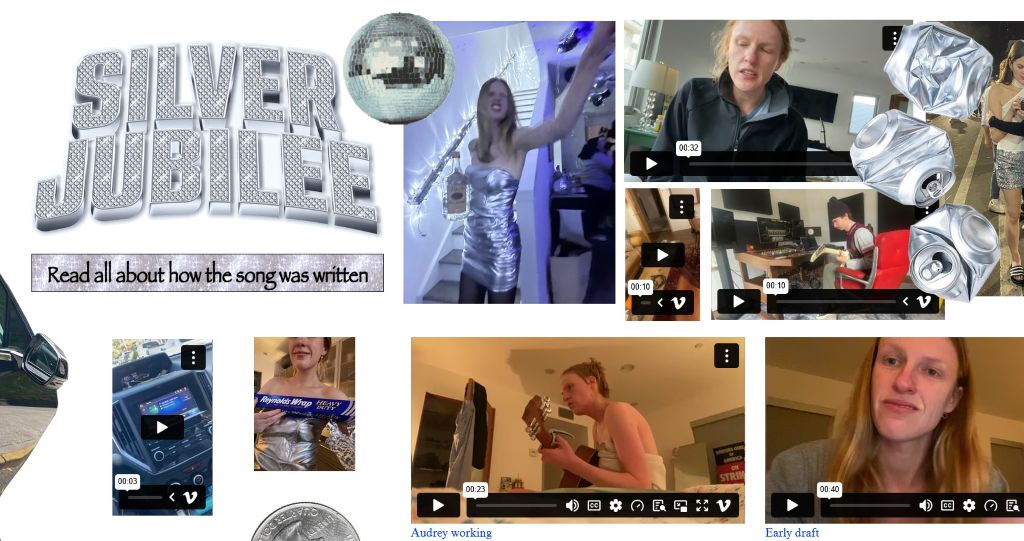
Image taken from Audrey Hobert’s Archive website (recommended viewing on desktop).
In light of recent developments in my YouTube diet that we are going to gloss straight over, I’ve been much more attuned to developments in pop music culture. I had heard Audrey Hobert’s name a few times, mostly in reference to how fellow nepo baby Gracie Abrams cannot write an album without her as shown on Abrams’ latest record, Daughter from Hell.
Naturally, YouTube directly served me Hobert’s Tiny Desk Concert the moment it came out. Immediately, I was struck with two thoughts: Did she just say she wants to be felt up when she’s drunk at the club? and Oh wow, she kind of looks like me. And when I thought that, I really meant, Oh, she’s kind of ugly.
(When I showed my sister this video, as I bent over the tub shaving off the calluses from my feet, and asked her if Hobert looked like me, she inspected the video and then said, “No, not really. I can’t see her eyebrows, but I can see yours.” After I busted out laughing, she added, “You two do have the same nose!” So take the look-a-like-ness amount with a grain of salt.)
Many of Hobert’s lyrics touch on this place of knowing you aren’t the prettiest girl in the room, but her songs don’t linger there. On “Thirst Trap,” she builds the chorus from “I’m taking thirst traps in the mirror in my room / I think I look bad so I change the lighting” to “I think I look bad so I take a hundred” and then finally “I think I look bad but it doesn’t matter.” She continues, “I once read that some people’s beauty can’t be captured / and he’ll be sorry, happy ever after.” In “Phoebe,” she writes that, “I think I’ve got a fucked-up face / and that thought used to haunt me / ‘till I fell in its sweet embrace.”
People, as you can imagine, did not all have a measured and normal reaction to seeing a woman looking like a normal person in a pop star role. But under videos commentating on the discourse (like this one), I became more ticked off by the knee-jerk reaction for people to insist that Hobert is gorgeous.
I’ve ingested a lot of woke Tumblr talk about how we assign morality to beauty—how in media the heroes are pretty and the villains are ugly. If we want to knock our political enemies down a notch, we’ll lob an insult based on their looks. When scrolling through a candidate for Senate, we’ll think about how attractive he is on Instagram reels rather than his policy stances (hello, Abdul El-Sayed). Beauty standards are also far from neutral, undergirded by racism and transphobia, evidenced even in this case as some deranged people online have decided that Hobert must actually be a trans woman based purely on her looks. But in facing these pressures, Hobert has a healthier mindset than just blithely calling everyone pretty—likely a mindset that was refined by the fires of growing up on social media and taking a public-facing job. She says, “Yeah, I look like this. I know it’s not the standard. But this is who I am. I still demand respect and love and lust. Sue me, I want to be wanted.”
In an interview, Hobert pulls out a line that her mother said when she was a teenager: “Audrey, every room you deserve to be in, just by standing there being silent.” This foundational belief shines through Hobert’s music. She refers to her looks, yes, but it is never something to pity her for; rather, she demonstrates how this radical acceptance leads to places that often feel inaccessible to people without pretty privilege, including pop stardom. And that is what the people who are insisting that she’s a model or that she’s gorgeous are missing. The point is that she is just herself, that she doesn’t have to have the perfect facial structure to be recognized for good craft in the industry of music. She doesn’t have to be pretty to be a good person.
Regardless of the fact that I will not be stopped on the street and asked if I am Audrey Hobert, a part of me feels healed by her very presence in the pop music sphere. I want to live in a culture where someone can say they are ugly, someone can say they are fat, and it’s not a thing to be soothed or argued against. It just is.

Alex Johnson (‘19) is a high school English teacher in Massachusetts. She spends her days being an uncool adult who enjoys reading romance novels and explaining niche rhythm game strategies.

