
Our theme for the month of June is “spirits.”
There are few more prescient lines in mid-twentieth-century poetry than T.S. Eliot’s “Distracted by distraction from distraction.” (I was distracted by distraction from distraction twelve times while writing this post alone.)
(And now, as if to distract me once again, Google Docs is underlining “by distraction from distraction” in blue and telling me it should just be “by distraction.” So I’m now distracted from “distracted by distraction from distraction” by “by distraction.” And now there are three blue lines.)
Anyway.
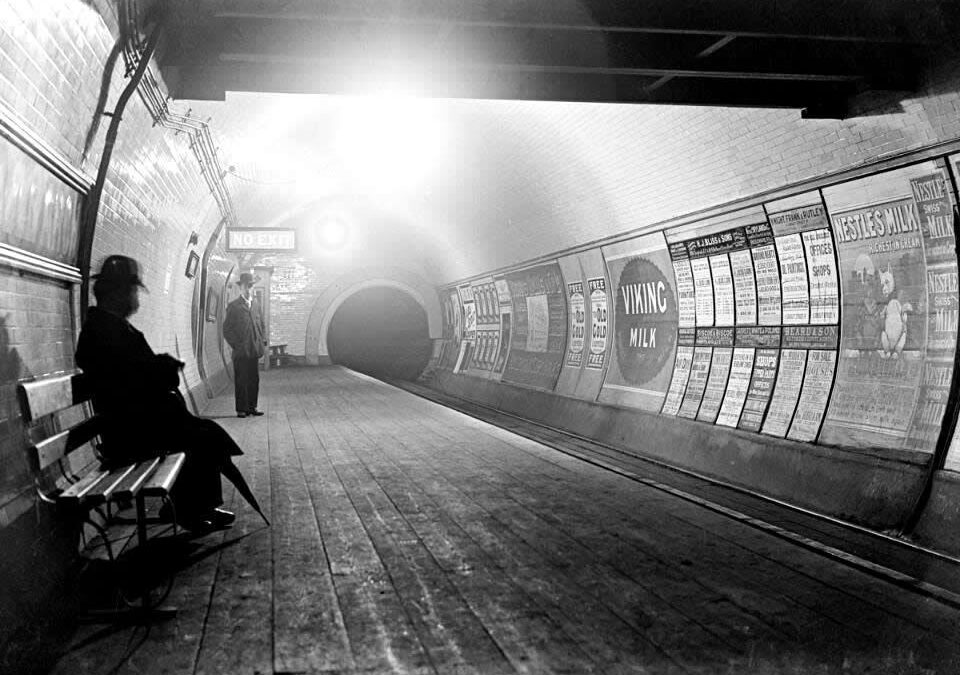
Eliot was on to something, not just in the “screen time report” brutality of this line but in this whole section of his 1936 poem Burnt Norton, which is set in a London Underground subway station. In its “dim light,” neither night nor day, Eliot observes the numb, desiccated existence of the “unhealthy souls” streaming from car to car and sign to sign, maybe-real place to maybe-real place. Their minds are “filled with fancies and empty of meaning”; anything more solid is impossible “in this twittering world.”
Sound familiar?
(And no, “this x-ing world” doesn’t have a ring to it.)
In the next passage, Eliot describes a world “lower” than the subway (a dark future, perhaps, or an unacknowledged present) in which everything that structures the world has fallen apart: “Desiccation of the world of sense, / Evacuation of the world of fancy, / Inoperancy of the world of spirit.” In the world of machines and corporations, you can’t think, you can’t dream, you can’t pray.
Um, sound familiar?
A lot of people in the past 150 years have felt like Eliot, convinced the modern world is fake, ghostlike, and suffocatingly artificial, full of “metalled ways” and empty of what’s really human or lifegiving or alive. Disenchanted.
And a lot of people have, like Eliot, nursed dreams of an airier world. Sometimes these are nostalgic fantasies of the past, sometimes they’re utopian visions of the future. For Eliot, it ended up being a deeply anti-democratic form of Anglican Christianity: a submission to the authority of tradition, with its ready-made reservoirs of purpose.
He lays his solution out in a later poem, The Dry Salvages. Despite the “inoperancy of the world of spirit” he lamented, he has absolutely no interest in creative attempts to re-enchant the world. Tto communicate with Mars, to converse with spirits,” to forge meaning with horoscopes and palm-readings and tea leaves and playing cards—”all these are usual pastimes and drugs, and features of the press,” he writes, with a cloud-yelling harrumph.
(He’d have no trouble getting a byline in the Atlantic that went something like “What the Spiritual But Not Religious Don’t Get About Tradition.”)
Instead, Eliot insists on a religious solution: to follow the “occupation for a saint,” to live in “ardour and selflessness and self-surrender.”
When I first read this poem in my senior seminar at Calvin, I loved this line. I still do, but now it also makes me nervous. It makes me nervous not because ardour and selflessness and self-surrender are bad, but because I’ve seen them idolized in destructive ways in the places that are supposed to be holy. I’ve also seen them practiced for real in the places Eliot wouldn’t recognize as holy.
In another line I’ve loved from Little Gidding, Eliot writes that “you are here to kneel where prayer has been valid.” Here again, I get nervous. “Valid” is a nonsense word to apply to prayer. The selflessness and self-surrender I’ve seen has occurred precisely in places and from people that have been deemed invalid. And some of it has involved tarot cards.
This is all to say that I think Eliot gets the diagnosis right but the solution wrong. Tradition and hierarchy, despite our politicians’ insistence, cannot be the answer to our anxieties. Look again at that word “inoperancy,” as in “inoperancy of the world of spirit.” It doesn’t really mean “disenchantment.” It’s a mechanical word, like “inoperable.” The spirit world isn’t absent or destroyed, it’s just out of order, in need of a reboot. It’s here, alive, present even in the subway station’s musty air; it’s just in sleep mode.
I wonder what Eliot would’ve made of the violinist Joshua Bell’s famous social experiment where he played in a New York subway station anonymously for several hours. Those who turned and listened and were late for their meetings were certainly distracted from distraction by distraction, trapped even longer in the subterranean dimness. But weren’t they better off for it?

Josh Parks graduated from Calvin in 2018 with majors in English and music, and he is currently a PhD student in religious studies at the University of Virginia. When not writing, he can be found learning the alto recorder, watching obscure Disney movies, and making excruciating puns.


I love to read your Calvin posts!