
Our theme for the month of June is “spirits.”
As a kid I was fascinated with space. I remember telling adults I wanted to be an astronomer when I grew up, and correcting them when they assumed I meant astronaut. I never wanted to go to the stars. Space travel is scary, and knowing that there were rovers, landers and satellites that could go in place of humans while I stayed safe at home was reassuring, especially because in the early 2000s, there were two new Mars rovers: Spirit and Opportunity.
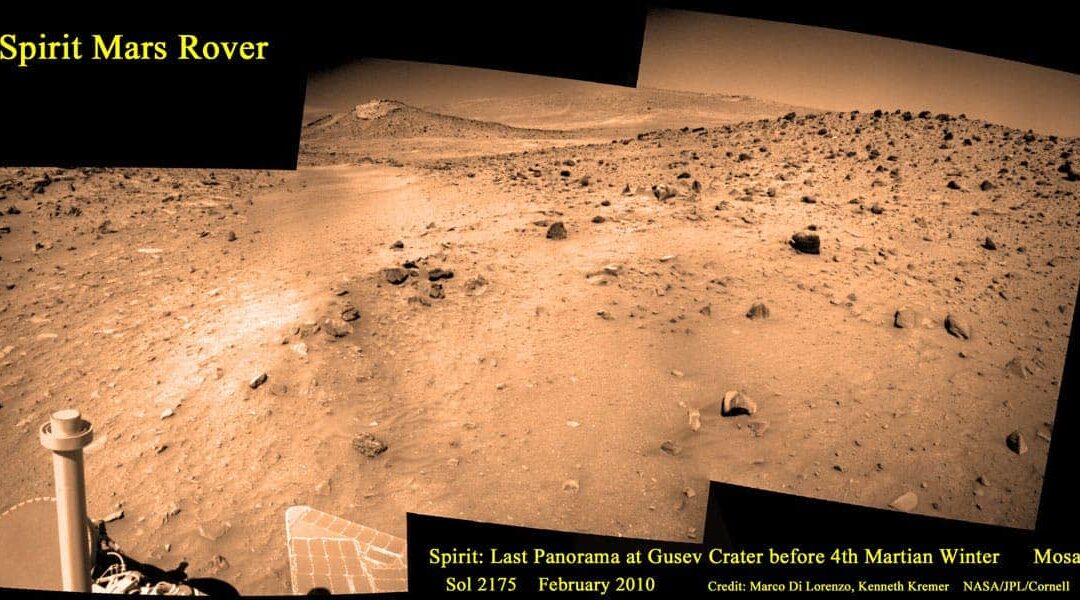
Spirit and Opportunity, or Mars Exploration Rover A and B respectively, were twin rovers which landed on Mars in 2004, on opposite sides of the red planet. Opportunity operated for fifteen years (about sixty times longer than planned) until 2018, when the combination of low power and dust on its solar panels caused the rover to lose contact with NASA. By comparison, Spirit only lasted until 2010, still twenty-five times longer planned 90-sol mission, but not the extreme length of its twin. This is partially due to how the mission ended: On May 1, 2009, Spirit got stuck in soft soil, and after many attempts to free the rover, it spent the final months of its mission performing science while stationary. In March of 2010, communication with Spirit ended, and while there was hope wind might clear Spirit’s solar panels and allow its battery to recharge, NASA ended the mission in 2011, after attempting communication with the rover for over a year had failed.
Spirit hasn’t gained as much of a foothold in the public consciousness as NASA’s other Mars rovers. Curiosity, which landed on Mars in 2012, sang happy birthday to itself in 2013 to celebrate a year since it touched down. Perseverance, which landed in 2021, brought a small helicopter with it which completed the first flights on another planet. Opportunity’s mission ended with news and social media fanfare, aided by one poster’s translation of the rover’s final message: “My battery is low and it’s getting dark.” Yet while reading about it while exploring this month’s theme, I found myself drawn to Spirit. It’s easy to get attached to things which far exceed expectations, it’s less easy when they don’t do as well.
There are a lot of success stories that come out of NASA; the organization’s PR department is good, and science influencers are excited to share good news. The stories of failure are often catastrophic events, like Apollo I, Colombia, and Challenger. There aren’t many stories that fall between the two, and other than the email problems aboard Artemis II, the end of Spirit’s mission feels unique for that.
The mission was certainly not a failure, but if Spirit hadn’t gotten stuck like a golf ball in a sand trap, it could still have operated for another five years, like Opportunity, and there’s no telling what we could have learned about Mars if it had. Yet while it was stuck, it did what it could within its capacity for as long as it could.
Is it weird to empathize with a rover? There are days I feel like Spirit: stuck and doing my best, waiting for a miracle to make things better. On those days, just knowing there’s a machine on another planet that got stuck in sand and had to do what was within its capacity provides some reassurance.


Great analogy!