

The view from my childhood home’s backyard
A few weeks ago, on the phone with a friend, she introduced me to her idea of “percent-home.” She’s moved away from her family and out of her home state for the first time in her life, and can no longer pop back to her childhood bedroom on the weekends or find the days off to see her family for every holiday.
It was an interesting idea to me, percent-home, and as she explained it I found myself wondering how my various places and people stack up—percentage-wise. I think that after I was about eleven or twelve, no place was one hundred percent home for me. I didn’t move houses or cities or states, my parents didn’t divorce and make me split time between them. But it was about that time, early middle school, when puberty hit me like a ton of bricks and the places and people that felt comfortable and familiar started to feel…different.
It’s not inherently bad, I don’t think, to no longer have a single place to call home. For young Lillie, it was a mark of my burgeoning independence and an itchy feeling in my bones that said there must be more out there for me than my small town and family farm.
By the time I left for college, 2,500 miles from my childhood home in central Oregon to big-city Michigan, I was more than ready to find a new home. I was looking for new people—my people. I remember thinking it was so important to me that everyone who met me and knew me and loved me at college knew me, not my family. Couple my newfound belonging with a newfound awareness that the places and philosophies I grew up with didn’t really fit me anymore, and the Home-o-Meter started ticking up and up, past fifty percent and on its way to one hundred. But it didn’t last forever.
For a second time in my short life, I picked up and moved even farther across the country from where I started, to New York State. I don’t think I know anyone in my friend group who has made two such life-altering moves, to new cities they’d never even visited before without knowing a single person in a 400-mile radius. So I think I’ve had to get good at making a home for myself where there was none before.
Last summer, I finally came to terms with the fact that the place I grew up with isn’t mine any more, and that it hasn’t been for a while. I got a tattoo of My Mountains to remember that sliver of home, but in a few months I won’t really know anyone in my home town anymore.
My parents are moving back to Alaska and the house where I spent my entire childhood is on the market. At Christmas this year, my mom had my brother and I sift through vats of old Kid Stuff to see what we wanted to keep. I still tell people I’m “from Oregon,” but sometimes I wonder how true that is anymore.
More than that, I wonder what has made any place home to me in the first place. Was it formative experiences? People who loved me well? Places I stayed for a long time? Cities I can navigate without Google Maps? Even that sappy saying “home is where the heart is” doesn’t feel quite right, since my heart is flung around the world with the people I love most.
But the more I think about it, the less home feels like a place and the more home feels like a season. Generally, I hate it when people describe their lives in “seasons,” it feels tacky and somehow invalidating. But realizing that nowhere will ever be one hundred percent home for me feels too sad after all the wonderful and formative experiences I’ve had. If no place is fully home for me, where can I find the calm and comfort and familiarity that home is supposed to bring?
When I first moved to Rochester, there was a settling-in period—a very long settling-in period—where I felt completely untethered from everything and everyone I’d ever known. That’s normal. I think somehow I felt the same way when I was twelve and itchy to be somewhere else. That uncomfortable, distracted feeling that tells me I don’t really fit.
But right now, today, here in my cozy little house in the life I’ve built for myself, I don’t have that feeling anymore. I’m sure it will come again, like it or not, for one reason or another. But today, I’ve decided that I am one hundred percent at home exactly where I am, at least for now.
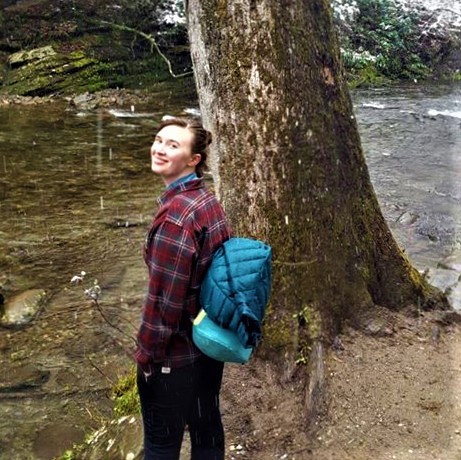
Lillie grew up on a forty-acre hay farm in Central Oregon, making the trek to Michigan to study mechanical engineering and sustainability. After graduating in 2020, she moved to Rochester, NY, where her day job as an engineer for the local gas utility funds her outdoor adventures, love of books, various craft projects, and investment in her new community.


I love this. Thank you.
Yes, yes, yes! Thanks for this post, Lillie–this piece is beautifully written and also introduces some big ideas for us readers to mull over. As someone who moved between California and Iowa growing up, and then (to her own somewhat-surprise) has made GR home after college, I love the idea of home percentages. My parents have moved away from the state where I went to high school, too, so I appreciate the way you’ve captured how it feels to have “home” shifting further and further away from its old definition.
I love the way you have “your” mountains, too; those landscapes leave such a deep mark on us, don’t they? I have “my” mountains of California and “my” rolling hills of Iowa, and I’m starting to feel that way about “my” Lake Michigan. I sometimes say that a part of me settles when I go back to a previous home and see one of those distinctive nature features. There’s something restless but also thrilling about the knowledge that no single place looks or feels just like home anymore.