
I see robots at the gym. They show up in khakis and beige jackets, carrying their bags at their sides. They smile, say “good morning” to the staff with beaming warmth. They are strong, able to lift great quantities of weight repeatedly. In the locker room, they converse with one another, discussing the weather among other things. The older robots will chuckle as they say things like, “My daughter got into Northwestern—looks like I won’t be retiring soon!” Some of them wear Speedos and goggles. Others sit at machines that offer repetitive, back-and-forth motions. Up, down, right, left: machines using different kinds of machines. There’s some grunting, but mostly it’s quiet.
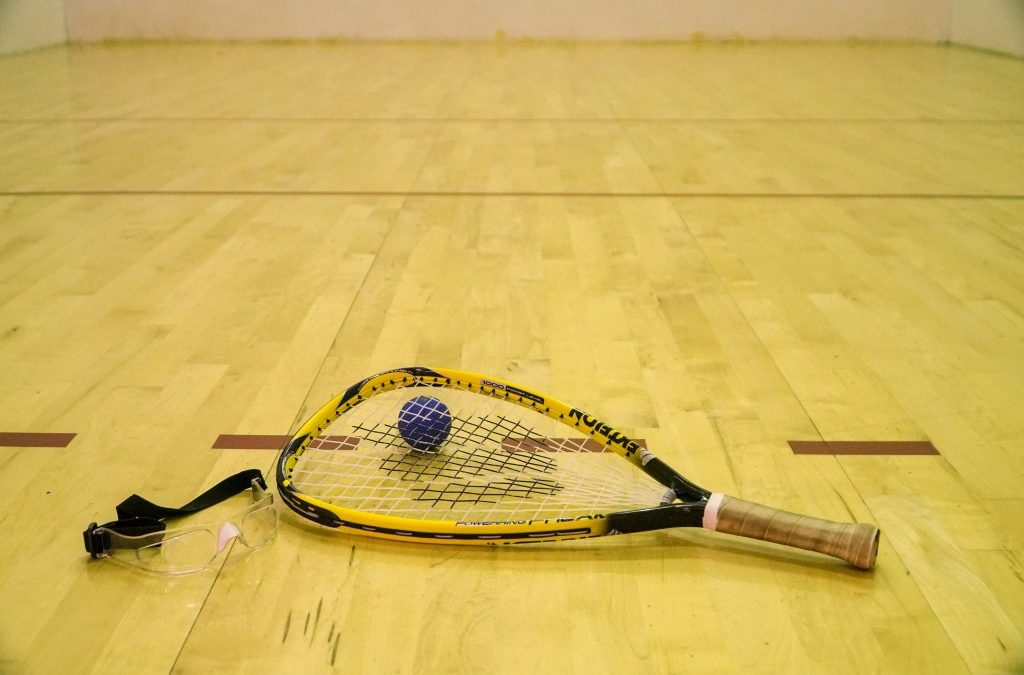
When you go beyond all of this, there are two big white boxes. This is where we play racquetball.
Inside these walls, we aren’t robots.
Inside these walls, we are artists.
We’re sure of this because we know the difference. Because we’ve been robots before. Grunting, bored, weather-talking robots.
When we step inside the white boxes, we become artists of the highest order. The six walls that make up this box become a canvas. Our racquets are our brushes, and the balls are singular blue paint. Invisible paint. We take turns with our brush strokes; we use multiple walls at a time, we use our legs to explore. The front wall is a window so we can see out and the robots can see in; undoubtedly this is for the purpose of giving the robots some real, gut-wrenching entertainment.
We stretch our arms and legs out in desperation, vying for the perfect brush stroke. Every game creates a different outcome, legendary portraits in the midst of a larger epic collection. In the end, there are winners and losers. Even when I lose, my Apple Watch—the robot on my wrist—tells me how many calories I burned, tells me I’m crushing it, and somehow I’ve still won.
And that’s just it.
Does the artist, when creating, ever really lose?

Matt Cambridge (’12) is a new dad to Chloe, husband to the beautiful Kendahl, and a human resources professional at Boeing. He lives in St. Louis and enjoys eating Hershey’s kisses, riding roller coasters, and watching the latest stand-up specials on Netflix. You can read more of his work at laughcrythink.com.


First of all, Matt, I commend you on your use of the em-dash. Well done. But more importantly, this essay represents a new genre of literature and should not be taken lightly. Your tongue-in-cheek description of boring gym-goers as robots is an astute observation of the modern one-dimensional man. Your noted irony of machines using machines, of robots using robots, greys the line between technology and humanity. Your poetic, and boundary-spanning, description of what constitutes art and how art is produced is an important step forward in acknowledging human potential. And your conclusion, asking if artists ever lose (essentially re-prioritizing the process of art rather than the end result) leaves the reader to continue the narrative on their own.
This is a bona fide thought-provoking essay, produced with the competence of a seasoned writer, in the guise of comedy and satire. A genre that spans genres. In asking the question, “Does the artist, when creating, ever really lose?” you simultaneously answered it. And the answer is emphatically, in this case, no.
Short and sweet. A good read and supporter of art.