
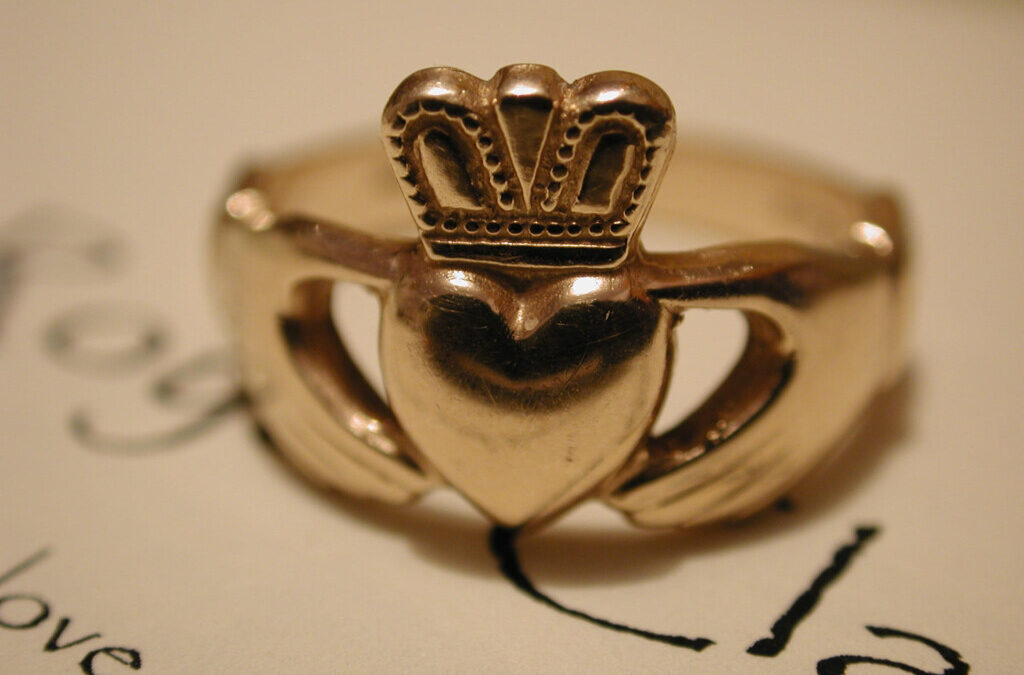
I was about twelve, looking at a tray of jewelry at a craft fair the first time I saw a ring featuring a motif of two hands clasping a heart with a crown.
I asked the artisan what it was. He explained.
The Claddagh ring was popularized in Galway, Ireland, in the late seventeenth century. Legend has it that a young sailor named Richard Joyce from the village of Claddagh was captured and sold into slavery by Algerian pirates. Trained as a goldsmith, he created the first Claddagh ring for the woman he loved back in Ireland and gave it to her when he eventually returned.
The heart symbolizes love, the hands friendship, the crown loyalty. Traditionally, women wear Claddagh to symbolize their relationship status.
Worn on the right hand with the heart pointed away from you, it indicates that you are single, or “fancy free.” Worn on the right hand with the point of the heart pointed toward you, it means you’re in a relationship—”spoken for.” Worn on the ring finger of the left hand pointed out, it means you’re engaged, pointed in it means you’re married.
At the age of twelve, I was, as I am today, a history nerd, a lover of symbolism and ritual, and a magpie for trinkets. A notable difference between then and now: at twelve, I was coming of age on the fridges of fundamentalist evangelicalism.
Purity rings were the hot new accessory.
Many of my friends were receiving purity rings and attending purity balls with their fathers. Naturally, jewelry and fancy parties appealed to me, but I remained mostly oblivious to the deeper beliefs, culture, and psychology at work. At twelve, remaining “pure” did not seem like a difficult task in exchange for the perks. Most of the boys I knew were a foreign sort of creature hidden behind the heavy fringes of hair that were the style of the day. They were not interested in jewelry and balls or The Odyssey and Jane Eyre, or the other classics bending my young mind. I’d cross the bridge of what to do about Mr. Darcy if and when I got to it.
I did want the ring, though.
I’d read plenty of stories about magic jewelry and sacred vows. I thought the elegant and symbolic Claddagh ring would be perfect. But my parents didn’t get me one.
Now, I see the harm I was spared.
Extracting promises of sexual abstinence from barely pubescent tweens by means of bribes is weird at best. But the degree to which purity culture silenced conversations about relationships, dating, sex, or love and saturated what conversations did exist with fear is disturbing and destructive.
The teachings of purity culture on the preeminent importance of sexual purity are so simple as to be barbaric. The basic message is that a person, particularly a woman’s, worth, life, and future can be irreparably ruined in one choice, one physical act. The fear of choosing wrong criminalizes curiosity and conversation, kills compassion, and is aimed at control.
To remove some of the risk of choosing wrong or being sullied, purity culture trades dating for “courtship.”
Courtship comes with chaperones, potentially involving the entire community.
At a church potluck, I remember an elder addressing the entire body of over 100 people, announcing that his daughter and a young man in the church were courting and the whole church should observe their interactions to make sure all was right and proper.
Purity culture is public. Because purity equates to value, it’s important that everyone can see that you maintain your status.
Hence the ring, the vow made visible.
But purity culture’s messages of fear and reduction transcended the physical to the spiritual. This was perhaps particularly true for those of us on the edges. We were told to guard our hearts as well as our bodies. The private aspects were emphasized over the public. We were taught to cautiously avoid giving away any irrevocable part of ourselves. “You are precious,” I was told, “Love misplaced wounds.”
The active ingredient in many poisonous lies is the bit of truth mixed in.
On vacation in Ireland in 2024, more than a decade after my childhood church imploded, I bought a beautiful silver Claddagh ring for myself.
Why wear something I partially associate with influences that warped my nascent understanding of love and romance? Why publicize my relationship status at all when it is neither the determiner of my worth nor the summation of my identity.
Well, it’s very pretty.
All of the things that initially drew me to the Claddagh symbol are still true. And it’s also true that my heart, my relationships, and my experiences of love matter. It is true that the love I offer to others is a precious and powerful thing.
I am a person who loves and fears. I lose sleep over mistakes, words that can’t be taken back, futures that may never come. And I know, love can be like handing someone else a stiletto knife and shrugging off my armor. But love is far more than vulnerability. Relationships are far more than a status or a test of wisdom or virtue.
And a little bit like Richard Joyce, as I left behind the oppressive influence of people who tried to reduce my worth and identity, I refined a truth from the dross of lies: I am a precious heart capable of incredible love. I’ve molded that truth into something I can hold, express, share, and, conveniently, wear.
Photo by Wikimedia Commons user Royalcladdagh (CC BY-SA 3.0)

Emily Stroble is a writer of bits and pieces and is distractedly pursuing lots of novel ideas and nonfiction projects as inspiration strikes. As an editorial assistant at Zondervan, she helps put the pieces of children’s books and Bibles together. A lover of the ridiculous, inexplicable, and wondrous as well as stories of all kinds, Emily enjoys getting lost in museums, movies old and new, making art, the mountains of Colorado, and the unsalted oceans near Grand Rapids. Her movie reviews also appear in the Mixed Media section of The Banner and her strange little stories of the fantastic are on the Calvin alumni fiction blog Presticogitation. Her big dream is to dig her hands deep into the soil of making children’s books as an editor…and to finally finish her children’s novel.


Thanks for informing about Claddagh rings! I love how you can start with a concept, tie it to two or three other things, and then bring it together at the end.
Especially love how the meaning of the title changes over the course of reading.