
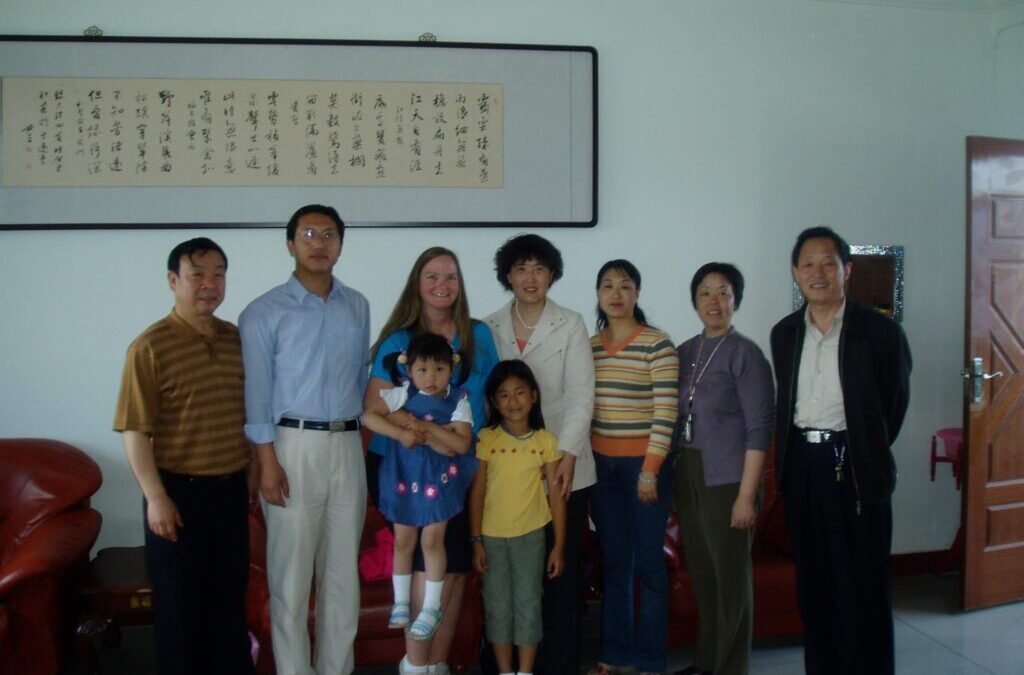
Please welcome today’s guest writer, Lindsay Laurie. Lindsay graduated from Calvin in 2021 with a degree in digital communications. She now lives in the former Nizhoni house and works in housing justice. She likes to think about urban planning, especially about how infrastructure impacts where sustainability and equity do and don’t overlap.
My first family structure was my birth family who couldn’t keep me because I was born with special needs and as a girl in a country with a one-child policy. Though I don’t remember them, I still miss them, especially around my birthday which makes the yearly celebration bittersweet.
Then there was that season in the orphanage without any family structure. The orphanage for me wasn’t filled with abusive adults like the media sometimes portrays. More realistically, kids were neglected because there were never enough caregivers. We were nobody’s first priority, so we learned to raise ourselves. That bred in many orphans a stubborn sense of independence which we used to cope with the disappointment of neglect.
I had a foster family at age five. I remember my foster dad would plop me in the back of his motorcycle and because I loved going in circles, he would take extra laps around the city’s central roundabout for me. I remember one time my foster mom was sick in bed, and kindergarten me was convinced that if I counted to one hundred, she would feel better. I was probably just very proud cause I’d just learned to count that high in school, but I remember her enduring through my self-appointed spotlight despite her headache. Perhaps I look back at these memories with rose-tinted glasses because they contrasted with my orphanage memories. I haven’t seen my foster family in years so they can’t verify these memories, but in general, I do remember being wanted when I was with them.
At six and a half, I was adopted into a permanent family. Even so, my adoptive family is still far from the poster family. For one, I never had a consistent fatherly figure as I was adopted by a single mom who divorced before I joined the family. Growing up, it felt like it was an unspoken rule that we weren’t supposed to talk about the general topic of husbands or dads. She had her wounds which made her less than perfect in my eyes.
At sixteen, my family structure changed again when I went overseas for school and lived with two different host families—one my junior year and one my senior year. It was just a year-long situation. Once the school year ended, I was out. They were good people, but I was more a guest in their home than family.
All in all, I’ve had a birth family, no family, a foster family, an adoptive family, and two host families. With all these different family structures, I look back and sometimes think, Wow what a wealth of experiences, but more often, I’m angry and sad that I missed out on a sense of stability. I’m sad that I “flew away from the nest” of family without really figuring out what my nest even was. It is easy to blame other people for this instability—very easy to make an argument that someone else should have taken better care of me. That I’m broken because of them.
But as much as I point fingers, I’m also realizing that I was a very difficult daughter to love because my orphan habitats didn’t end at adoption. One habit was my inability to be cared for—specifically by my adoptive mom. I lost a lot of my trust in adults who were supposed to be caregivers at the orphanage. To my adoptive mom, I kept my distance, not giving her a chance to show that she was different from the orphanage nannies. But I also had a deep fear of abandonment from what my birth parents did to me which showed up in an overactive sense of terror that I would be left alone. I was a contradiction— accusing my adoptive mom of not loving me but then also pushing her away. To say the least, I was a very difficult child to bond with.
So today, my relationship with my mom is bittersweet, complicated, and a work in progress. It’s full of the aftermath of a broken world, and that’s the truth for many of our own families. I’m trying to figure out what from my childhood I should take into adulthood. I guess everybody is after college. I don’t want to take my old childhood fears and pain into my future family, but I also can’t just disregard them because they are also the foundations for some of my proudest accomplishments and core beliefs. It’s like I’m moving. I’m sorting through boxes of childhood memories and experiences from the old house and deciding what I want to throw away and what to keep for the next home.


Thank you for this moving piece, Lindsay. You are a womderful writer!
I love the metaphor at the end of this piece.