
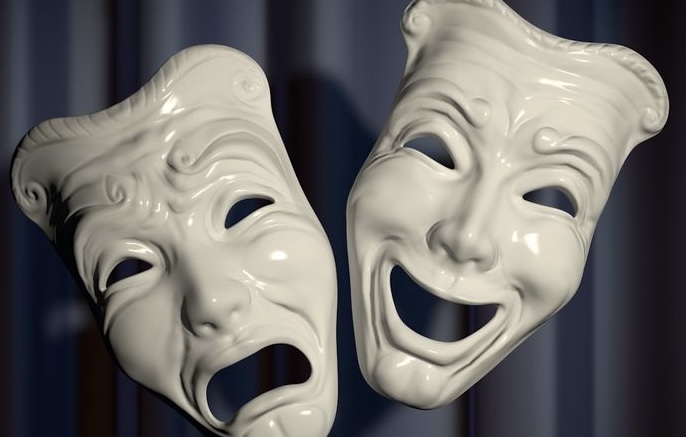
In Elizabethan and Jacobean theatre of the sixteenth and seventeenth centuries (that’s “Shakespeare time”), the Fool was a regular stock character that appeared in comedies and tragedies alike. This character could be a domestic fool, meaning it was their job to entertain the king or noble—like the character Touchstone in As You Like It, Trinculo in The Tempest, or the Fool in King Lear. But the “fool” character could also be a simple peasant of any vocation, whose wit and clever wordplay made him comedic in nature, like Dogberry in Much Ado About Nothing, who was a constable, or Costard in Love’s Labours Lost, who was a simple man from the country, or Bottom in A Midsummer Night’s Dream, who was an actor.
In either case, Shakespeare’s “fools” are often (ironically) the most introspective, observant, and honest characters in the plays. While they spout rhymes and songs and trip on malapropisms, hidden in their words are insights about the protagonist, revelations surrounding the plot, and hard truths about life itself that no other character is able to recognize or communicate. You’ll notice that the fools’ trick of weaving wisdom with witlessness actually shines the brightest either during or immediately after some of the most dire and intense tragedies in the plays: consider the Fool in the midst of King Lear’s maddening storm, or the gravediggers in Hamlet immediately after Ophelia’s tragic death, or Dogberry leading the evincing of Hero’s true innocence after Claudio’s accusation of her at the altar.
Some say that this pattern in the narrative (“comedic relief”) is simply to give the audience an emotional break. Yet many scholars believe that Shakespeare was actually indicating something far more meaningful: that in the complexities of life, comedy is a tool that humans need to process and understand tragedy.
So, what does that mean for us today? There is certainly quite a lot of tragedy in the world. With so many voices vying for attention and clout, the consumer’s brain space has become more cluttered and confused than their social media feeds or email inboxes. Not even to mention global news, immigration, and inflation. With the growing cacophony of information chaos, every national and global tragedy over the last two decades has only fostered more fear and insecurity in people and institutions, leading many to cling to the loudest (and often most extreme) political positions or people, or to turn away completely and embrace neo-political parties and groups. In the age of “fake news,” AI, and the most severe political and social divide that this country has ever seen, who do we—the native, the local, the immigrant, the American—trust?
Enter the “fools”?
American stand-up comedy is an art form that was birthed from minstrelsy and vaudevillian culture throughout the twentieth century. It developed into what it is today through the 1960s to 1980s as various monologists such as Lenny Bruce, George Carlin, Joan Rivers, Redd Foxx, and Richard Pryor pushed the limits of comedy by experimenting with controversial content such as racism, politics, sexism, and explicit language. They turned the tides from comedy just being simple slapstick scenes, and steered it into hardcore commentary with insights and punchlines about the reality of the world around them.
Since then, comedians have continued to rise to the top of pop culture—not necessarily just because of their comedy, but because of their roles as “cultural commentators,” and their “painfully true” takes on the state of the world. From The Chappelle Show redefining the rules of social commentary and sketch comedy, to comedians like Joe Rogan, Theo Von, and Andrew Schulz interviewing professors, scientists, entrepreneurs, and even presidential candidates on their platforms, standup comics have dominated the zeitgeist from every angle. Audiences have started going to comedians’ podcasts and platforms as their news sources rather than the formerly trusted institutions. And after everything we’ve seen with the dancing circus of our politicians, the ruthless and devastating business empires, and the unfathomable sickness of trafficking rings among the elite—who can blame them?
Perhaps Shakespeare was right. Perhaps we need “the fools.” Perhaps we need some levity, perhaps we need a new perspective… Or perhaps comedians are reminding us to ask ourselves—just like they do in Shakespeare—who are the real fools in our story?

Sophia (‘19) double-majored in theatre and religion and insists that her life is a “storybook.” She lives in an apartment above a flower shop in downtown Chicago and has multiple roles working across the arts in comedy, music, theatre, film, and visual art—though her greatest passion is writing. Her work includes stage plays, screenplays, and articles, focusing mostly on cultural trends, comedy, reviews, and religious satire. She loves road trips, visiting her family in Grand Rapids, hunting for the perfect latte, and rescuing plants from the flower shop’s dumpster.


There’s a lot of wisdom in this! Thank you for addressing such heavy topics with a sense of being grounded and with openness!