
A few months ago, a friend of mine shared Ursula K Le Guin’s Carrier Bag Theory of Fiction with me. It’s been a real brainworm. One of those new lenses that you try out and then forget what it was like with the glass you were previously peering through. It’s a wonderfully simple idea, with an infinitely complex practice.
Le Guin lays out a theory of our stories as connected to the technology we use to sustain ourselves. A dominant narrative is that of the hunter, courageous and strong, adventuring out into the dangerous wild to slay a mammoth with his long, hard tool. Then he returns to his tribe victorious with a harrowing tale of power and the sacrifice of his brethren who died in the battle.
This Hero, besides being not so subtly phallic, is not the Hero Le Guin has in mind. Hunter-gathers likely spent most of their time gathering or doing things that are otherwise ordinary and boring. So, how do we tell this story of day to day life? Drawing from Virginia Woolf’s Glossary with heroism defined as botulism, Le Guin puts forward a new Hero: bottle.
No, not a beautiful coke or alluring champagne, instead she means bottle, “in its older sense of container in general, a thing that holds something else.” After all, would we not have invented something to keep all of our berries in before coming up with the spear to do something as grand as slaying a mammoth?
I’m obsessed with this idea of a story about the thing we put other things in. A bag, basket, container, holder. I left Calvin wanting to tell stories of the ordinary, an idea I got from Charles Taylor’s Sources of the Self. Le Guin’s frame helps give me a shape for those stories. (Read a few attempts here.)
For me, the tricky part of this is noticing and describing the things inside the bag. How do you notice a background that is so damn blurry with the humdrum of a busy life? And how do I shape what I’m seeing into a compelling narrative?
“Doing it a lot.” – someone annoyingly right, probably.
Here are a few candidates I have knocking around in my head:
The Cowardly Neanderthal
Gool is a tired, smallish, neanderthal man with overly hairy arms but, to his dismay, he’s balding. He’s no good at hunting, instead preferring to weave with the women of his tribe. He’s deeply in love with the chief’s son, but the chief scorns him as the shame of their people. Gool yearns for a way to earn respect from the other men in his tribe. His best friend, Yara, is an older woman who broke her leg in a fall recently, and Gool finds himself naturally gifted at medicine.
The (secret) Email Factory
Who’s spying on the spies? Psi and Fermi are twin electrons in the KGBs closed circuit computer system. They’re gossips and love to trade stories about the fragments of each document they carry around as the Soviet Union falls. Psi was even a fragment of the memo that Gorbachev himself wrote!
Tired, Long Dried, Flower Beds
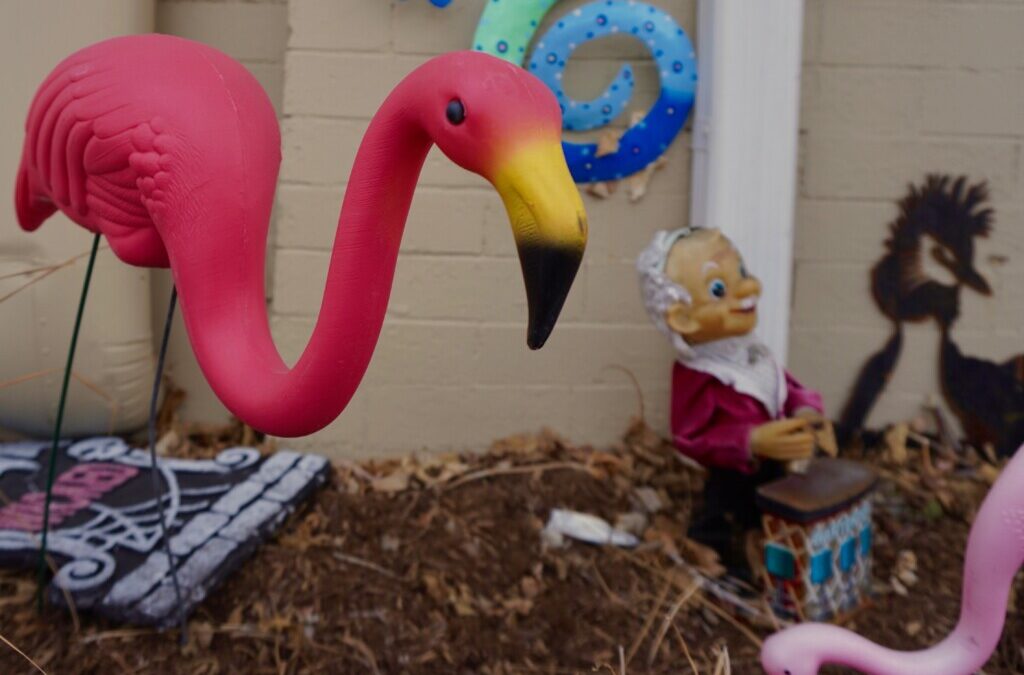
Sixteen years ago, the homes on Speer Ave. between 1st and 3rd Street were flocked with pink plastic flamingos. Though the humans couldn’t hear, they were a noisy bunch of birds. They couldn’t walk, but they could shout, and to those with plastic ears, it was a loud street to walk down. Over time, most of the flamingos migrated (got recycled) and only a handful remain in the flower beds that haven’t seen flowers in years. They chat, with the gnomes and lizards nearby, about the passing runners, the dogs whose shit never gets cleaned up, and about a time when they were less alone.
These are mostly meant to be silly, and maybe inspire some ideas in you. There are more things missing from these sketches than I would like to admit. That’s the good problem with a carrier bag story. There’s always room for something else, and I love collecting. But it might never end, and try as I might, the story I shape cannot be infinitely big.
Pop other things in the comments below that belong alongside our new Hero, bottle.
Clint Wilson (‘23) graduated from Calvin with an official degree in philosophy and unofficial degree in outdoor rec. They currently live in Denver and are working remotely for an LSAT prep company. You’ll likely find them slowly jogging a trail, belaying their wife up some rocks, or reading beneath a heap of blankets.

