
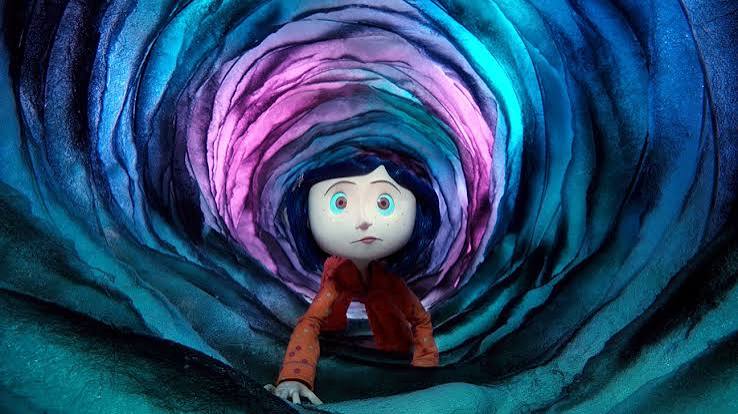
Our theme for the month of October is “childhood fears.”
Like many young children in the late 2000s, I was exposed to Coraline a little too early.
Well, that’s my opinion. I actually was the target audience for the stop-motion animated film about a girl who learns about the value of family after traveling to a parallel dimension.
I don’t remember exactly when I watched it, but I do know that I was young enough to forget most of the details of the film, which probably just exacerbated my fear of it. The one image that still haunts my mind is the Other Mother cornering Coraline while holding buttons and a needle. From then on, I couldn’t look at a button for too long without chucking it across the room.
As the years passed, I successfully avoided rewatching Coraline well into my young adulthood. But of course, like many college experiences, I was made to face my old fear head-on.
A friend of mine had mentioned that they had actually never seen the film before, mostly due to their rather protective Christian parents who saw the film as a gateway to the occult. Funny enough, my mother had barred me from watching Harry Potter for the same reasons, but didn’t seem to apply the same logic to Coraline. At the mention of Coraline, my curiosity sparked. I had harbored a fear of that film for so long, I wondered how adult me would react to the film (you know, with all the wisdom and logic I had acquired in 22 years of life). So my friend who’d never seen it before, another friend, and I planned a night to watch Coraline after a solid two hours of studying.
To be honest, I was a little scared as the opening credits rolled. The eerie music coupled with the clay-sculpted scenery brought back the same uneasy feeling I had as a child. But as the movie progressed, I started to grow fond of the creepy nature of the film. And, with my memory and mind better fit for understanding the film, I finally got exactly what this film wanted its audience to receive.
Apart from being a rather straightforward story about being careful of what you wish for and being grateful for the parents you have, Coraline is a story about what love really looks like. And, for a children’s horror movie, it does a very good job of presenting an experience that almost every person goes through in their lifetime.
Love can look like a lot of different things to different people. And in a world where our perception of what love looks like is being shaped by the countless people posting about it on social media, this movie feels just as relevant now as it did seventeen years ago. We may not like the way our parents choose to love us, but they’re our parents. They often do know better. And if your parent isn’t a psychopath like the Other Mother, then they most likely do love you wholeheartedly and have your best interests in mind. I know this sounds like a given, but sometimes it can be hard to believe.
I think that’s why Coraline began to resent her parents. She had lost her belief in the fact that her parents truly loved her. They had moved her to a new place, far away from all she had ever known, and seemed to prioritize their work over their daughter. At the beginning of the film, you feel for her. She feels neglected. So her desire to leave and seek what she thought was love is understandable. But of course, what we think love looks like is often just a facade, one meant to lure us into rather unloving situations. And to think, all of this was so perfectly depicted in a claymation film about a girl traveling to a parallel universe. Storytelling is just so cool.
I still get chills down my spine when I think about Coraline. They really did a good job of balancing the creep factor and didactic entertainment. But I have really come to appreciate the types of stories children’s films tell, no matter how scary they may be.
Priscilla Chang (’25) majored in English literature and minored in linguistics at Calvin. She now works as a missionary teacher in Thailand, teaching language arts at Chiang Rai International Christian School. Apart from her love of reading and writing, she is also obsessed with learning languages, dancing, and watching the latest Korean dramas.

