
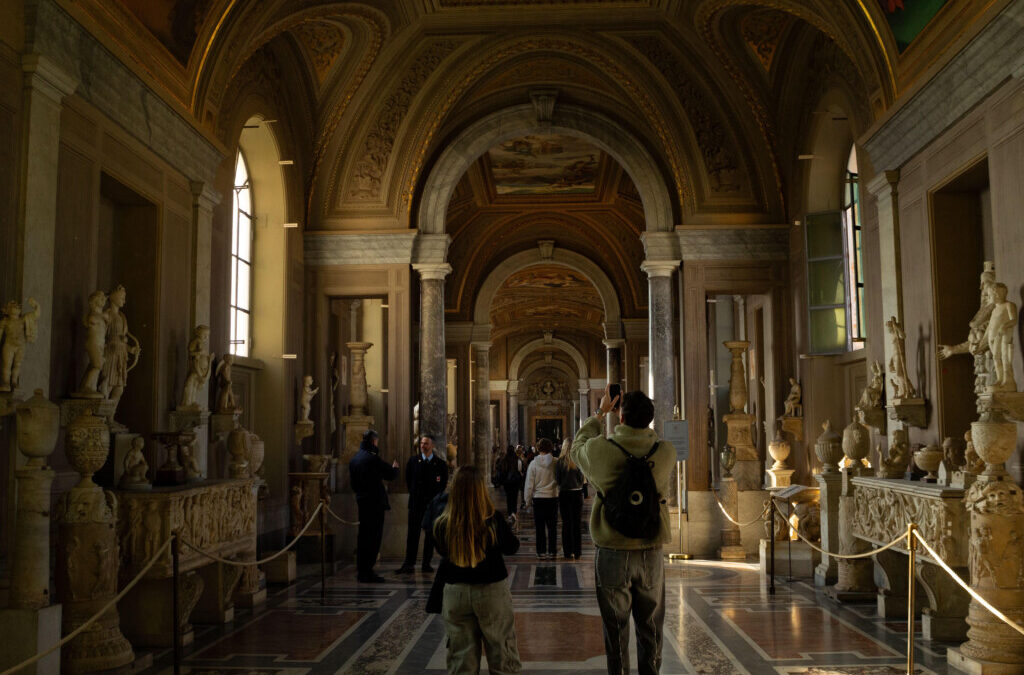
I won’t pretend this post is anything other than a spite-motivated critique of the world’s worst museum: the British Museum. Granted, I haven’t visited every museum in the world. But the many loved ones I have tricked, cajoled, or dragged through the museum marathons I call vacations consider me a connoisseur.
I will also state, for the record, that my animosity has nothing to do with the facts that my pants tore in an awkward location during my visit and it was a suffocatingly muggy day in late August. (It was an all-around dehumanizing experience).
Instead, I recommend all of the following.
Toyitomi Stone Wall Museum (Osaka, Japan)
Yes, it’s just about walls. Specifically, the technology involved in the layers of stone wall fortifying the iconic Osaka Castle. My museum visits average hours, and even I only spent about fifteen minutes here. However, this tiny museum of stacked rocks is more informative and impressive than the Rosetta Stone because it is so clearly made with love. The very dramatic voiceover in a video exhibit describing the role of the rocks in the politics of feudal Japan is worthy of a blockbuster movie trailer. It’s not about the rocks, it’s about the story about the rocks. It’s not that complicated.
Crystal Bridges Museum of American Art (Bentonville, Arkansas, USA)
Bet you didn’t expect Arkansas. It’s a flyover or drivethrough sort of place. But if you are driving through, stop by this hidden palace in the woods where beetle-shaped, glass structures appear suspended over a serene lake. The galleries house an enormous collection of American art, from paintings by portrait master John Singer Sargent to iconic illustrations by Norman Rockwell,to bold Georgia O’Keefe florals.
Museums, particularly art museums, should refresh the soul and feel like something between home and sanctuary.
Like the British Museum, Crystal Bridges is free. Unlike the British Museum, the contents are displayed within their cultural context of origin.
The Titanic Museum (Branson, Missouri, USA)
If you’ve made it to Crystal Bridges, you may as well keep going until you hit Branson, Missouri. There, on the main drag (picture a more wholesome and quirkier version of the Vegas Strip), you’ll see a building shaped like the front half of the Titanic, which is either marvelously creative or horribly tasteless, but that describes much of the street.
It took some convincing to persuade my family to allocate a day of our vacation to this museum. The brochure is somewhat cheesy, touting a tub of water kept at an icy Atlantic temperature.
The brochure writer should be fired.
Upon entry, each guest is assigned a ticket featuring the photo and backstory of a real first-, second-, or third-class passenger. This simple touch immerses visitors in a story that is ultimately as much about universal human virtues and flaws as it is about class division.
A far cry from sterile plexiglass containers marked with placards, artifacts are displayed in detailed recreations, bringing the fateful voyage to life.
The Great Lakes Shipwreck Museum (Chippewa County, Michigan, USA)
The sunken treasure hoard of the Great Lakes is proportionally smaller than that of the Atlantic. The museum poised on a rocky, lighthouse-crowned beach jutting out into Lake Superior is small but well worth the trip.
Only twenty-five percent of the one-room museum is devoted to the infamous wreck of the Edmund Fitzgerald. Supervised by the glittering geometric eye of a crystal lighthouse lens, a thoughtful collection of artifacts wrested from the grip of the lakebed and objects illustrating the formation of the Life Saving Service tell a story of humanity’s turbulent relationship with nature and impulse to help one another.
Complete your experience by spending a night in one of the simple rooms that used to house the crew of the Whitefish Point Life Saving Station. The wind howls off the lake, cooperatively creating ambiance.
The Museum of Polish Jews (Warsaw, Poland)
I have conflicted feelings about what I call “tragi-tourism.” History is shot through with evil and suffering. And we must tell it true. Most museums take their obligation seriously, but, with a notable exception, most museums also make some effort toward entertainment. Holding tragedy and wonder together can seem like an impossibly delicate goal, however.
Visitors to the Museum of Polish Jews expect to see tragedy. But the museum weaves a much larger story through the lives of medieval merchants and nineteenth-century mystics, leading visitors past walls swirling with projections of illuminated manuscripts and under a beautifully painted canopy from a synagogue portraying the Kabbalistic zodiac. It’s a narrative about belonging and othering, faith, community, and politics, relevant and accessible to anyone.
A recreation of a city street plastered with Nazi propaganda (and empty of other visitors when I walked through) serves as the eerie entrance to the portion of the museum dedicated to the Holocaust. But the story doesn’t end there.
Emerging back into the entrance hall, I was left with a profound sense of joy, hope, and curiosity. It’s something I think even the most somber museums should strive to emulate.
The Resistance Museum (Amsterdam, The Netherlands)
My mother said she would endure exactly one World War II–related site on our recent trip to Europe. I chose Amsterdam’s Resistance Museum, a modest building hidden away on a quiet residential street.
Each guest is given an audio player and prompted at display cases to listen to the story behind the objects. The stories are less about ingenious sabotage and more about regular people who made courageous decisions and great sacrifices in the face of a seemingly insurmountable evil. The artifacts on display were largely unremarkable. The purpose of the museum is the story, not the stuff.
Historium (Bruges, Belgium)
Historium in the medieval city of Bruges has basically no stuff at all. Stuff, it turns out, is not a requirement for a good museum. Historium is the concept behind the Titanic Museum taken to an extreme. It’s a fully immersive, state-of-the-art journey through medieval Europe’s primary trade hub. Through VR technology, multi-sensory set dressing, and audio/visual production, visitors basically time travel.
I would even contend that Historium is an art museum rather than a history museum (though there is no reason a place cannot be both.) It’s a stunning example of creativity and technology pushed to their limit to inspire and delight.
The Isabella Stewart Gardner Museum (Boston, Massachusetts, USA)
The Isabella Stewart Gardner Museum is one of the most beautiful places in the world. Four floors spiral around a lush atrium decorated with fountains, sculptures, and windows from around the world. In some of the rooms, bright impressionist paintings hang so thick you can hardly see the damask wall paper.
Almost nothing is accompanied by those placards that tell you what you are supposed to feel, see, or appreciate. Those little descriptions walk a fine and often faltering line between informative and tedious.
The absence of these cards in the Isabella Stewart Gardner Museum feels intentional. The whole place feels like a great act of love. Every inch is meant, not to instruct or to parade a curator’s taste, but to please, and refresh, and enchant. Its purpose is to revel in the beauty of human creativity.
I think that’s ultimately what makes a museum good–the extent to which you feel more human upon exit.
And the British Museum simply could never.

Emily Stroble is a writer of bits and pieces and is distractedly pursuing lots of novel ideas and nonfiction projects as inspiration strikes. As an editorial assistant at Zondervan, she helps put the pieces of children’s books and Bibles together. A lover of the ridiculous, inexplicable, and wondrous as well as stories of all kinds, Emily enjoys getting lost in museums, movies old and new, making art, the mountains of Colorado, and the unsalted oceans near Grand Rapids. Her movie reviews also appear in the Mixed Media section of The Banner and her strange little stories of the fantastic are on the Calvin alumni fiction blog Presticogitation. Her big dream is to dig her hands deep into the soil of making children’s books as an editor…and to finally finish her children’s novel.


as someone who usually approaches museums as a challenge on how fast I can make it from entry to exit, I thoroughly enjoyed your review! who knows, I might give the British Museum a shot now;)