
Our theme for the month of June is “spirits.”
“Oh no, you don’t want to drink that,” my sister said. “It’s hallucinogenic. It’ll make you see stuff.”
The big green bottle said “Absinthe,” an odd word to my thirteen-year-old mind. There’s a texture to it almost, like velvet. The very word makes you hush yourself, like it’s a secret. I’d learned about a number of alcohols at this point in my life: whiskey, wine, vodka, bourbon, beer, all things I’d heard of or seen in an adult’s hand.
But absinthe. This was new. It was nowhere in songs or the shows or any movies I’d watched. I was curious to say the least, but my sister had never tried it either so she really couldn’t say. All she knew was it was green, people like Van Gogh used to drink it, and it made you see stuff.
Cut to my twenty-first birthday and a friend of mine asks “is there any alcohol you’ve never tried before that you want to?”
I look at him and say, “Yeah, I’ve never tried absinthe.”
True to his word, he showed up at my party with a small bottle of absinthe and I was suddenly struck with the thought of how I don’t know anything about absinthe. Whiskey and vodka have their mixers, but what does one do for absinthe? Surely something so powerful it can only be sold in small bottles needs more than a red solo cup of coke to prepare it.
I held onto that small bottle for months before I finally did the research. Turns out I was very correct, absinthe needs more than a plastic cup and soda. Much more.
People are often quite mystified regarding absinthe due to its reputation and the long history it’s had specifically among bohemian creatives who adored the stuff to the point of elaborate ritual making. Of course, humans have been doing elaborate ritual making for beverages since forever. Between communion and coffee, absinthe honestly isn’t even that strange; it’s just not something most people come into contact with unless you’re looking for it.
Absinthe is a liquor, like gin or vodka. Instead of being derived from juniper or potatoes, it is derived from annise, fennel, and wormwood. It’s traditionally green, hence its nickname of “the Green Fairy,” but with modern distilling it can also be completely colorless. It has a reputation for being hallucinogenic, but other than being highly alcoholic (usually between 90–148 proof) there’s nothing about it that actually is so. Nothing magical, just a very strong liquor.
Like most liquors (like gin), it started out as a medical tincture. Wormwood remedies have been used since ancient Greece, but the French had absinthe as we know it going since the 1700’s. It was hawked as an All Purpose Cure-All remedy with its recipe in high demand. French troops in the 1840’s were given absinthe while abroad to help avoid catching diseases and came home fans of the stuff. Absinthe became a very popular drink socially, drunk by people in every class. France was exporting bottles all across Europe and to the United States. It was a favorite beverage of the bohemian subculture of artists in France.
And then came the bans. Between wine sellers angry at how well absinthe was selling and the Temperance movements of the early 1900s, absinthe became the drink of violent lowlifes and anarchistic radical thinkers. The drink makes you crazy! It makes you see things! And more importantly, it makes you a criminal. In 1905 violent murders of a Swiss farmer’s family were blamed solely on his consumption of absinthe, regardless of the fact that he’d also drunk wine and brandy that night. The headline splash still blamed the Green Fairy and absinthe began to be banned in numerous countries across the world.
Frankly, I think the amount of bans on absinthe specifically have only added to its mysterious reputation. Not only was it the drink of artists, but it was an underground secret. This was the picture painted for me when I finally cracked open my little bottle. I was walking into a new world where I’d learn a new legacy of mysteries crafted by foreign minds hundred years before me.
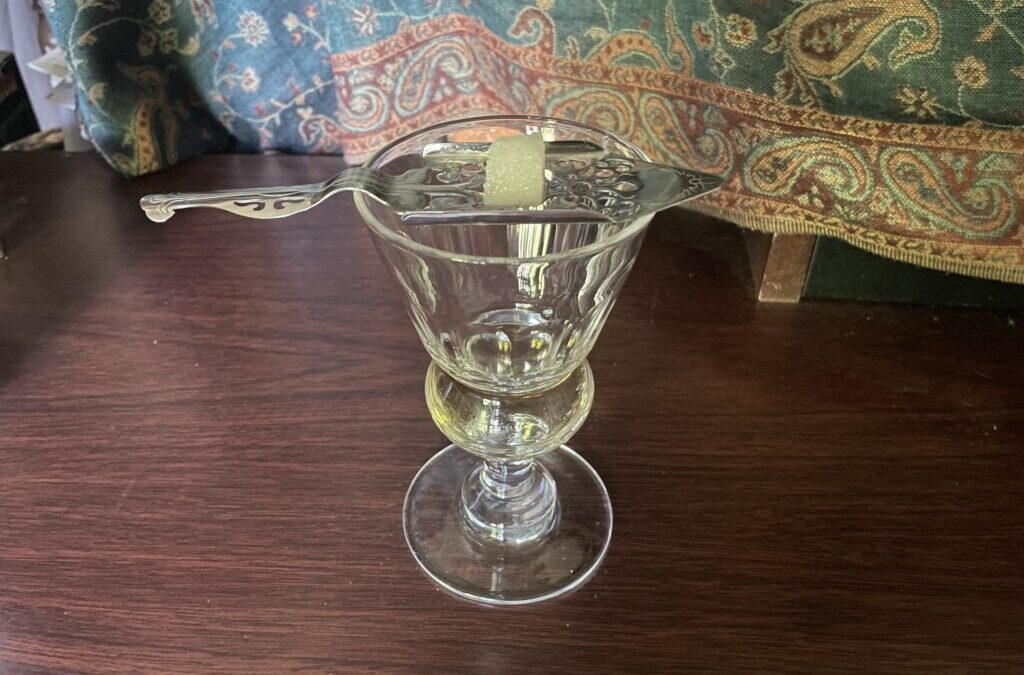
And mysteries there were. The thing with absinthe is its preparation. The ritual is the key—as with most things that people consider to matter. Being so alcoholic, absinthe is supposed to be watered down and sweetened when you prepare it. You could throw a sugar cube and water into one cup with some absinthe and call it a day, but that’s not the ritual. No, to make absinthe the way a French bohemian would is to first pour one part absinthe, then place a sugar cube on a slotted spoon and slowly melt the sugar cube with cold water, gradually mixing in three parts water. It is not a quick cocktail, it is a process.
Having done the research, I was excited to try it out. It felt magical. I had studied the ritual of preparation and now would try this mysterious elixir for myself.
So my first time I mixed absinthe into a rocks glass with an avocado slicer on top to balance the cube. The French bohemians might’ve had a laugh at me, but I enjoyed their drink all the same! It was lovely! It was a taste I hadn’t had before in a drink. It didn’t burn like whisky, but it wasn’t saccharine like a fruity cocktail. It didn’t have the complex bouquet of a red wine, but it was altogether something new. It had a warmth and depth that I really enjoyed. I was deeply enamored and my little bottle did not last very long.
So I decided to be direct in my enjoyment. Afterall, I’d gotten the results but not with the appropriate equipment one really needed. I lacked a proper glass and a spoon. Absinthe glasses are traditionally bell shaped with a reservoir at the bottom, designed to show you how much absinthe to pour. Absinthe spoons are flat, slotted ‘spoons’ designed specifically to hook on top of an absinthe glass to hold your sugar cube. They’re also often very beautiful with designs or images in the metal. They’re not common glasses and even more uncommon spoons. I tried many kitchen and liquor stores to find both and usually found neither, unless I wanted a very fancy bottle of expensive absinthe usually themed around Vincent Vangogh.
I found my spoon in the basement bar of a lovely upscale establishment—one of the few places I know serves absinthe near me. As my friend got a regular cocktail glass, I was handed a small tray. It had the glass, the spoon, and a small carafe of ice water. The bartender gave me an assessing look offering a kind “do you need any help?” I gave a bit of a smug “no thank you,” as I had already picked up the ice water and began the ritual. My friend looked on in quiet awe throughout the process, making comments of “of course you know how to do this.”
I think that’s half the fun to absinthe enjoyers—the pseudo-secrecy of it all. This reputation of illicitness and built in barrier of participation is the price paid to be one of the elite, one of the last true bohemians, living for love, truth, beauty, and freedom. Or at least we can pretend to be.
I remember laughing at coffee people—people who were so specific about how their coffee needed to be. People who spend money on french presses or fancy drip filters, people who bought specific pots to make a specific kind of coffee that was popularized in a foreign country they’ve never traveled to. I used to think it was all so absurd, especially for a drink that in my opinion isn’t even very good.
I stole the absinthe spoon from the bar, though I tipped a twenty, so really I bought that spoon from them. I took it home and pulled out my absinthe glass that I had hunted down to make sure I got a traditional Parisian style glass. I pulled out the giant box of sugar cubes I bought because it’s hard to get small boxes of sugar cubes apparently, and set about making myself a traditional glass of absinthe with my own set in my own home. It tasted the same, but it was still just somehow more special.
Absinthe is not the greatest liquor in the world. It’s not even necessarily my drink of choice when given an open bar. But there is something special about it because it’s been made into something special—partially because of people and history long before I was born, but also by me. I still seek out absinthe where I can find it, and I still offer to mix a traditional glass for anyone who’s never tried it. It’s an odd little ritual, to be sure, but it’s become one of mine.

Sam is unsure what exact words describe them best: Lunatic has been used, Gothic Romantic is apt, and Big ol’ Nerd is reductive but true. Mostly they just like stories in whatever form stories can be found. Sam specializes in Frankenstein, running “The Uncanny Productions” on YouTube, but they also dabble with podcasts, singing, and theatre as well. They have a DVD collection that’s long outgrown its shelf, a coffin they use as a desk, and an unrelenting joy for things that are spooky, ridiculous, or magical.

