
Our theme for the month of June is “spirits.”
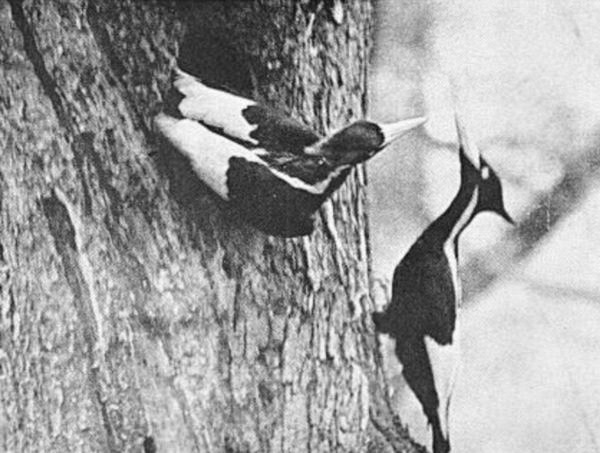
The ‘bird watching creeps up on you—wait till your thirties’ phenomenon got to me pretty early. Ever since working at the Calvin Ecosystem Preserve, I’ve slowly been checking more and more birds off of my life list. Some species are always more exciting to see than others, any day you see an owl is a good day, and I’m always aware of potential new species to spot. The allure of one species, however, stands above the rest. An Ivory-billed woodpecker sighting would be like finding the holy grail. But like the holy grail, these birds might not exist.
The last verified sighting of an Ivory-billed woodpecker was in Cuba in 1987. The last sighting in the US was forty years prior in 1944. Native to the swamps of southern North America, extensive logging across their range drastically reduced the woodpecker’s population. In 2021, the US Fish and Wildlife Service proposed the species be listed as extinct. The largest woodpecker in North America was no more.
There have been five mass extinction events over earth’s history. These include such catastrophic events as the loss of the dinosaurs and the ‘Great Dying’, the Permian-Triassic extinction event that saw upwards of seventy percent of terrestrial vertebrate species go extinct. Many scientists say we are heading towards a Sixth Extinction (great book by Elizabeth Kolbert). This time it won’t be an asteroid strike or volcanic eruptions. Instead, it will be characterized by coal power plants, parking lots, and glyphosate. Humans have so drastically altered the world we live in that other species can no longer survive. Habitat destruction has been the primary driver for recent extinctions, and the proliferation of insecticides and spread of invasive species certainly have not helped.
The species we’ve lost still haunt us: silence where there should be birdsong, broken foodwebs, and flowers slowly going extinct because their pollinators succumbed. Our world is lessened by their loss. Their spirits live on by subtraction. What’s noticed now is the absence.
Except that’s not how it has to be. Conservation efforts have made significant differences. Solar power is booming in response to the degradation caused by climate change. Bald Eagles have recovered from around 400 nesting pairs to 70,000 pairs. The Endangered Species Act of 1973 has by many measures been successful. Of delisted species, sixty-five percent have been removed because they recovered compared to just twelve percent due to extinction. The status of Ivory-billed woodpeckers is actually hotly contested. Potential Ivory-billed sightings were a crucial part of the creation of 113,000 acre Big Thicket National Preserve in Texas in the 1970’s. Amateur sightings and local anecdotes abound. The USFWS received so much public feedback in 2021 that they have suspended their ‘extinct’ proposal to review more information. Many are holding on to the hope that these birds can still be found, me included.
I’d like to visit the Louisiana lowlands some day, slowly glide between the bald cypress trees in a canoe and keep an eye out for flashes of black and white. Maybe we’d hear the drumming of a woodpecker and steer the canoe quietly in that direction. Raising my binoculars, I’d think it’s probably just a Pileated woodpecker. But maybe it’s not.

Nathan Hilbrands (’21) graduated with degrees in geography and environmental health and conservation. He is currently working for the Allegan Conservation District as a watershed technician. He enjoys collecting National Geographic issues that he rarely looks at again, playing disc golf a lot without improving, and trying new board games.


This is so well written. What a great read, Nathan!