
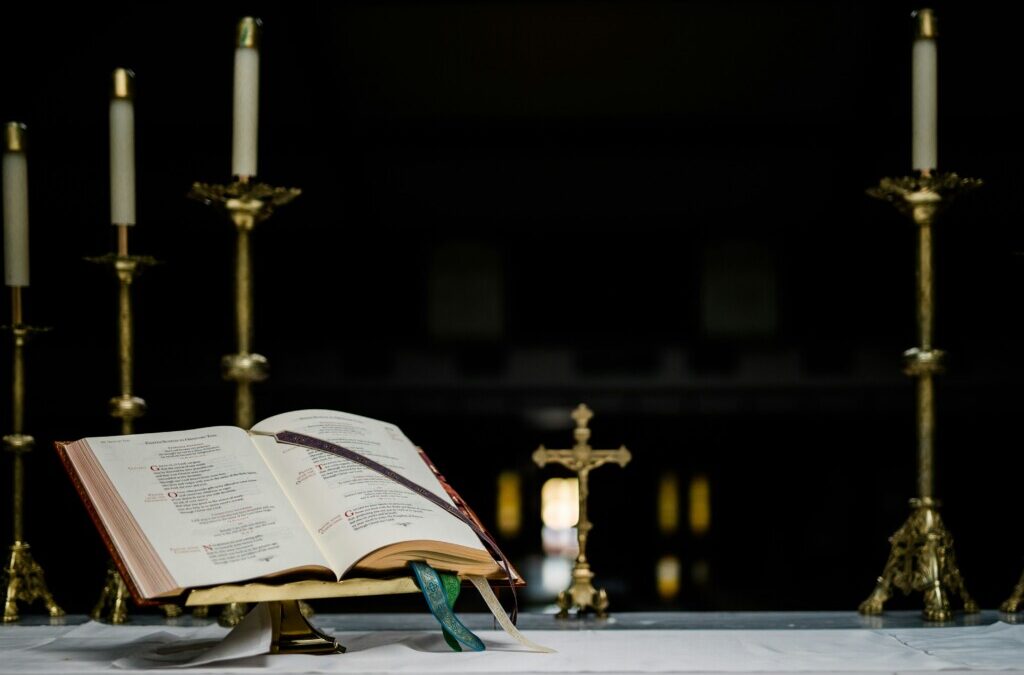
Our theme for the month of June is “spirits.”
In my mind, there’s no better word than “uniform” to describe the sprawling community that is the Catholic Church. And I’m not referring to the stiff and scratchy jumpers I endured throughout elementary school.
During family vacations, we’d always find a church to attend on Sundays. Sometimes, the church would be at least twice as wide as my childhood church, more modern and complete with a separate room for after-mass socializing.
Usually, I wasn’t familiar with the hymns these parishes preferred, and with a new priest, different homily style, and no familiar faces, it felt a little uncomfortable to celebrate mass in these new spaces, like I was visiting a friend’s house for the first time.
But even though I was among a sea of strangers, I could always follow the mass to a T.
No matter where you go on a Sunday morning, every Catholic mass will include the same scripture passages and follow the same routine. Stand up, sit, kneel, call and respond.
Whether I was in Georgia or Michigan, I could recite the Nicene Creed like I was back at home, sitting with my family in the third pew.
Sure, some churches may have slight variations to the script, but the overall structure of Mass and the call-and-responses that make up both the Liturgy of the Word and of the Eucharist are largely the same. Catholic churches worldwide, regardless of the countless cultural, historical, and geographical differences, remain uniform, perhaps connected, through the structure of the mass.
So when the Church decided to make a small edit to the script, churches worldwide remained in uniform by adapting to this change together.
I had to be at least five when my parish announced the change. Sturdy programs were tucked into the wooden shelves attached to the back of the pews, next to each hymn book.
On the pamphlet was the normal call and response the priest leads, but there was one glaring difference. No longer were we to respond to the priest’s “The Lord be with you,” with “And also with you.” Instead, a new response was dictated in bold letters. “And with your spirit.”
According to the United States Conference of Catholic Bishops, this change was made by the Church to better translate the Latin response, “et cum spiritu tuo.” Other languages had already incorporated a translation of “spiritu” into their responses, so English-speaking churches followed suit with this update.
While I was not privy to this reasoning as a child, one thing I do remember from this time was the disjointed responses that briefly consumed mass.
In the beginning of the “And with your spirit” era, after the priest said “The Lord be with you,” what used to be a crisp, synchronized response became rife with pauses and a smattering of people forgetting the new response. Even with the programs in front of us, one-sentence change took some time. Sometimes, the two responses mingled together, the old and new sounding awkward and strange.
Most of my Catholic upbringing has consisted of “and with your spirit,” so I can’t imagine what it must’ve been like for my parents and grandparents, anyone who’d been attending church for over a decade. When you attend mass for so long, the various responses and prayers become so familiar that you can recite them mindlessly, picking your fingers or staring at a painting as your lips perfectly recite The Lord’s Prayer. Niche examples that surely don’t summarize my adolescence.
It makes sense that this change was a bit messy, unlike the neat structure the mass prides itself on. Only a sentence was changed, but maybe one change is all it takes to make countless believers hesitate over a script they have relied on, struggling to say the new, correct way.
Eventually, the remaining murmurs of “And also with you” faded away, replaced by an echo of the updated translation. “And with your spirit” became our new in unison. The pamphlets left the pews.

Liana Hirner graduated from Calvin in 2024 with a bachelor’s in writing. She currently lives in her hometown of Aurora, Illinois and works full-time in a warehouse filled with books waiting to be sorted. Writing is her first love, followed swiftly by lattes and dark chocolate.

