
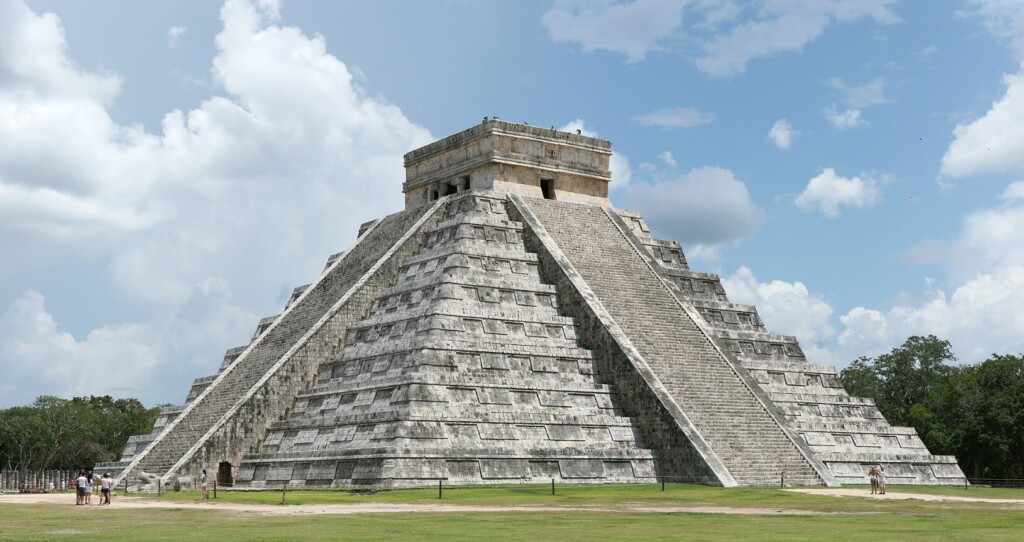
Near the tip of the Yucatan Peninsula in Mexico there is an enormous limestone step-pyramid known as the Temple of Kukulcan (pictured above). It stands nearly two hundred feet across and a hundred feet tall, at the center of an area that was once a thriving Maya city called Chichen Itza.
Chichen Itza was most likely built and active during the late Classical and early Postclassical period of Mesoamerican history, around 600–1200 CE, and served as the capital for an independent Mayan people who held significant economic and military power in much of the Yucatan area for several hundred years. Importantly, relative proximity to the coast meant that Chichen Itza was located conveniently for maritime trade, and the specific site for the city was likely chosen due to close proximity to four cenotes, an important feature for settlement in the karst geography of northern Yucatan.
The temple was dedicated to Kukulcan, a feathered serpent deity that appeared in many mesoamerican religions under different names (e.g. Quetzalcoatl), likely as a result of cultural diffusion among the various peoples who inhabited present-day Mexico. The pyramidic structure that serves as the base of the temple makes reference to Kukulcan in two important ways: first, it’s constructed in such a way that, near the equinoxes, light and shadows along the side of the steps create the illusion of a feathered serpent descending the stairs. Second, a person clapping their hands near the pyramid stairs hears an echo that resembles the sound made by a quetzal, a bird that was considered representative of the deity. Stone depictions of feathered serpents also adorn the bottom of the stairs on the north side. The steps of the pyramid add together, ninety-one on each side, plus the final top platform, to make three hundred and sixty-five total steps, the number of days in a year in the Mayan calendar that would have been used at the time.
Chichen Itza began its decline as a powerful regional capital around 1100 CE, but nevertheless remained inhabited by local people until the 1500s, when Spanish imperialists led a conquest of the surrounding land, focusing specifically on the city as a predetermined capital. By the time the temple was first photographed in the 19th century, it was nearly entirely overgrown by vegetation, despite being under Spanish ownership for around 300 years. Starting in the 1920s, the area underwent significant excavation by Mexico and the United States in order to be seen in all its glory.
These excavation efforts have since revealed two interior rooms, as well as evidence that an earlier, smaller temple was originally built in the same location, and served as the base for the final construction. More recently, archaeological investigations using the non-invasive technique of electrical resistivity tomography also discovered that the Temple of Kukulcan is not just located centrally from four nearby cenotes, but actually built directly above a fifth, inaccessible cenote which has yet to be seen by human eyes.
The interior of the pyramid is no longer open to the public, but you can still visit the site of Chichen Itza to see the massive structure, along with several other impressive and fascinating buildings that comprised the city.

Phil Rienstra (they/he) (’21) studied writing and music, and since graduating has developed an interest in labor rights and coffee. They’re an amateur chef, a perennial bandana wearer, a fledgling dungeon master, and an Enneagram 4. He lives in St. Paul with his spouse, Heidi.



It’s also the place where a smart-aleck warlock ended a war between vampires and wizards. (IYKYK)
It is amazing that, with no idea of Egypt or Cambodia’s existence, the Mayans built their own pyramids.