
To my granddad, there are no strangers.
Little to no provocation is necessary to start a chat with someone new. Every person standing in line nearby, every fellow diner at a restaurant, every other passenger on a train, is a potential friend, or at least a temporary conversation partner. Personal stories tumble out of him, unbidden, followed by personal questions as he seeks the stories of others. A talker, he’s also got something of a collector in him—when stories are reciprocated, he files them away, later regaling family with tales of acquaintances.
Myself, I am no big talker to strangers, yet an aspect of his Southern disposition to find connections anywhere lives on within me. Changed across generations and contexts, it compels me not to speak, but to a quieter and more fleeting shared consciousness; to observing, shared eye contact, a word or simple expression exchanged, and moving on. Like my grandfather, I collect these moments, these small intimacies with strangers, shoring up an evidence base of my own existence and its overlap with others’.
Lately, I’ve been seeking outdoor swimming opportunities everywhere I go—a symptom of my desperation driven by a complete lack in Brussels. While water can often be found, changing facilities are a tall order. Nevermind all of this nonsense about psychological privacy and walls, the conventional wisdom seems to go; who needs a changing room when you’ve got a towel?
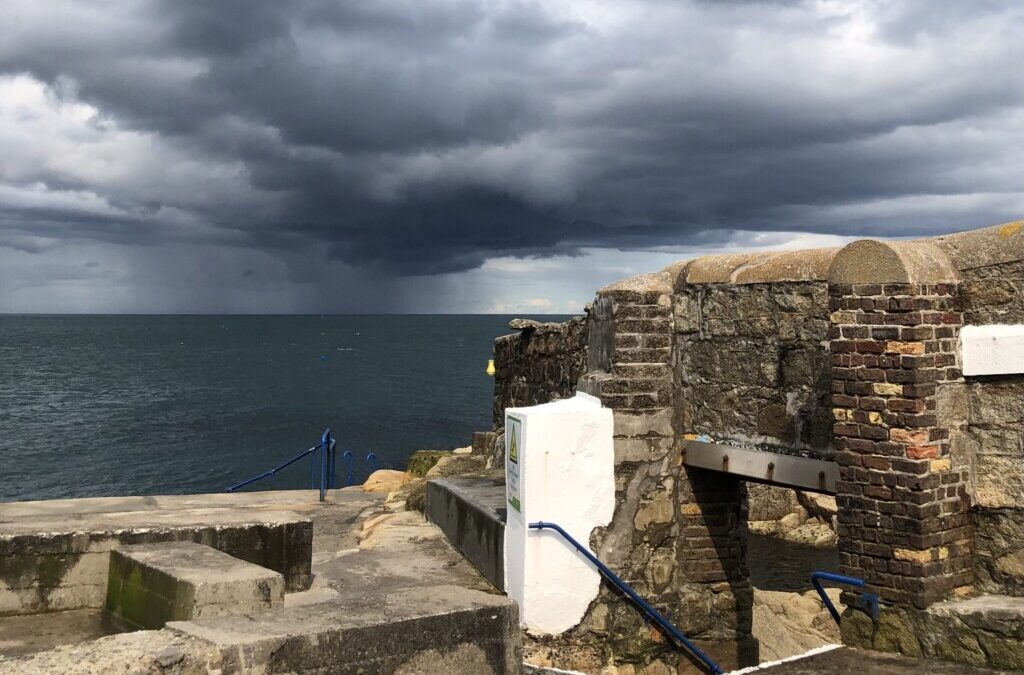
Employing this method makes me hyper-conscious of both myself and my surroundings, which is perhaps another attitudinal Southern holdover. At the beach with plenty of room to spread out, the towel method is nothing of note, unless it’s particularly windy. At Dublin’s Forty Foot promontory into the Irish Sea and Zurich’s thin wooden pier along the Limmat River, it’s a different story. With small surface areas and cold water temperatures, there’s high swimmer turnover. The independent affair of the beach becomes an even slower thing when two feet away from someone doing the same, everyone trying their best to avoid a stumble or a slip, and simultaneously becomes a collective mirthful practice. Neighbors share quick, close-lipped smiles as they lace up their shoes.
For a frequent pedestrian in a rainy climate, water often brings another collective practice: that of hiding from it. It rains frequently yet irregularly in Brussels, and one quickly learns to bear a misting or even a gentle patter; even better, to always be prepared with a raincoat. The heavy precipitation of a breaking summer heat wave, and its occasional appearance in the form of hail, will nonetheless send even the best prepared among us residents running for shelter. We hide together under small awnings or tree canopies, waiting for a break in the rain and staring after the brave who set off first.
Another transportation mode bearing connective fruit, public transport riders will know the awareness that comes with sitting next to a stranger in a tram or bus row, where there’s not enough legroom to squeeze by the person sitting in the aisle. When occupying such an aisle seat, I always try to be conscious of the person at the window, waiting for their shifts to indicate that their stop has arrived and they need me to stand to let them off. Yet when I’m the passenger at the window, my stop drawing near, I dread this moment of negotiation. What if I shift too early, and they stand while the bus is moving and lose their balance? Or if I make my move too late, and they don’t notice, and my stop passes me by? My “thanks” every time my row-mate stands for me is a genuine appreciation at this little social miracle.
These are all such small things, entirely circumstantial little blips of shared experience. Still, I find they add up to something lovely, and I hoard them in my urbanophilic heart. They are beautiful for their publicness, for the random nature by which people are thrown together. They are delicate and ephemeral, words and continued connections unnecessary. Such small intimacies, for all of the inconvenience that may accompany them—from inconvenient bus routes to wet clothes—are tiny deconstructions of the idea of the “stranger” and rebuttals against tides of loneliness. They are a dear inheritance.

Rylan Shewmaker (‘21) calls herself a geographer, though none of her degrees substantiate this. After growing up in Texas and studying in Grand Rapids, she moved to Brussels, Belgium, for her master’s degree in urban studies. She still lives in Brussels and works for a housing non-profit. She enjoys audiobooks, bike commuting, sunny days, and learning new things.

