Our theme for the month of June is “spirits.”
Several months ago, I took part in a “future fictions” exercise wherein each participant was asked to represent an assigned character in an imaginary Brussels in the year 2050. A bowl of paper slips containing character descriptions was passed around our circle. I unfolded mine to read: “The Zenne.”
Back in January, I buzzed with the pleasure of embodying the spirit of the Zenne. I am pleased to reprise my role this month.
–
Brussels is a very old city, its founding typically attributed to approximately the year 979. Cities of such an age in this geography are typically marked by the significant presence of water bodies in their historic centers. This water, while it must be bridged, often serves as a connector and as an essential piece of the city’s identity. Amsterdam and Paris, Ghent and Bruges, cannot exist without their rivers, without their canals.
In Brussels, this millenium-old city, something strange happens. The capital’s visible water body, the canal, is neither a point of connection nor of identity. The canal is instead a marginal space, a border both de facto and de jure. There is a seeming lack in Brussels—and something is, in fact, missing. Or rather, it is rendered invisible.
The S/Zenne (“S” in French, “Z” in Dutch) is the historic river of Brussels. The name “Brussels” comes from “marsh settlement” in the local dialect of one thousand years ago; water is an essential part of the city’s identity, even if it’s been forgotten. The Senne and its tributaries created the valley in which the city grew, from a small settlement to a medieval center of royal and economic power, facilitating its trade and agriculture and drinking water. The fates of Brussels and the Zenne were, seemingly, inextricably tied; creation and creator.
But creating is non-linear, and the creator is not left untouched by the creation. The Brusseleirs channel Nietzsche, decades before his famous quote.
As the centuries passed, the Senne’s longtime flow through the medieval city was threatened by the growth of the industrial city. In periods of high rainfall, increasing construction and impermeabilization led to flooding. In dry seasons, increasing demand on water from new residents, new industries, and the newly-constructed canal meant that there was not enough water in the Zenne to maintain a regular flow and evacuate the city’s waste. The former life source of the river becomes a hazard, even an open-air sewer.
With an uncared for and polluted river as its major water source, Brussels is hit hard by the cholera epidemic of 1866. Over three thousand residents die of cholera, predominantly from the low-lying, working class districts. A systematic response was essential. Public health theory at the time held that cholera was spread by “miasmas,” or foul smells, especially attributed to polluted waterways. Consequently, and in an era of drastic urban re-making—Haussmann was completely transforming Paris at the time—the Brussels government made a drastic choice. The Senne, landmark of the city for 800 years, would be buried.*
The “vaulting”—a glamorous word for a burial—of Brussels’s river began promptly the next year and was largely concluded by 1871. In just five years, the Zenne was erased from the historic center.
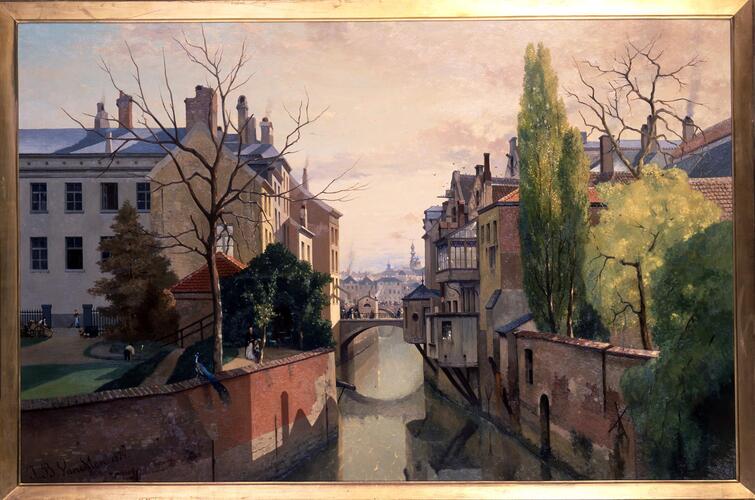
Since, the Senne has only further disappeared. On occasion, though, the city testifies to its absence, and not only through comparison to other places. The river has left traces. An urban farm is carefully cultivated in a winding alleyway between old warehouses, this alleyway in fact the former riverbed. The nineteenth-century section of the Fine Arts Museum features many local painters and plentiful views of the river immortalized in oil paint. South of Brussels, the river remains daylighted as it runs through a small Flemish town, burbling and green.
But even while linear parks are built along old riverbeds, bearing the name of lost streams, the Senne continues to be used as a dumping ground. As in many cities, Brussels’s sewage and rainwater systems merge in times of high rainfall, resulting in sewage overflowing into the river.
Is this all that the Zenne can be? Infrastructure, an overflow for our waste? Before being locked away in its vaulting, hidden from the sun, the Senne created Brussels. It has been a home, a body of shelter and of nourishment, for diverse non-human life—and it continues to be so, outside of Brussels, where the river is given a chance to do her work. Perhaps we can again be shaped by the river, by its spirit if not by its waters, to imagine our city differently.
Cover image: Jean-Baptist Van Moer, Le pont des Vanniers dit ‘Manne Brugge,’ 1874

Rylan Shewmaker (‘21) calls herself a geographer, though none of her degrees substantiate this. After growing up in Texas and studying in Grand Rapids, she moved to Brussels, Belgium, for her master’s degree in urban studies. She still lives in Brussels and works for a housing non-profit. She enjoys audiobooks, bike commuting, sunny days, and learning new things.