
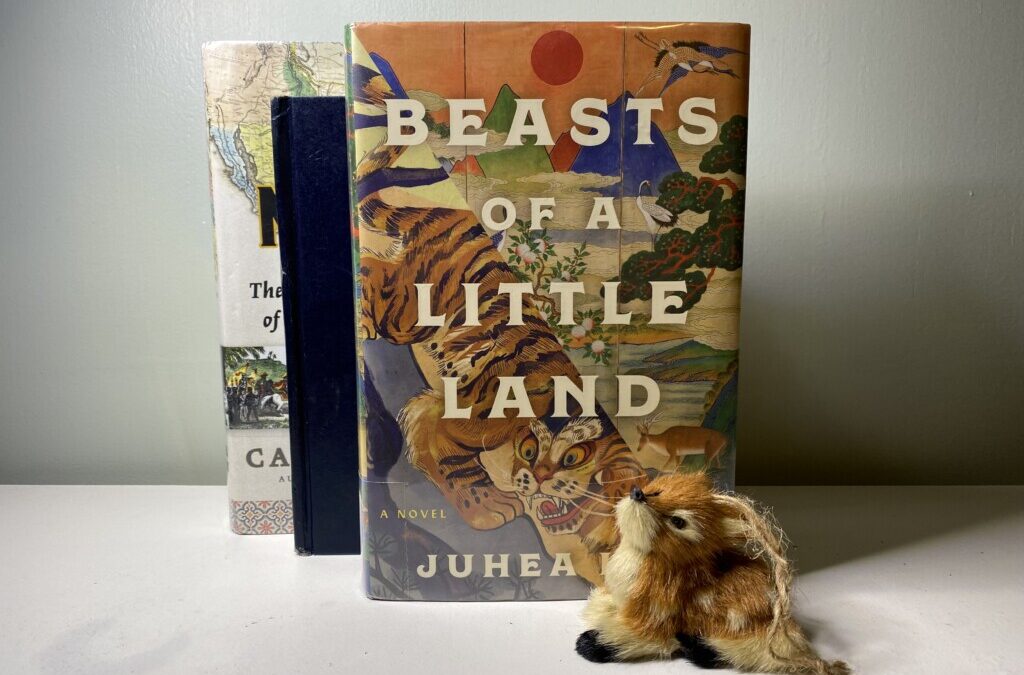
Shallow as it may sound, I am a sucker for a book with good curb appeal: a vibrantly colored yet elegant cover, an embossed title, a judicious choice of font, a good, weighty-yet-not-crushing feel. And I’ll freely admit that it was these superficial concerns which led me to pick up Juhea Kim’s Beasts of a Little Land (2021) on my most recent library run.
The novel, Kim’s debut, follows an ensemble cast of characters in early 20th-century Korea, but it centers around Jade, whose status as a courtesan, reviled yet well-connected, puts her in contact with both the occupying Japanese elite and those seeking Korea’s independence. She also meets and befriends JungHo, a young street boy, another key voice in the story. As the two seek their fortunes, the political tensions in their homeland become increasingly unavoidable, and their lives are both shaped by the conflict.
Other characters include Silver, Dani, and Lotus, Jade’s fellow courtesans; Yamada Genzo, a Japanese captain who finds his fellow officers’ cruelty hard to stomach; and Kim SungSoo, a landowner’s son who also runs a bicycle shop and a literary magazine.
The novel hits many of the right points. The story is grounded in a physical landscape, where food, clothing, and furniture reflect the changing world of Jade and her acquaintances. (Nothing is more bewildering than a novel—especially one in an unfamiliar setting—where the characters seem to be floating in their plot.) And while I am biased against novels with lots of main characters, I’ll concede that it was the right choice for this one. The wide cast of characters allowed her to bring in the historical context at judicious points, without too much heavy exposition.
Nevertheless, as much as I wanted to like the novel, its detached tone made it hard to fall in love. With certain characters, such as Yamada and SungSoo, the distance makes sense. It is important both to Yamada’s highly reserved character and SungSoo’s rather vapid one that they are dispassionate narrators.
However, with both Jade and JungHo, I would have liked to get under the surface. JungHo is pugnacious to the point that it frequently gets him in trouble; he would speak forthrightly to his audience. With Jade, giving her a more direct voice could resolve some encounters in the novel that left me unsatisfied.
I don’t think Kim is incapable of letting her characters speak. Toward the middle of the novel and toward the end, she switches from a relatively objective third-person to give us two passages told in first-person, one by JungHo and the other by Jade. Though I think Kim made the right decision not to tell the whole novel with the intense and limited lens of first-person narration, I do think she moved too far in the other direction. These passages suggest a very different novel, one in which we are drawn in through JungHo’s determined banter and Jade’s pensive memories.
If Kim had written this version of the novel, it would have gotten a whole-hearted recommendation. As is, I would say that it’s an enjoyable holiday read (and one that will look good on your nightstand), but not a must-read.

After graduating from Calvin in May 2025 with a degree in writing and Spanish, G. E. Buller decided to stay in Grand Rapids. Currently, she is working as a special education aide. Her non-writing hobbies include fussing over her aquarium and reading about medieval/early modern nuns.

