
For more explanation of this month’s theme, “millennials in thirty things,” check out this post.
My cousin Tim got married this summer at a swanky hotel in Lake Geneva, Wisconsin. After the ceremony, Tim, his wife Jody, and their parents threw a rip-roaring party in the hotel’s upper reception room. It was my first wedding with an open bar and, coincidentally, the first wedding where my parents’ generation danced as hard as mine did.
My cousin Sarah, my sister Monica, and I roamed the reception together. We gushed over Jody’s gown. We dragged our more reticent cousins onto the dance floor for “Love Shack” and the “Cupid Shuffle.” We partook of the open bar. We scribbled our well-wishes on the giant wooden “J” and “T” that served as a guest book. We dropped notes containing advice of dubious value into the empty wine bottles that Tim and Jody will open on their first, fifth, tenth, twenty-fifth, and fiftieth anniversaries.
And, of course, we wandered past the photo booth. Because what millennial event is complete without a good photo booth?
Actually, I initially thought about bypassing this one. I was already red-faced and mussed from the dance floor and feeling particularly non-photogenic. But we’d heard rumors from other guests that this was no run-of-the-mill affair. Then a relative showed us the booth’s final product, and we knew we had to give it a try.
Blinking away the lights of the dance floor, Monica, Sarah, and I approached the crowd surrounding the booth. We surveyed the accessory table, laden with mardi gras beads, oversized top hats, lime-green sunglasses, and moustaches on sticks. I grabbed a black fedora and slung a gold chain around my neck. Then, holding an inflatable pink guitar, I stepped in line.
When our turn came, Monica, Sarah, and I positioned ourselves in front of the bright white backdrop and listened as the unflaggingly cheerful booth operator recited his spiel. Then, he gave us the signal, and we jumped, shimmied, and hammed it up for the camera. Ten frenzied seconds later, we desisted, panting. The operator gave us the high sign and we stepped aside to let the next group take the stage.
We shed our hats and shades and joined the crowd milling around the printing table. A few minutes later—voila!—we were the proud owners of chunky little flipbooks commemorating our ten seconds of fame. We riffled through the pages and watched ourselves dance again and again. Flip faster, flip slower, flip backwards. Trade with a relative and flip again.
The video-photo-flipbook booth was a hit. Even my 91-year-old grandfather got in on the action—twice. Milling guests flaunted their flipbooks, the brief sequences looping like analog Vines. The books seemed charming, almost quaint, a physical throwback in a digital age.
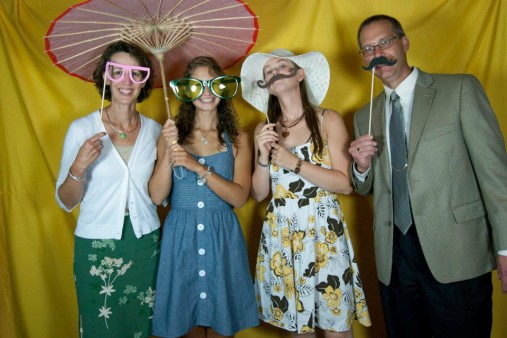
Now, months later, the flipbook sits on a shelf in my closet at home. It had migrated from my dresser to my side table before winding up in the closet. Before I stashed it away, I flipped through it again, smiling at our goofy faces. I almost wish the images were digital. Then I could keep them on my laptop, pop them onto Facebook, use them in this blog post. Instead, I rooted around online to find a digital photo taken at a booth after a different cousin’s wedding; that’s what made it into the blog header.
It’s strange that now I need to make physical space to store this flipbook of photos. It’s strange that this is strange.
Our millennial generation isn’t unique in its drive to capture every memory, no matter how fleeting or banal. We are, however, the first to do so digitally. Unlike memories written in diaries or caught on Polaroid film, digital memories require little commitment. Photographs can be taken by the dozen. Digital snapshots can be edited, emailed, uploaded, deleted. They take up almost no space in our hard drives and Facebook albums, so we accumulate with impunity. Every once in a while, I get the itch to purge the clutter of photographs gathering digital dust in my computer folders. I usually take one look and close the window. I can tuck the files into folders, slot the folders into other folders, and pretty soon, I can forget that the clutter even exists. The memories aren’t doing any harm there. Why revisit them, only to delete them?
But now I have this little flipbook. I’m sentimental, so it’ll probably be a year before the novelty wears off and I slip the book into the recycle bin. The irony: if it had been digital, I might have saved it forever—and likely forgotten about it entirely. Now, I’ll save it for a little while, but I’ll see it every time I open my closet. And every time, the memories will come dancing back. Until I decide I need the space. Then it’ll be gone.

Geneva Langeland (’13) survived graduate school with minimal blood loss, escaping with her ms in environmental policy and communication. She now works in Ann Arbor, Michigan, as the communications editor at Michigan Sea Grant. There, she gets to hang out with educators, researchers, and communicators who love the Great Lakes as much as she does.


“…and moustaches on sticks.” Of course.
I almost wrote this post about moustaches, actually. Bowler hats, monocles, swoopy moustaches, the whole “gentleman” thing we millennials seem to love.