
Our theme for the month of March is “cities.”
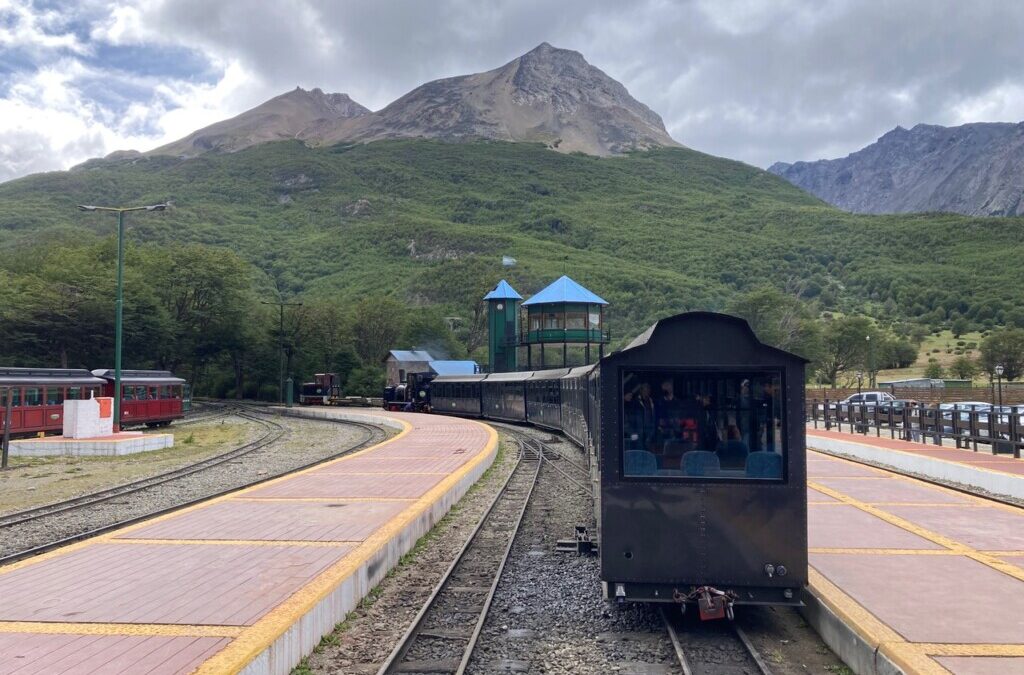
If you squint, it looks a bit like Disneyland. There’s a ticket counter, a gift shop, an antique train car on display, and hundreds of tourists piling into less-antique train cars, speaking Spanish and French and a transoceanic handful of English dialects. Once on board, these tourists will take in the sights, snap a few photos, and then move on to the next leg of their vacations.
But unlike the Disneyland Railroad, this train wasn’t built to attract tourists or to look good on TV or to fulfill the childhood fantasies of the world’s most recognizable media mogul. It certainly wasn’t built to play an audio narration track in seven languages or to grace everything from water bottles to enamel pins. It was built to haul prisoners.
Ushuaia, Argentina, was settled in 1870 by Anglican missionaries. Its name, meaning “deep bay,” comes from the language of the Indigenous Yaghan people. Over the next fifteen decades, the town was carved out of the southern slopes of the Andes Mountains on Isla Grande de Tierra del Fuego, further south than any other major population center in the world.
Due to this remoteness, Ushuaia’s first missionary settler, Waite Stirling, called himself “God’s Lonely Sentinel.”
But as has so often happened, God’s sentinel soon heralded not good news but weapons, walls, and chains. An Argentine naval base was established at Ushuaia in 1884, and in 1896, the town accepted its first prison inmates. There wasn’t much of a prison building yet (nor much of a town), so the railroad was built to ferry prisoners to the forests west of Ushuaia, where they spent their days logging. When the logs reached the town, other prisoners used them to build their own cage: a five-winged cell block based on Jeremy Bentham’s famous panopticon design.
Today, the prison is a museum. It has model boats, preserved scientific instruments, and infographic-style maps: monuments to Ushuaia’s status as one of five internationally recognized Antarctic gateway status. But the building’s renovation was far from total. Each exhibit is housed in an old prison cell, and one wing of the prison has been left almost entirely untouched. Two monuments then, intertwined: one to wonders and another to horrors. Always close, these two, but here you can see them touch.
The train, defunct since 1952, was reopened in the 90s as a tourist attraction with the sexy name “El Tren del Fin del Mundo.” Hop on board, turn on the audio narration, and you can hear the rhetorical dance. If you had to be in prison in the early 1900s, the disembodied voice suggests, this wasn’t the worst way to do it. The inmates who rode the train to the forests got fresh air, exercise, scenery, an escape from the prison’s panoptic stare. But it was also horrible: the work was backbreaking, the guards mistreated and dehumanized the inmates, and in 1947 the prison was shut down by Argentine president Juan Perón due to humanitarian concerns. But now—*invisible heroic gesture*—thanks to an ingenious public-private tourism partnership, you can experience part of the prisoners’ daily train trip! All these narrative acrobatics are accompanied by the kind of pseudo-cinematic music that comes in GarageBand samples: blood-pumping string ostinatos, heroic trumpet lines, jaunty clarinet bits.
Elsewhere in Ushuaia, there’s another dance: the constant zigzag of cruise liners, cargo ships, and scientific vessels loading and unloading at the port. Some are headed to Antarctica, others to Chile or otherwise northward. After leaving the port, they spill into the Beagle Channel, named after the ship that famously carried Charles Darwin around the world, passing through these waters on the way.
There are no more native speakers of the Yaghan language; the last one, Christina Calderón, died in 2022. She was born not in Argentina but across the Beagle Channel in the small Chilean town of Puerto Williams—the reason Ushuaia has to call itself the “southernmost city” and not the “southernmost town.”
Visiting a place like Ushauia, where remote geographies and recent histories dance together, feels unreal. The scenery is too gorgeous not to be a painting. Everything you learn seems like another bit of audio narration, an augmented reality projected onto the surrounding mountains. Touch a prison wall, though, or hear the train’s whistle just right, and you start to sense something terrifyingly real.

Josh Parks graduated from Calvin in 2018 with majors in English and music, and he is currently a PhD student in religious studies at the University of Virginia. When not writing, he can be found learning the alto recorder, watching obscure Disney movies, and making excruciating puns.


Josh this article was interesting and very well written
I am impressed of your narration. I just returned from a visit
to Ushauaia. It is sureal!! No camera can cpture the beautyof the surroundings.
The train ride is amazing.
The boat ride we had to see the penguins is amazing as well as the 8 hours round trip hike to Imerald lake.
If you can afford it, a visit to Ushuaia at least once in you life is a must.